In 2026, renting a plane stands as one of the most effective strategies for reclaiming time lost to commercial aviation’s chronic inefficiencies. Consider the numbers: a New York–Miami round trip on a chartered super-midsize jet saves approximately 4.2 hours compared to scheduled airlines, accounting for security queues, boarding procedures, and tarmac delays that now average 45 minutes at major hubs. Similarly, a London–Geneva business hop delivers 3.8 hours back to your schedule when you bypass the commercial terminal entirely.
This guide unpacks what it truly means to rent a plane in 2026—whether you’re a certificated pilot seeking access to a Cessna for cross-country trips or a corporate executive requiring a crewed Gulfstream for intercontinental travel.
Key Takeaways
Time efficiency defines the value proposition: Private aircraft rental saves 3–5 hours door-to-door on routes such as New York–Miami or London–Dubai compared to commercial alternatives, thanks to dedicated FBO terminals and direct routing.
Two distinct rental worlds exist: Certificated pilots can rent small aircraft for self-flying through flight schools and FBOs, while high-net-worth travelers access fully crewed private jets through charter operators or Jet Card programs.
Jet Cards offer structured access without ownership burdens: Prepaid hour blocks lock in rates, guarantee availability, and often include carbon-neutral operation as standard—ideal for travelers flying 25–100+ hours annually.
Safety and certification are non-negotiable: Premium providers operate under Part 135 (US) or AOC (Europe) and undergo third-party audits by ARGUS or WYVERN, employ crews with thousands of hours, and provide annual simulator recurrent training.
Sustainability is now built-in: Leading programs integrate Sustainable Aviation Fuel where available, automatic carbon offsets, and AI-optimized routing to reduce environmental impact without compromising convenience.
What “Renting a Plane” Really Means in 2026
The phrase “rent plane” encompasses two fundamentally different experiences in private aviation. The first involves certificated pilots renting small general aviation aircraft—think a Cessna 172 Skyhawk or Piper Archer—from a local flight school or FBO to fly themselves. This traces back to post-WWII flying clubs and remains governed by FAA Part 91 regulations in the US and EASA equivalents in Europe.
The second, and far more common interpretation among affluent travelers, refers to accessing a fully crewed private jet through charter or Jet Card programs. A private pilot in Arizona might rent a Cessna 172 for $150–$190 per hour with fuel included, while a family in London chartering a super-midsize jet to Dubai faces a different calculation entirely—roughly $40,000–$55,000 for the round trip, with professional crew, catering, and ground handling seamlessly arranged.
Industry trackers like WingX confirm that over 90% of “rent plane” inquiries relate to crewed private jet access rather than self-piloting. This article addresses both pathways but focuses more deeply on the high-end charter and Jet Card solutions where discerning travelers find the greatest value.
Why Rent a Plane Instead of Flying Commercial or Owning?
Private aircraft rental has evolved from a luxury indulgence to a strategic tool for executives and family offices navigating 2024–2026’s congested commercial hubs. The calculus is straightforward: when time carries measurable value, private flights transform unproductive transit into productive hours.
Time Savings That Compound
Consider a journey from New York to Chicago. Commercial travelers face 2+ hours of pre-flight procedures at JFK or LaGuardia, potential tarmac delays, and post-arrival baggage retrieval. Flying privately from Teterboro to Chicago Executive, you arrive at the FBO 15 minutes before departure, board directly, and land closer to your final destination. Door-to-door savings exceed three hours each way—six hours recovered on a single day trip.
Privacy and Productivity
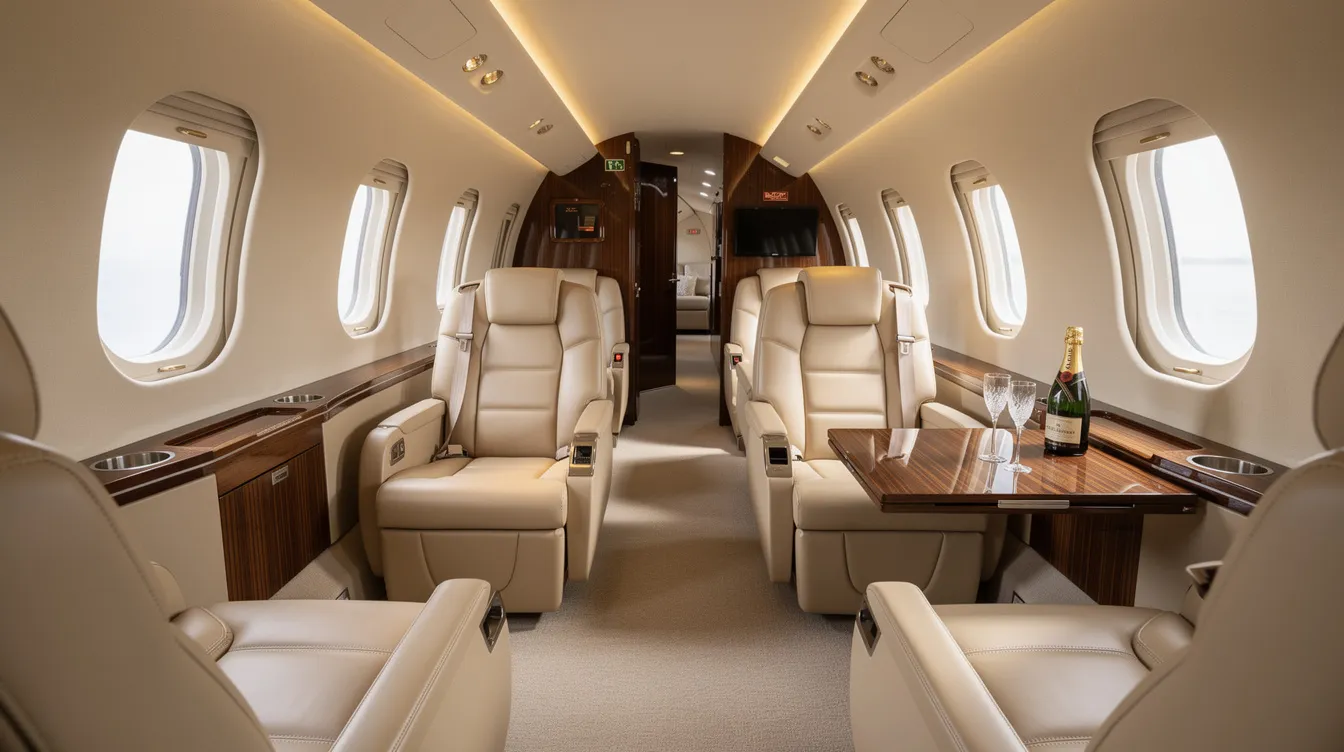
On a rented Gulfstream G280 equipped with encrypted Starlink connectivity delivering 200–400 Mbps, executives conduct M&A due diligence, board meetings, or sensitive negotiations without eavesdropping risks. There’s no cabin neighbor glancing at your screen, no public Wi-Fi vulnerabilities, and no device confiscations at security checkpoints.
Flexibility Commercial Airlines Cannot Match
Private aviation operates from smaller airports worldwide—Teterboro handles 250,000 operations annually without JFK’s congestion. Day-of schedule adjustments within 2-hour windows become routine. Compare this to airline rigidity, where rebooking a missed connection can derail an entire itinerary.
The Ownership Alternative
Owning a midsize jet means $1.5–$2 million in annual fixed costs: hangar fees around $400,000, crew salaries exceeding $600,000, and insurance premiums near $200,000. Add $4,000–$6,000 per flight hour for fuel and maintenance. This ties up $20–$50 million in capital, requiring 200–400 annual hours to justify. Aircraft rental liberates you from these burdens—paying only for hours flown.
Types of Aircraft You Can Rent
In 2026’s global fleet of over 25,000 business aircraft, rental options range from basic training aircraft to ultra-long-range jets capable of connecting continents nonstop. Selecting the best aircraft means matching your mission profile—range requirements, passenger count, and runway constraints—to the right category.
Piston Singles and Light Trainers
Renting a plane involves choosing between piston-powered single-engine aircraft and larger multi-engine planes or jets, with many travelers today specifically seeking the cheapest private aircraft and budget-friendly options. Flight schools typically rent out single-engine trainers for local flights and hour-building. The DA20 is a popular aircraft for initial private pilot training, seating two and offering excellent visibility. Aircraft rental rates for light single-engine planes typically cost around $80 to $100 per hour wet, making them accessible for flight training and short regional trips.
Turboprops for Remote Operations
The Pilatus PC-12 NGX and Beechcraft King Air 350 excel where jets cannot venture. The King Air 350 is known for its reliability and ability to operate from shorter runways, making it a popular choice for private aviation. With STOL capabilities down to 2,500-foot runways, these turboprops access remote destinations—Alaska bush strips, Alpine airports like Sion, or Caribbean islands with limited infrastructure. They typically seat 6–9 passengers, offer a 1,500–2,000 nm range, and have hourly rates of $1,800–$3,000 all-in.
Light Jets for Intra-Continental Travel
Light jets such as the Citation CJ3+ deliver jet performance for regional routes. Designed for shorter flights of three hours or less, they can access hundreds of airports that larger jets cannot. With 480-knot cruise speeds, 2,040 nm range, and 6–8 seats, they efficiently handle routes like Los Angeles–Chicago or London–Nice. Charter costs range from $3,000 to $5,000 per flight hour.
Super-Midsize and Midsize Jets
The Challenger 3500 and Praetor 500 represent the sweet spot for many corporate travelers. Stand-up cabins (6’0” height), 8–10 passengers, and 3,400+ nm range enable routes like London–Dubai nonstop. Expect $5,000–$10,500 per hour, making them a premier choice for frequent transatlantic segments.
Heavy and Ultra Long Range Jets
For intercontinental missions, the Gulfstream G600 and Bombardier Global 6500 deliver 5,500–6,600 nm range. These aircraft fly nonstop between New York–Tokyo or London–Johannesburg, with 12–19 passengers in full-flat beds, supported by a dedicated cabin crew. Hourly rates range from $8,000 to $20,000+, reflecting their capabilities and amenities.
Regional Airliners for Groups
When corporate roadshows, sports teams, or incentive groups require 30–40 seats, regional airliners, such as the ATR 42-500, configured for private use charter at $12,000–$18,000 per hour, provide access to airports that commercial carriers don’t serve, similar in role to the best private jets for 20 passengers and large groups.

How to Rent a Plane if You’re a Certificated Pilot
For licensed aviators, renting small aircraft offers an accessible entry into flying without the ownership costs. FAA and EASA regulations as of 2024–2026 establish clear requirements, though non-pilots should proceed to the private jet sections below.
Where to Rent
Flight schools, fixed-base operators (FBOs), and flying clubs at mid-sized airports offer rental fleets. Flight schools provide training and have an inventory of multiple trainer aircraft available for rental. In the US, facilities at Phoenix Deer Valley (KDVT) or Oshkosh (KOSH) maintain well-equipped rental airplanes. European options include Blackbushe (EGKB) near London or regional German airfields, with aircraft rental rates from €160–€200 per hour.
FBOs conduct business at public-use airports and may offer additional services such as lounges and fueling, enhancing the rental experience for certificated pilots.
Flying clubs allow pilots to rent aircraft at a lower cost by sharing ownership and expenses among members. Renting from a flying club can significantly reduce the average hourly cost compared to renting from an FBO or a private owner.
Pilot Requirements
Standard prerequisites include:
Valid pilot certificate (Private Pilot License minimum)
Current medical certificate (second-class or BasicMed in the US)
Biennial Flight Review (BFR) within 24 months
Type-specific checkout (typically 3–10 hours depending on aircraft complexity)
Proof of a certified flight instructor sign-off for complex aircraft
Rental Policy Essentials
Renting an aircraft typically requires signing a rental contract that outlines the aircraft type, proposed destinations, and rental terms. Most operators enforce minimum daily billing of 2–3 hours on cross-country trips, overnight fees if the aircraft remains at away airports, and geographic limits without additional endorsements.
Most importantly, renters must provide proof of renters' insurance, including non-owned aircraft coverage, to protect both the pilot and the operator.
Pre-Rental Inspection
Before renting an aircraft, a pre-rental inspection should be conducted to identify any existing issues, such as body imperfections or fuel levels. This protects both the renter and the owner from liability for pre-existing damage.
How to Rent a Private Jet for Business or Leisure Travel
For executives, family offices, and UHNWIs seeking private aviation benefits without managing tail numbers, several access models exist—each with distinct advantages depending on travel patterns. A clear view of the private jet price list, costs, and access options helps frame these decisions.
On-Demand Charter
Calling a broker or using a charter app provides one-off access to private flights. Booking windows range from same-day (70% feasibility off-peak) to 2–3 months ahead for peak weeks, such as Christmas 2025 or European summer 2026. Operators source appropriate aircraft from their fleets or trusted partners, handling crew, ground services, and catering, whether you’re chartering the entire aircraft or buying a seat on a private jet through shared and semi-private options.
Private jet charters allow travelers to bypass long security lines and crowded terminals, often arriving just 15-30 minutes before departure while maintaining private-jet safety standards and low-risk profiles. This advantage is particularly beneficial for executives and families with complex itineraries, enabling seamless connections and flexible travel plans.
Jet Card Programs
Jet Card-style programs offer a more structured approach—prepaying for flight hours or deposits that lock in service levels, safety standards, and often hourly rates, making it essential to understand jet card cost per hour and pricing factors. Comprehensive resources on jet card cost and private jet membership pricing can help you benchmark options before committing significant capital, including detailed breakdowns of 100-hour jet card cost and value for very frequent flyers. BlackJet and similar providers guarantee availability within defined zones, providing access to a diverse range of aircraft from light jets to ultra-long-range cabins, with products such as 25-hour jet card programs, features, and costs tailored to moderate-usage travelers. Standard programs include:
• Hour blocks typically offered in 25, 50, or 100-hour increments
• Rate structure can be fixed or capped at hourly rates
• Availability is generally guaranteed within 24–48 hours
• Carbon offset is often included as a standard feature
• Peak surcharges are transparent and disclosed upfront
Fractional Ownership Comparison
Fractional ownership—purchasing a 1/16 or 1/8 share of a specific aircraft like a Challenger 3500—suits travelers exceeding 50–75 hours annually, though understanding fractional jet ownership depreciation and tax treatment is critical before committing capital. This requires significant capital ($500,000+ buy-in), long-term contracts (5–10 years), and monthly management fees, though fractional jet ownership can offer tax benefits for certain business users. For most clients, Jet Cards offer comparable access with greater flexibility.
Sample Itinerary: London Executive Day Trip
A CEO based in London uses a Jet Card for a compressed business day:
07:00: Depart London Farnborough → Zurich (1.5 hours, Challenger 350)
09:30–12:00: Board meeting in Zurich
12:30: Depart Zurich → Paris Le Bourget (1 hour, Citation Latitude)
14:30–17:00: Client presentation in Paris
17:30: Depart Paris → London Farnborough (1.5 hours)
Total flying: approximately 4 hours. Total cost: ~$25,000. Value delivered: three locations, one day, zero overnight stays.
Technology-Enabled Experience
Modern Jet Card portals store traveler profiles, catering preferences (sourced from providers like Harrods in London), and sustainability choices. For frequent flyers, understanding the best jet cards for regular private travelers helps align these technology features with guaranteed availability and transparent pricing. Real-time fleet availability, digital itinerary management, and integrated carbon offset tracking ensure personalized services without repetitive coordination.
What It Costs to Rent a Plane (2024–2026 Benchmarks)
Private aviation pricing fluctuates by region, aircraft category, and demand periods. Super Bowl week commands 30% premiums; Monaco Grand Prix can surge 50%. Understanding baseline costs helps with planning and budget allocation.
Hourly Rate Ranges (USD/EUR)
Typical Hourly Rates by Aircraft Category
Piston singles: $100–$250 (wet)
Turboprops: $1,800–$3,000
Light jets: $3,000–$5,000
Midsize jets: $4,500–$7,500
Super-midsize jets: $5,000–$10,500
Heavy/Ultra long range jets: $8,500–$20,000+
Wet vs Dry Rentals
Renting an aircraft wet includes fuel in the rental cost, while renting dry means the renter must refuel the aircraft before returning it. Wet rentals provide convenience and predictable costs, whereas dry rentals may reduce upfront charges but require careful fuel management. For longer-term commitments, some travelers evaluate leasing a private jet, including costs and providers, as an alternative to ad hoc wet or dry rental.
Additional Fees
Additional fees, such as taxes, landing charges, repositioning fees, crew overnight charges, and fuel surcharges, can affect the final price of renting a private jet. These costs vary by region, season, and aircraft type, and should be clarified before booking.
Average Charter Costs
The average cost to charter a private jet can range from $10,000 to $45,000 for a one-way flight, depending on factors such as aircraft category, distance, and service level. Travelers comparing charter to membership models often review jet card pricing, costs, and benefits to understand when predictable hourly rates provide better value, including detailed breakdowns of NetJets jet card cost and program structure for those considering marquee brands.
Safety, Certification, and Operational Standards
Safety represents the foundational pillar of any credible private aviation provider. Renting a plane should never mean compromising on the standards that protect passengers and crew.
Operator Certification
In the US, commercial charter operations are certified under Part 135, which requires rigorous operational procedures, crew qualifications, and maintenance protocols. European operators hold Air Operator Certificates (AOCs) under EASA jurisdiction, with equivalent requirements in the Middle East and Asia.
Third-party audits provide additional oversight:
ARGUS Platinum: Top 5% of audited operators
WYVERN Wingman: 99.9% safety threshold verification
IS-BAO Stages 1–3: Safety Management System protocols
Pilot Qualifications
Jet crews meet stringent requirements:
Airline Transport Pilot (ATP) certificate with 1,500+ total hours minimum
Type ratings specific to aircraft operated (e.g., G600, Global 6500)
Annual simulator recurrent training at CAE or FlightSafety centers
Average experience on ultra-long range aircraft: 5,000–15,000 flight hours
Maintenance Regimes
Reputable operators maintain aircraft under Part 145 certified facilities with:
A-checks every 200–600 flight hours
C-checks every 20–24 months
Digital CAMO (Continuing Airworthiness Management Organization) logs
Transparent maintenance histories available upon request
Cabin Safety Standards
For heavy and ultra-long-range jets, flight attendants complete 16-hour FAA recurrent training covering emergency procedures, first aid, and passenger management. Aircraft equipment includes AEDs, satellite communications (Iridium Certus for oceanic crossings), and standardized safety briefings.
Sustainability and Technology in Modern Plane Rental
By 2026, customer satisfaction will increasingly correlate with carbon-conscious operations. Many discerning travelers expect environmental responsibility without sacrificing convenience—and leading providers deliver exactly that.
Sustainable Aviation Fuel (SAF)
SAF blends now available at hubs like Los Angeles, Amsterdam, and Singapore reduce lifecycle CO2 emissions by up to 80% compared to conventional Jet-A. The EU mandates 2% SAF minimum by 2026, with industry leaders already exceeding this threshold where supply permits.
Carbon Offset Integration
Credible providers calculate emissions per leg and automatically offset them through Gold Standard-verified projects—such as reforestation, renewable energy deployment, or methane capture. Costs typically run $10–$20 per ton of CO2 equivalent, often absorbed into Jet Card pricing rather than charged separately.
Technology-Driven Efficiency
Modern fleet management employs:
AI-optimized routing: 15% fuel savings through wind-optimized flight planning
Empty leg matching: Reducing repositioning emissions by 20–30%
Digital aircraft sizing: Matching mission requirements to right-sized aircraft, avoiding unnecessary fuel burn on oversized jets
Effortless Sustainability
A premium provider makes environmental responsibility seamless: built-in offsets, transparent reporting dashboards, and options to prioritize SAF uplifts when available—all as standard rather than optional add-ons. This approach ensures meaningful travel becomes the default, not an exception.
Renting a Plane vs. Owning: Which Makes Sense for You?
The rental-versus-ownership decision hinges on annual flight hours, capital strategy, and your appetite for operational complexity. Neither approach suits everyone—understanding when each makes sense is essential.
When Rental Wins
Aircraft rental through charter or Jet Cards proves optimal for many travelers, especially those exploring the cheapest private jet options for entry-level flying, and is particularly attractive for:
Travelers flying 10–75 private hours annually ($200,000–$500,000 spend)
Those flying diverse routes rather than a single city pair
Individuals preferring to avoid crew management, maintenance oversight, and hangar logistics
Corporations seeking flexible access without balance sheet aircraft assets
When Ownership May Justify
Ownership or fractional ownership makes sense for:
Frequent flyers exceeding 200–300 hours annually
Corporations requiring specific cabin configurations for branding
Travelers are demanding guaranteed tail number availability without advance booking
Numerical Comparison
Consider a 60-hour annual traveler comparing options:
Jet Card (super-midsize): approximately $350,000–$450,000 annually
Midsize jet ownership: all-in costs ranging from $1.8 to $2.2 million per year
Fractional ownership (1/16 share): requires a $500,000 buy-in plus around $150,000 in annual fees
For sub-100-hour users, rental economics dominate. Many clients begin with Jet Cards for 12–24 months, measuring actual usage patterns and studying the 50-hour jet card cost and benefits before considering any ownership pathway.
How to Choose the Right Provider When You Rent a Plane
Provider selection matters as much as aircraft type. The operator behind your charter determines safety margins, service reliability, and environmental responsibility.
Due Diligence Checklist
Verify operating certificates (Part 135, AOC) and safety ratings (ARGUS, WYVERN)
Request proof of insurance limits (standard: $250 million liability coverage)
Review incident history and ask direct questions about safety management
Confirm pilot qualifications and recurrent training protocols
Fleet Breadth and Flexibility
Evaluate whether the provider can source aircraft across categories—from light jets to ultra-long-range—in your primary markets (North America, Europe, Middle East), similar to top private jet companies known for fleet breadth and service. A limited fleet constrains options during peak periods.
Transparency in Pricing
Seek providers offering:
Clear contracts without hidden repositioning charges
Honest disclosure of peak-day surcharges
Straightforward cancellation policies (e.g., 72-hour free cancellation)
No surprise fees for standard services
Service and Technology
Modern providers deliver:
24/7 operations teams with proactive disruption management
Intuitive apps or portals for booking and itinerary tracking
Stored traveler profiles, including catering preferences and sustainability choices
Integration with ground transport and hotel coordination
Explore Structured Access
For travelers seeking safety audits, carbon-neutral operation, and consistent service quality baked into every journey, Jet Card programs provide the reliability that ad hoc charter cannot guarantee. Products like the BlackJet 25+ Hour Jet Card illustrate how fixed hourly rates and inclusive amenities can simplify budgeting and trip planning. Discover how structured access transforms private travel from a transaction into a seamless extension of your business operation.
FAQ: Renting a Plane and Private Jet Access
How far in advance should I book a private jet rental?
For peak periods—European summer 2026, Davos, and major sporting events—booking 7–14 days in advance secures preferred aircraft and times. Ultra-long range jets and holiday weeks (Christmas–New Year, late July through mid-August in Europe) benefit from 3–4 weeks of advance planning. However, same-day and next-day flights achieve approximately 80% feasibility with robust provider networks, making private aviation accessible even for last-minute requirements.
Can I rent a plane without being a pilot?
Absolutely. For jets and larger turboprops, rental always includes a professional crew—you never need a pilot certificate. Only certificated pilots with valid licenses and medical certificates may rent and operate small general aviation aircraft themselves. The vast majority of travelers seeking private jet access are non-pilots relying entirely on crewed charter or Jet Card services.
Do I need special insurance when I rent a private jet?
Charter and Jet Card clients are covered under the operator’s liability insurance, typically with limits of around $250 million per incident. Additional trip-specific coverage can be arranged for high-value cargo or special circumstances. This contrasts with self-fly rentals, where pilots must carry non-owned aircraft insurance personally, with 2025 premiums averaging $300–$600 annually through aviation-specific underwriters.
Can I bring pets or special equipment on a rented jet?
Most private jets accommodate pets (dogs, cats) and items like golf bags, skis, or musical instruments when operators receive advance notice. Countries including the UK and Australia enforce strict biosecurity and pet documentation rules—providers typically coordinate paperwork, crate-specific requirements, and arrival procedures. This flexibility represents a key benefit versus commercial aviation’s restrictive policies.
What happens if my plans change after I’ve booked?
Reputable providers maintain clear change and cancellation terms. Standard policies allow free adjustments up to 48–72 hours before departure, with scaled fees closer to flight time. Jet Card agreements typically offer more flexible rebooking rules and priority access than one-off ad hoc charters—valuable for executives whose schedules shift frequently. Always review the terms of the agreement before committing.
Elevate your travel—effortlessly. With Jet Card programs, private aviation isn’t reserved for aircraft owners alone—it becomes accessible on your terms, complete with rigorous safety protocols, carbon-neutral performance, and unmatched flexibility. Whether you fly 25 hours or 250 hours annually, structured access ensures every journey meets the standards discerning travelers demand.
Explore how refined, meaningful travel becomes your new standard.
Conclusion: Your Gateway to Seamless Private Aviation
Renting a plane in 2026 offers unparalleled convenience, flexibility, and efficiency for both certificated pilots and discerning travelers seeking crewed private jet experiences. Whether you choose to self-fly smaller aircraft through flight schools and flying clubs or access a diverse range of private jets via on-demand charters and Jet Card programs, the benefits are clear: significant time savings, enhanced privacy, and personalized services tailored to your unique travel needs.
For those seeking a trusted partner for private jet access, platforms like BlackJet’s premium private jet cards and programs offer an innovative solution. BlackJet offers a seamless booking experience with transparent pricing, access to a global network of vetted operators, and a commitment to safety and customer satisfaction. Utilizing such services ensures you get the best aircraft for your trip, backed by reliable support and industry-leading standards.
Embrace the future of private aviation—rent a plane with confidence, convenience, and the personalized touch that transforms travel into an effortless extension of your lifestyle and business.


 Sign up with google
 Sign up with Apple