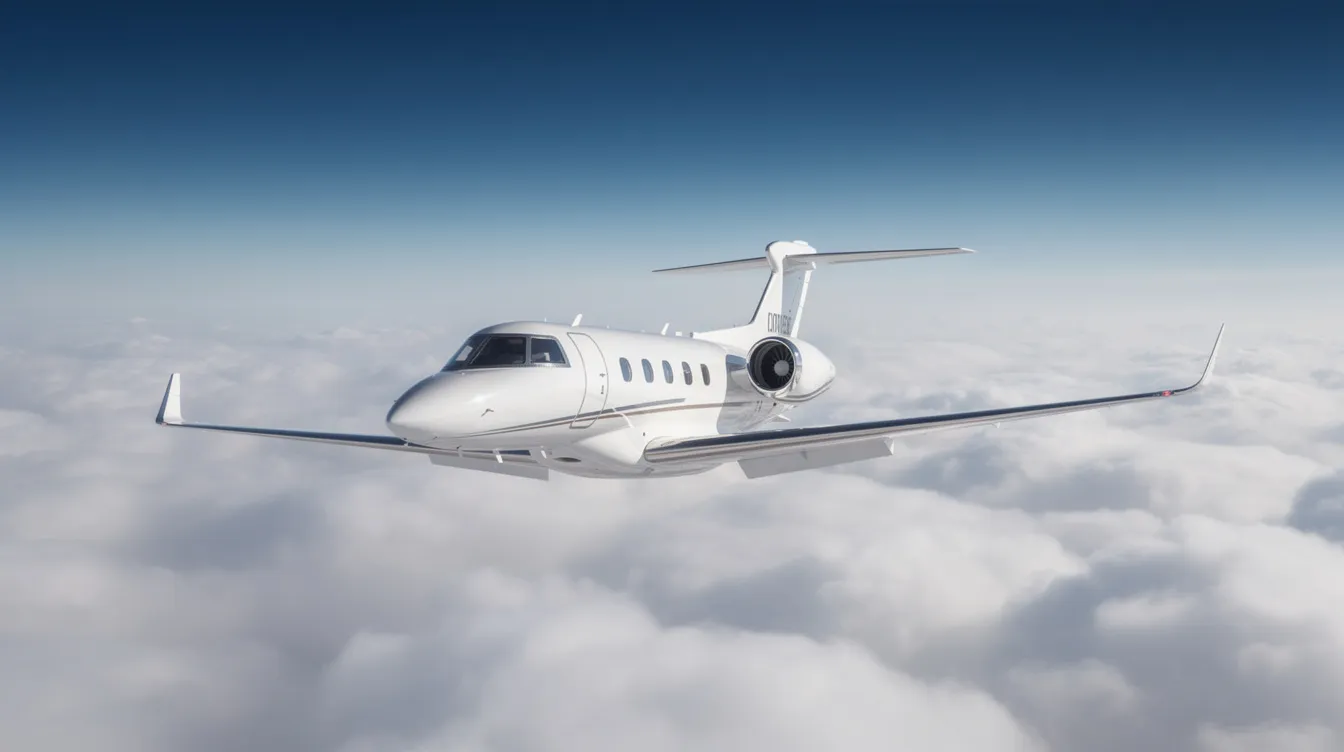
The Cirrus Vision Jet is the world's first certified single-engine personal jet. For executives, founders, and families searching for a Cirrus Vision Jet for sale, the real question is not whether the SF50 deserves a place in private aviation. It does. The question is whether buying one outright or accessing one through a Jet Card delivers more value for how you actually travel.
Why the Cirrus Vision Jet Matters for Serious Private Travelers
A regional trip that takes six to eight hours via commercial airlines (connections, ground transfers, security lines) often shrinks to two to three hours in a Vision Jet. The aircraft opens access to smaller airports closer to final destinations, bypassing congested hubs entirely. For an executive running a business across multiple cities, or a family splitting weekends between San Diego and Scottsdale, that time compression compounds across dozens of trips per year.
Buying a Vision Jet outright locks $3 million or more into a single asset. New G2+ models list between $3.2 million and $3.6 million depending on options and delivery year. Late-model pre-owned aircraft, typically 2019 to 2022 builds, trade in the $2.3 million to $2.9 million range. Beyond the purchase price, owners face fixed annual costs: hangar fees, insurance (which, for single-pilot operation,n can be expensive and carry strict requirements), pilot training, maintenance reserves, and depreciation.
BlackJet's Jet Card model strips away those burdens and connects directly to its broader premium private jet card programs. Members prepay for blocks of flight hours and access Vision Jet missions for one to four passengers on regional hops up to roughly 1,000 to 1,200 nautical miles, without scanning pre-owned listings on brokerage platforms or negotiating with brokers. Pre-owned listings for the Vision Jet are available on various major aircraft brokerage platforms, and there are several established marketplaces and specialized brokers for purchasing Vision Jets, but BlackJet eliminates the need to engage with any of them.
This article covers the aircraft's specs, generation differences, safety features including the Cirrus Airframe Parachute System and Safe Return autoland, ownership versus Jet Card economics, and how BlackJet sources Vision Jet lift within its light jets network.
At a Glance: Cirrus Vision Jet Models on the Market Today
The Vision Jet has distinct generation variations affecting performance and specifications. Each generation brought tangible changes that buyers, owners, and Jet Card members can feel in the cabin and on the schedule. Used Cirrus Vision Jets are available for purchase across all three generations.
G1 (2016 to 2018): The original SF50 features a carbon-fiber airframe and a V-tail design, powered by a Williams International FJ33-5A turbofan engine. The ceiling is around FL280. The Cirrus Perspective Touch flight deck provides Garmin-based avionics, but no autothrottle or Safe Return autoland. This generation suits owner-pilots who prioritize price over the latest technology. A 2018 Cirrus Vision Jet, for example, is priced at $1,995,000 on the current market, though CAPS repack status and avionics currency can shift that number by six figures. The aircraft is certified for single-pilot operations.
G2 (2019 to 2021): Higher ceiling at FL310, extended range of 1,275 nautical miles, and improved hot-and-high performance. Cabin refinements include better soundproofing and more comfortable executive seating options. Autothrottle and Safe Return appeared in some G2 builds but are not universal; verification per serial number is required. A 2019 Cirrus Vision Jet G2 is priced at $2,349,000 in current listings. Certified pre-owned Cirrus Jets in this range meet high safety standards when backed by factory programs.
G2+ (2022 onward): Improved takeoff performance, inflight Wi-Fi, Garmin SafeReturn emergency autoland, and the latest auto radar in many examples. Late-2023 and 2024 G2+ aircraft frequently include JetStream maintenance programs, auto throttle, auto radar, and inflight Wi-Fi as standard equipment. A 2020 Cirrus Vision Jet G2+ is priced at $2,695,000. New G2+ pricing starts around $3 million and can reach $3.6 million fully loaded with all options.
BlackJet's network prioritizes G2 and G2+ Vision Jets for member flights, ensuring access to current avionics, safety technology, and comfort upgrades.
Vision Jet Cabin, Comfort, and Use Cases
For trips under roughly three hours, the Vision Jet occupies a distinct position in personal aviation: fast enough to eliminate airline connections, small enough to use airports within minutes of your destination, and comfortable enough for productive work or genuine relaxation.
The Vision Jet seats up to seven passengers, including five adults and two children. The cabin layout features club-style mid-row seats (four facing each other) with a removable or reconfigurable aft row. The cabin is pressurized, enhancing comfort at altitude. Baggage space splits between an external compartment (about 30 cubic feet) and internal storage (roughly 24 cubic feet), accommodating carry-ons, skis, or golf bags for a weekend trip.
Consider two scenarios. A BlackJet member flying New York to Nashville (approximately 600 nautical miles) with three colleagues for a same-day meeting: door-to-door in under three hours, compared to a full day involving connections through a hub. Or a family of five flying Los Angeles to Jackson Hole for a long weekend: the Vision Jet handles the roughly 550-nautical-mile leg with room for weekend luggage and ski gear.
G2 and G2+ models deliver improved soundproofing that makes phone calls and laptop work practical at cruise altitude. USB-C power ports at most seats keep devices charged. The Vision Jet features options for Wi-Fi and enhanced comfort in its cabin configurations, particularly in later builds. The interior combines wide cabin floors (about 61 inches), large windows, and relatively low door height to create a space that feels closer to a bespoke SUV than a traditional small jet.
BlackJet members do not need to evaluate cabin configuration for each tail; the team ensures the selected aircraft matches passenger count, baggage requirements, and comfort expectations for every journey.
Flight Deck, Avionics, and Pilot-Friendly Automation
Most BlackJet clients sit in the cabin, not the flight deck. But the Vision Jet's cockpit technology directly affects their safety and schedule reliability.
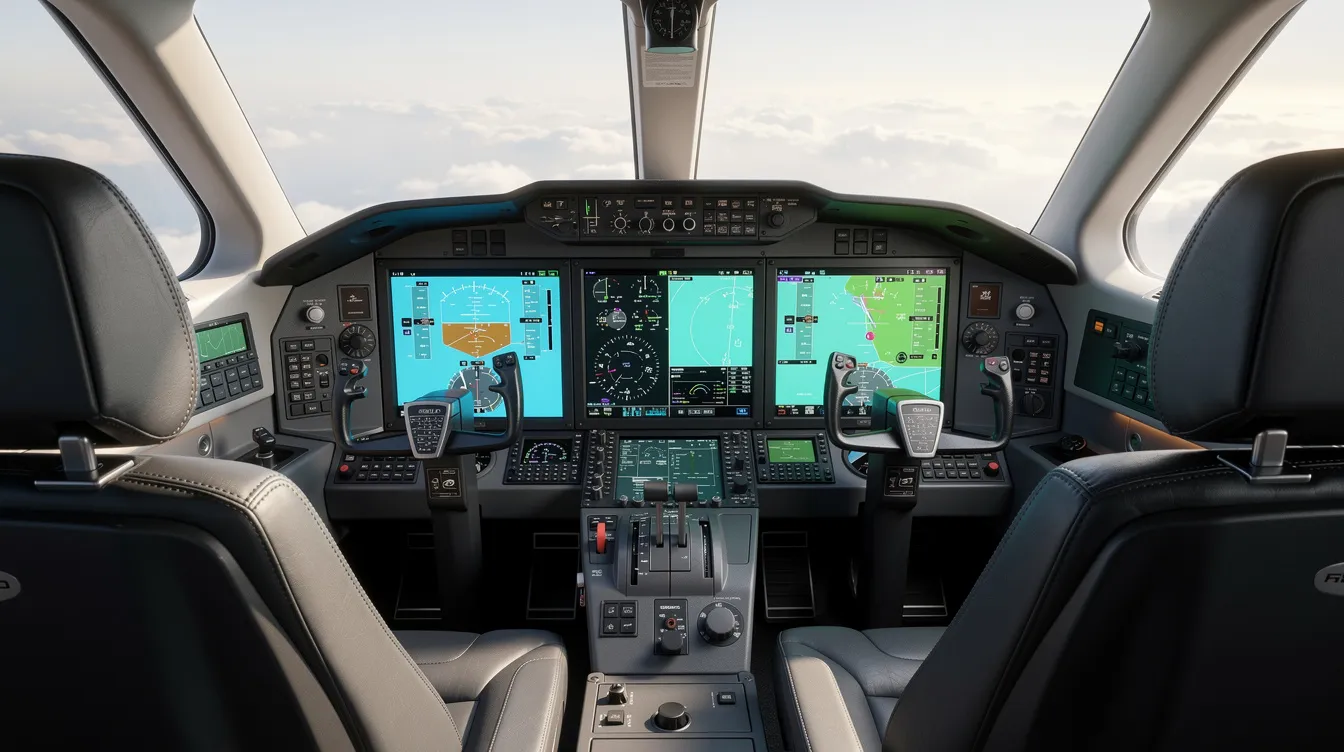
The avionics suite is built around the Garmin-based Cirrus Perspective Touch (upgraded to Perspective Touch+ in later models) with large-format displays, synthetic vision, and integrated engine and flight management. The system is optimized for single-pilot operations, reducing pilot workload through automation rather than requiring a second crew member.
A fully digital autopilot from the GFC 700 family provides envelope protection and advanced approach modes. Auto throttle, standard on many G2 and G2+ Vision Jets, manages power settings to reduce task saturation during critical phases. Auto radar (such as the Garmin GWX 8000) detects storm cells; traffic and terrain awareness systems, combined with data-linked weather, feed pilots a complete picture of the flight environment.
These systems produce tangible passenger benefits. On a summer flight through the Southeast, auto radar and data-linked weather allow pilots to route around convective activity with precision, minimizing turbulence and delays. During winter approaches into locations like Knoxville or Springfield, automated systems manage power and navigation through instrument conditions, keeping the schedule intact.
BlackJet requires Vision Jet operators in its network to maintain strict currency and training standards, with recurrent simulator-based training and type-specific proficiency checks that go beyond regulatory minimums.
Safety First: CAPS, Safe Return, and Known Icing Capability
Cirrus built the Vision Jet around layered safety systems that distinguish it from other light jets and personal aviation aircraft. BlackJet's own safety focus aligns directly with these capabilities.
The Cirrus Airframe Parachute System (CAPS) is a whole-airframe parachute designed for last-resort emergencies. If a pilot encounters a catastrophic failure or loss of control, deploying CAPS brings the entire aircraft to the ground under canopy. For buyers and operators, CAPS repack intervals and line-cutter replacements are major maintenance items: an aircraft with an overdue repack or lapsed service history will carry a lower market value and may not meet BlackJet's standards. Each used Cirrus Jet is thoroughly inspected before sale, and CAPS status is a primary checkpoint.
The Vision Jet incorporates the Safe Return Autoland system for autonomous landing. Available on many G2+ models, Safe Return lets a passenger press a single button in an emergency, triggering a sequence where the digital autopilot, auto radar, navigation, and radios work together to select a suitable runway and land the aircraft without pilot input. This capability adds $100,000 to $200,000 in resale value for equipped aircraft.
Flight into known icing (FIKI) capability, using TKS fluid-based ice protection, is certified on many Vision Jets. This enables winter operations across the Northeast, Midwest, mountain routes, and parts of Europe, maintaining safety margins that would otherwise ground the aircraft. Without FIKI, cold-weather flying in locations like Richmond, Lebanon, or Oxford becomes constrained.
Additional layers include automatic level mode, terrain and traffic awareness, and envelope protection that collectively reduce loss-of-control risk in single-pilot jets.
BlackJet uses only operators with top-tier third-party safety ratings (such as ARG/US or Wyvern audits), requires recurring simulator-based Vision Jet training for pilots, and enforces strict compliance with all maintenance bulletins. These operator standards ensure the aircraft's safety systems are maintained by disciplined, well-trained teams.
Performance Specs: What the Numbers Mean for Your Trips
The combination of speed, range, and short-field capability translates to faster door-to-door times than commercial business class on many regional routes, plus access to airports that larger jets cannot use.
The Cirrus Vision Jet has a maximum cruise speed of 311 KTAS, with typical long-range cruise settling around 300 knots. The Vision Jet features a range of approximately 1,275 nautical miles under NBAA IFR reserves in favorable conditions. The aircraft can operate at a maximum altitude of FL310, placing it above most weather and below the congestion of heavy commercial traffic corridors.
Takeoff distances run around 2,000 to 3,250 feet depending on weight, elevation, and temperature. Landing distance under typical conditions stays below 1,700 feet, opening access to smaller regional and executive airports near city centers and remote destinations like Henderson, Duluth, or Houston-area relievers.
Route examples bring these numbers to life. Miami to Nassau (approximately 175 nautical miles) is a short hop well within the Vision Jet's envelope for four passengers. Dallas to Aspen (roughly 700 nautical miles, seasonal and weight-dependent) fits comfortably within range for two to three passengers with ski gear. Chicago to Montreal (about 700 nautical miles) works for a full-day business meeting and same-day return.
BlackJet's flight support team uses these performance envelopes to match each member's itinerary, runway length, weather profile, and load requirements to the right aircraft and route plan.
How Much Does a Cirrus Vision Jet Cost in 2024 to 2026?
Prices shift with demand, options, hours, and support programs. Buyers searching for a Cirrus Vision Jet for sale need specific numbers rather than broad generalizations.
New aircraft: A 2024 or 2025 Cirrus Vision Jet G2+, fully configured, lists between $3.0 million and $3.6 million. Options that push the price toward the upper end include Xi custom design packages, in-flight Wi-Fi, SafeReturn, auto radar, and premium interior finishes.
Late-model pre-owned (2019 to 2022): Certified pre-owned Cirrus Jets range from $2.3 to $2.8 million, assuming moderate hours, active JetStream or similar maintenance coverage, and current avionics software. Used Cirrus Jets include models like the SF50 Vision Jet across all three generations. Cirrus Aircraft provides factory-backed programs, including Certified Pre-Owned options, which add a layer of confidence for buyers.
Older G1 (2016 to 2018): These may appear under $2.0 to $2.3 million, but often require upcoming CAPS repack, avionics and software upgrades, and other capital-intensive maintenance that can add $100,000 or more to the total acquisition cost.
Beyond purchase price, the Vision Jet's operating costs include fixed and variable expenses such as insurance, hangar, training, maintenance reserves, engine programs, and crew (if not owner-flown). Variable costs run approximately $1,500 to $1,600 per flight hour; fixed costs push annual budgets into the high hundreds of thousands, fitting within broader private jet price list benchmarks. One estimate pegged total annual cost at roughly $721,574 for 325 hours of flying.
BlackJet's Jet Card programs, available in 25-hour and 50-hour blocks, let members access Vision Jet capability without tying up millions in an airframe. Members prepay at fixed hourly rates structured around comprehensive jet card pricing, and BlackJet handles sourcing, safety vetting, and schedule coordination.
Ownership vs. Access: Buying a Vision Jet or Using a Jet Card
The decision comes down to a straightforward trade-off: own one aircraft that fits many but not all missions, or access a fleet through BlackJet with different aircraft categories matched to each trip, potentially via larger blocks such as a 100-hour jet card program for very frequent flyers.
Ownership advantages:
Full control of your schedule, down to the hour
Ability to custom-tailor a specific Vision Jet (Xi design, bespoke interior, specific avionics)
Potential tax structures for business use (depreciation, expense deductions)
Emotional satisfaction of ownership
Ownership drawbacks:
Capital risk (millions tied to a depreciating asset)
Residual value uncertainty, especially as newer models like the G3 enter the market
Maintenance downtime requiring backup lift
Insurance costs and financing complexity for single-pilot jets
Limited cabin size and range for trips that demand larger jets
Jet Card advantages: (and additional best jet cards for frequent flyers guidance)
Predictable hourly rates with no capital outlay
Guaranteed availability windows
Automatic upgrade from Vision Jet to larger light jets or midsize jets when passenger count or range demands it
No exposure to maintenance, depreciation, or pilot management
An executive flying 80 to 120 hours per year on mixed missions (short regional hops ideal for Vision Jet plus occasional transcontinental legs) often finds a Jet Card more efficient than single-aircraft ownership, especially when comparing detailed jet card cost per hour to fully loaded ownership economics and choosing between options like a 25-hour jet card versus larger blocks. Ownership economics tend to favor those consistently flying 150 or more hours annually on routes the Vision Jet can serve, and even then, downtime and opportunity cost of capital narrow the gap.
BlackJet also assists members who are aircraft owners, providing supplemental lift on other categories when the member's Vision Jet is in maintenance, or the mission exceeds its capabilities, and offering guidance on whether a 50-hour jet card structure aligns with their supplemental flying needs.

Where the Vision Jet Fits in the Light Jets and BlackJet Fleet Mix
The Vision Jet bridges the gap between high-performance turboprops and traditional light jets like the Citation CJ series or Phenom 300. It delivers jet speed (300+ knots), jet altitude (FL310), and jet comfort in an aircraft designed for single-engine efficiency, and it sits alongside other best single-pilot jets for budget-conscious buyers in the entry-level jet segment.
Its core mission profile covers one to four passengers on legs up to roughly 1,000 nautical miles, with a preference for shorter runways and closer-in reliever airports. Baggage capacity is adequate but not generous; a weekend trip for four with normal luggage is comfortable, while a week-long trip for the same group may push limits.
For missions requiring six to eight passengers, legs beyond 1,500 nautical miles, or twin-engine performance over water or remote terrain, BlackJet would recommend stepping up to a Citation, Embraer, or midsize cabin, and for larger groups it may propose options similar to the best private jets for 20 passengers or even private jets for 50 passengers. The platform treats the Vision Jet as one tool among several; flight advisors match each trip's route, passenger count, luggage, and weather conditions to the right aircraft type.
For many first-time private fliers coming from commercial first or business class, the Vision Jet is an ideal introduction to personal aviation: modern, tech-forward, with reassuring safety systems and an approachable cabin scale. Members do not need to master aircraft categories themselves, whether they are booking a whole aircraft or simply buying a seat on a private jet for specific routes. BlackJet curates the optimal choice while honoring preferences for specific models when availability allows.
How BlackJet Sources and Vets Cirrus Vision Jets
Not every Vision Jet for sale, and not every operator, meets BlackJet's safety and service standards. Buying a Vision Jet involves considering mission profiles, operational capacity, and maintenance records. BlackJet applies this same rigor when selecting operator partners.
BlackJet partners with operators who run Vision Jets under high-quality commercial certificates (Part 135 in the U.S.), maintaining meticulous records and using authorized Cirrus service centers for all maintenance. Aircraft are evaluated on total time, engine and airframe program status, CAPS and line-cutter compliance, avionics and software currency, and known icing system maintenance history, mirroring the due diligence recommended when comparing top affordable private planes like the Cirrus Vision Jet. A thorough pre-buy inspection by a qualified service center is recommended before purchasing a Vision Jet; BlackJet applies a similar standard to every aircraft in its network.
On the human side, BlackJet sets PIC experience thresholds (total hours, time in type), mandates recurrent simulator training on the Vision Jet, and enforces medical and CRM standards that exceed regulatory minimums. Pilots must demonstrate proficiency with Safe Return, auto throttle, and FIKI systems where applicable.
To illustrate: a prospective G2+ Vision Jet with acceptable low hours and a clean exterior appeared promising. BlackJet's sales team rejected it after discovering the CAPS repack was overdue by two months, and the operator had deferred Safe Return software updates. That kind of selectivity is the difference between a fleet network and a booking marketplace. Members who book a Vision Jet through BlackJet do not need to check each serial number or verify maintenance history. The vetting is already complete.
Safety, Sustainability, and Technology in Every BlackJet Flight
Safety, sustainability, and technology form three non-negotiable pillars for discerning private travelers. Vision Jet flights arranged through BlackJet combine all three.
On safety: every Vision Jet in the network carries CAPS, digital autopilot with envelope protection, and (on G2+ aircraft) Safe Return autoland and auto radar. These systems are layered on top of operator and pilot standards that BlackJet continuously monitors.
On sustainability: every flight, including Vision Jet sectors, is offset to net-zero through vetted carbon projects at no extra cost to members. The aircraft design promotes lower operating costs compared to twin-engine jets; the Vision Jet's single Williams engine burns roughly 70 gallons per hour, a fraction of what many twin-engine light jets consume on similar missions, aligning with broader trends toward the cheapest private jet options for efficient travel. This makes it an inherently more efficient choice where the mission profile fits.
On technology: BlackJet's digital booking tools let members request a Vision Jet or comparable light jets category from their phone, track itineraries in real time, and coordinate changes with 24/7 support. Innovation in avionics (Cirrus IQ connectivity, live maintenance tracking) and booking platforms converge to create a travel experience where the filters between intention and arrival are minimal.
Frequently Asked Questions About Cirrus Vision Jet Access with BlackJet
Can BlackJet members specifically request a Cirrus Vision Jet?
Yes. Members can express a preference for the Vision Jet rather than simply booking a "light jets" category. Availability depends on market, season, and notice period. BlackJet's trusted guidance team works to match specific aircraft preferences when scheduling allows.
What routes does BlackJet typically assign a Vision Jet?
The Vision Jet fits trips of one to four passengers on legs up to about 1,000 to 1,200 nautical miles. Typical routes include city pairs like Chicago to Nashville, Dallas to Aspen, or Houston to the Florida Gulf Coast, and in some markets extend to dedicated corridors such as private jet charters in Karachi. For longer legs, higher passenger counts, or heavy baggage loads, BlackJet recommends a larger light jet or midsize cabin.
How does BlackJet evaluate Vision Jet operators?
Every operator must hold current commercial certificates, pass third-party safety audits (ARG/US, Wyvern, or equivalent), maintain aircraft at authorized Cirrus service centers, and staff pilots who meet BlackJet's experience and recurrent training thresholds. The combination of these requirements sets a floor well above regulatory minimums.
How does the hourly cost of a Jet Card compare to ownership?
Q2 2026 data shows very light jet Jet Card rates averaging approximately $7,688 per occupied hour, including fuel and tax, consistent with broader jet card cost benchmarks and competitive with programs from major providers such as Flexjet jet cards or NetJets jet card options. Ownership variable costs run $1,500 to $1,600 per hour before fixed costs. At moderate usage (under 120 hours per year), Jet Card economics often match or beat ownership once capital cost, depreciation, and management overhead are included.
How does BlackJet's carbon-neutral program work for Vision Jet flights?
BlackJet estimates fuel burned per flight based on route distance, load, and weather conditions, then purchases verified carbon offsets for each sector. There is no additional cost to the member. The Vision Jet's single-engine efficiency means fewer offsets are required per mile compared to larger jets.
Next Steps: Explore Vision Jet Access Through BlackJet
If you are currently evaluating a Cirrus Vision Jet for sale, consider what you are actually buying: not just an aircraft, but an obligation to manage capital, maintenance, insurance, crew, and schedule risk. A Jet Card offers the same cabin, the same performance, and the same airports, without the balance-sheet weight, and can be compared directly to other budget-friendly private aircraft options when optimizing your overall aviation spend.
BlackJet's 25-hour and 50-hour Jet Card programs include access to Vision Jets alongside other aircraft classes, with guaranteed availability and fixed hourly rates, and build on the broader BlackJet 25+ Hour Jet Card platform for larger-cabin missions. Speak with a BlackJet advisor about your typical routes, whether San Francisco to Sun Valley, Chicago to Montreal, or London to Geneva, to discover where the Vision Jet fits and when a different category serves you better.
Elevate your travel on your terms. Join BlackJet's Jet Card program for private flight with rigorous safety, carbon-neutral performance, and the flexibility to fly the world's top personal jet without owning it. Discover BlackJet's Jet Card options and request a tailored flight plan within one to two business days.
The market for Vision Jets is active, the aircraft is proven, and the choice between ownership and access has never been clearer. BlackJet stands ready to put a Cirrus Vision Jet and a complete private fleet at your disposal.


 Sign up with google
 Sign up with Apple