For travelers who measure value in hours saved rather than dollars spent, the Embraer 175 range typically runs about 1,700 to 2,200 nautical miles, with roughly 2,000 nautical miles achievable in its most common long-range, full-passenger configuration. In aviation, "range" refers to the maximum distance an aircraft can fly under standard conditions without refueling. The Embraer 175 has a maximum published range of 2,000 nautical miles, but its typical operational range varies from 1,700 to 2,200 nautical miles depending on payload and conditions. For frequent business travelers and high-net-worth flyers comparing a regional jet with a private aircraft, that number shapes which trips can be flown nonstop, when connections start adding time and friction, and when stepping up to a more flexible premium option makes sense. This guide looks at the Embraer 175’s range, performance, seating and cabin classes, how it compares with private jets, and where comfort, productivity, safety, sustainability, and BlackJet’s premium Jet Card programs fit into the decision.
Embraer 175 Range: Quick Facts for Time-Sensitive Travelers
Range determines whether a flight is nonstop or requires a connection, and connections cost time. For high-net-worth travelers and executives who fly weekly, even a single unnecessary layover can erase half a day. The Embraer 175 is a workhorse of domestic aviation, and knowing its range envelope helps you plan accordingly.
The typical operational range of the Embraer E175 is 1,700 to 2,200 nautical miles, depending on variant, payload, and conditions. In its most common long-range configuration, the aircraft’s core Embraer 175 features for mission planning are its balanced seating layout, cabin comfort, and performance at a 2,000-nautical-mile range with a full passenger load. The Embraer 175 has a maximum published range of 2,000 nautical miles, but its typical operational range varies from 1,700 to 2,200 nautical miles depending on payload and conditions.
Published range figures assume standard atmospheric conditions and full passenger load. In practice, airlines plan conservatively, factoring in fuel reserves, potential diversions, and weather, which can reduce usable range by 10–15%.
The maximum fuel capacity of the Embraer E175 is roughly 9,335 kg of usable fuel. The Embraer E175 can cruise at speeds up to Mach 0.82, translating to roughly 430–500 knots true airspeed.
Route examples well within the E175's advanced range: New York to Dallas (~1,240 nm, about 3 hours), Chicago to Los Angeles (~1,750 nm, roughly 4 hours), São Paulo to Buenos Aires (~780 nm, under 2 hours), and London to Athens (~1,100 nm, about 2.5 hours).
For comparison, light private jets typically cover 1,500–2,000 nm, overlapping the E175's reach. Private jets often cruise higher than commercial airliners, and midsize jets stretch to 2,000–2,500 nm, while super-midsize jets exceed 3,000 nm-enabling true coast-to-coast nonstop capability that the E175 cannot reliably match under full load.
Where the Embraer 175 Fits in the E-Jet Family
The Embraer E-Jet family includes the E170, E175, E190, and E195-four aircraft designed to fill the gap between small regional turboprops and full-size narrowbodies like the Boeing 737. The Embraer 175 is the stretched, higher-capacity member of the smaller pair, optimized for regional to medium-haul routes where demand doesn't justify a larger plane.
The Embraer ERJ 175 sometimes appears under the "ERJ" designation in registries, but Embraer commercially brands it within the E-Jet family. It represents a significant leap from earlier regional jets like the ERJ-145 in wing design, noise, and fuel-efficient engines.
The aircraft is designed for short to medium-haul routes. Key range drivers include its twin-engine layout, key specifications, high-aspect-ratio wings, a maximum takeoff weight of approximately 85,000 pounds, and generous fuel capacity relative to its size. The configuration of the aircraft can affect fuel efficiency, with the E175's clean aerodynamics outperforming bulkier narrowbodies on thinner city pairs.
Republic Airways and other regional operators fly the E175 on behalf of American Airlines, United, and Delta, making it the dominant regional jet on sectors too thin for a Boeing 737 or Airbus A320. The Embraer E175 is often favored by North American carriers and is optimized for high-revenue regional operations, while travelers seeking lower entry points into private aviation can explore more affordable private jet options on comparable regional missions.
Advanced 45-degree winglets contribute to approximately 6.4% lower fuel burn versus older wingtip designs, while the broader aerodynamic system supports efficiency, extending economic range and reducing CO₂ per seat-mile-making the airplane one of the more fuel efficient options in its class.
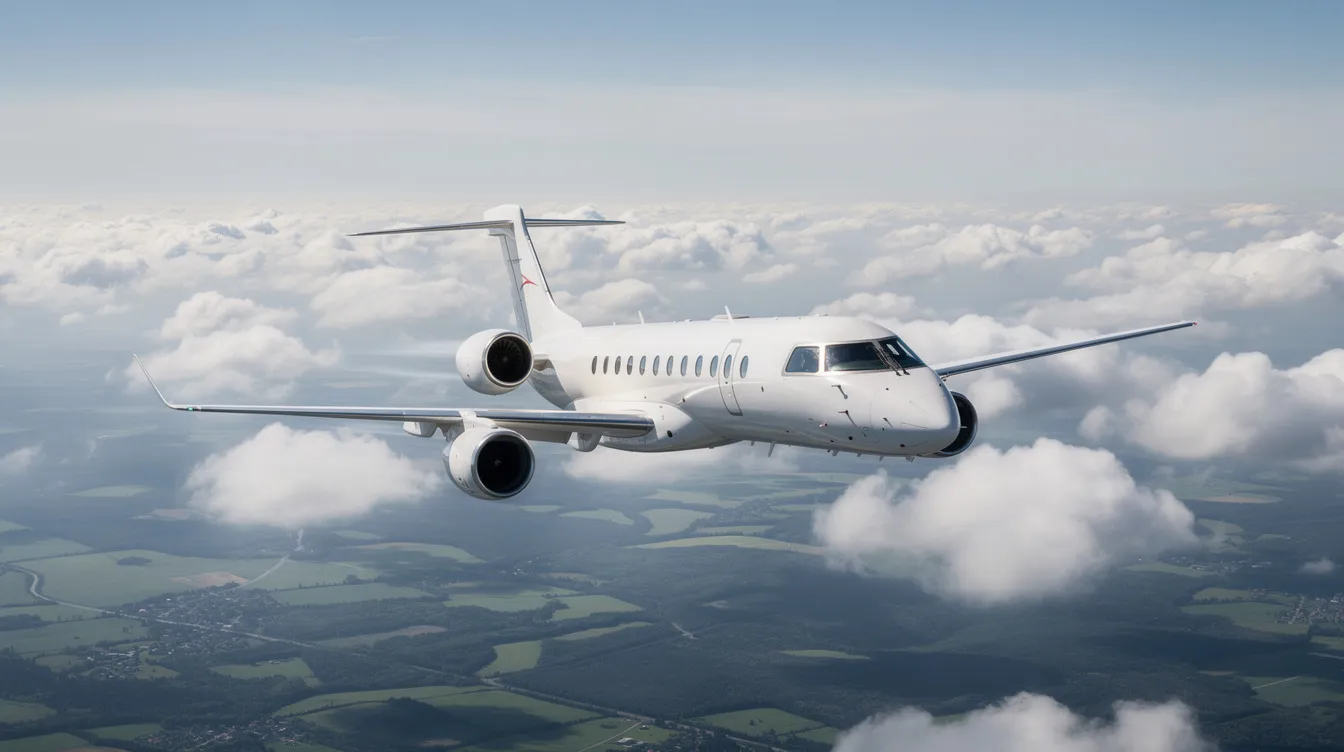
Embraer 175 Seat Map, Cabins, and Why Range Feels Different on Board
On a two-hour hop, nearly any seat is tolerable. On a flight that pushes the Embraer 175's range envelope toward three or four hours, the seat map starts to matter. The E175's cabin layout is one of its strongest selling points for a regional jet-and understanding it helps travelers choose wisely.
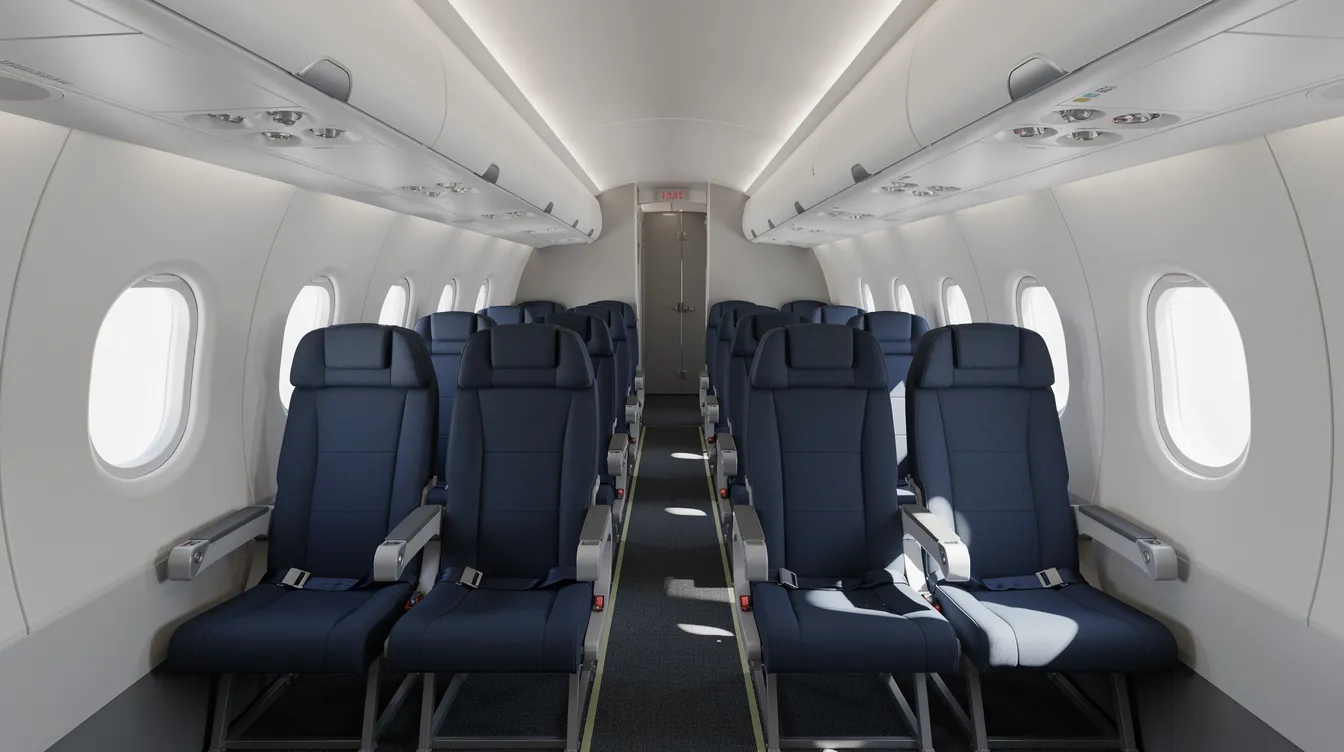
The Embraer 175 typically seats 76 passengers in commercial configurations, arranged in a 2–2 layout across all cabins. The E175 has no middle seats in any cabin, which immediately differentiates it from 3–3 narrowbodies where middle seats are unavoidable.
A typical dual class configuration used by U.S. carriers divides the plane into First Class, Main Cabin Extra (or equivalent premium economy), and standard Main Cabin economy. Republic Airways and similar operators run these layouts on behalf of major airlines, with the most common split being 12 first class seats, 20 Main Cabin Extra seats, and 44 main cabin seats.
Because every passenger sits in either a window or aisle seat, the E175 delivers a more private, less cramped experience than larger aircraft on comparable routes. This advantage compounds on longer flights-passengers arriving after a three-hour segment feel notably less fatigued than those crammed into a 3–3 cabin for the same duration, yet some flyers still opt to buy a single seat on a private jet when privacy and time savings trump even the best regional jet layout.
For flights at the upper end of the E175's range, forward rows in First Class or Main Cabin Extra are recommended: quieter cabins, quicker deplaning, and better amenities make a measurable difference when block time stretches past 2.5 hours.
Cabin Classes on the E175: First Class, Main Cabin Extra, and Main Cabin
The Embraer 175 aircraft offers three distinct service tiers on most domestic routes, each designed to balance capacity with comfort. Here is what travelers can expect in each class cabin.
First Class: First class on the E175 has 12 seats in a 1-2 configuration, meaning solo travelers on the left side of the aisle enjoy a private row. The first class cabin offers roughly 37 inches of pitch, seat width near 20 inches, and 5–6 inches of recline. First class seats typically include power outlets, larger tray tables, and enhanced catering amenities that matter significantly on sectors exceeding two hours. Adjustable headrests in these rows add comfort for passengers who rest en route.
Main Cabin Extra: Main Cabin Extra includes 20 seats with 34 inches of pitch, positioned directly behind First Class. Seat width mirrors economy at approximately 18–19 inches, but the additional legroom and proximity to the front of the plane make these class seats a strong value choice for business travelers pushing toward the E175's upper range on 3-plus-hour sectors.
Main Cabin: The economy section has 44 seats in a 2-2 layout with roughly 30 inches of pitch and modest recline. While adequate for flights under two hours, comfort tapers on longer routes approaching the aircraft's range limit. Overhead bins accommodate standard carry-on bags, and the aisle is wide enough for efficient boarding and deplaning.
The absence of middle seats across all rows softens the discomfort of longer segments, but seat selection-window versus aisle, forward versus aft-still matters considerably for flights over 2.5 hours.
Power Outlets, Wi‑Fi, and Tech: Staying Productive Across the E175's Range
On segments approaching the Embraer 175's maximum range, in-seat power and connectivity determine whether the flight is productive or simply endured.
Most E175 fleet aircraft operated by American Airlines and comparable carriers are equipped with Wi-Fi through a streaming portal. There are no seatback screens, so personal devices are essential for entertainment and work.
Power outlets are typically available at all first class seats (AC or universal) and USB ports in many Main Cabin Extra rows. Rear main cabin rows may have limited or no power access, depending on the specific airframe and retrofit status.
On 3–4 hour flights within the E175's range, battery anxiety is real for passengers without outlets. Reading the airline's seat map before booking-looking specifically for documented power access by row-is a practical step that frequent flyers should not skip.
The cabin crew can advise on available amenities board-side, but by then your seat is locked in. Planning ahead pays dividends on longer sectors.
By contrast, private jets accessed through BlackJet Jet Cards feature cabin-wide power, multiple outlets per seat, and more robust connectivity, making even extended segments productive from wheels-up to landing.
Range, Routes, and Real-World Performance of the Embraer 175
Brochure numbers and real-world performance are two different things. Understanding the gap is essential for anyone planning itineraries that depend on the Embraer 175 range.
The difference between maximum published range and operational range comes down to payload weight, weather conditions, air traffic routing, and mandatory fuel reserves. Payload weight impacts the E175's operational range-a full load of 76 passengers with checked bags and standard reserves can reduce usable range by several hundred nautical miles versus the manufacturer's optimistic figures.
The Embraer E175 typically operates on sectors of 300 to 1,000 nautical miles in scheduled airline service: for instance, Denver to Reagan National, Chicago to San Antonio, Seattle to Phoenix, Toronto to Houston, and New York to Kansas City are representative examples. These are well within the aircraft's comfortable operating window.
Weather conditions can affect the range of the Embraer E175 significantly. It features superior hot and high performance capabilities, but departing Denver in summer still imposes penalties on takeoff distance and climb performance, sometimes forcing airlines to limit passenger or baggage weight.
Cruising at higher altitudes generally improves fuel efficiency, and the E175's maximum service ceiling is approximately 41,000 feet-competitive with larger narrowbodies.
The E175 offers flexibility for longer missions and diversions, but it cannot handle U.S. transcontinental coast-to-coast flights or transatlantic segments nonstop under typical commercial flight loading. Its roughly 2,000 nm range makes it ideal for connecting mid-tier cities to major hubs, not for replacing larger aircraft on trunk routes, which is where chartering a private jet can open up nonstop options that bypass hubs entirely.
Scheduling realities reinforce this: longer E175 flights consume more block hours, so operators reserve them for high yield, strategic routes rather than routinely stretching the plane to its absolute limit. The Embraer E175 is a capable, high-performance regional jet-within its designed mission profile.
Embraer 175 vs Private Jets: Range, Flexibility, and Cabin Experience
For frequent travelers, the decision between a commercial flight on an E175 and a private jet is not purely about range-it is about what that range enables. Here is how the two compare as strategic travel tools.
Range overlap and divergence: The E175's ~2,000 nm range overlaps with many light private jets (1,500–2,000 nm). Midsize jets push to 2,000–2,500 nm, while super-midsize and large-cabin jets reach 3,000–5,000+ nm-enabling nonstop missions the E175 simply cannot fly.
Schedule and routing: A commercial E175 route is operated on a fixed schedule with hub-and-spoke routing. Private jets fly point-to-point between thousands of airports-including smaller fields closer to final destinations-eliminating connections and dramatically reducing ground time.
Cabin experience: On a full 3-hour E175 sector, even first class passengers share the cabin with up to 11 others, board through a common jet bridge, and navigate standard security. A private jet on the same route offers an entire cabin reserved for your party, bespoke catering, and tailored seating-no overhead bins jockeying, no shared lavatories, and in the case of top-tier private jets, flagship interiors and performance that redefine long-range comfort.
Itinerary complexity: When a traveler's route requires connections beyond the E175's direct network-say, arriving from a secondary city and connecting through a hub to reach a final destination-a private jet at similar or greater range may cut total door-to-door travel time by two to three hours, even if raw aircraft range is comparable.
The average hourly rental rate for an E175 in charter configuration is approximately $14,850, but comparing charter rates to Jet Card programs is misleading; Jet Cards offer predictable, prepaid access across multiple aircraft categories without per-trip negotiation, and understanding Jet Card cost per hour helps clarify when they beat ad hoc charter.
Embraer 175 vs Commercial First Class: When Comfort Isn't Enough
First class on an Embraer 175 is arguably one of the more comfortable regional jet experiences available. The 1-2 seating eliminates middle seats, power outlets keep devices charged, and catering exceeds what most economy passengers receive. But comfort and control are different things.
What first class delivers: Greater legroom, wider seats, improved recline, a quieter environment at the front of the cockpit-adjacent cabin, and quicker exit at the destination. For a 2.5-hour domestic flight, these advantages are meaningful.
What first class cannot fix: Fixed departure times that don't flex around your schedule. The need to arrive 60–90 minutes early for security and boarding. The risk of delays, gate changes, and missed connections. The presence of other passengers in a shared cabin, including those in rows directly behind you—limitations that drive many frequent flyers to evaluate Jet Card membership pricing as an alternative.
The private jet contrast: On a similarly long segment via BlackJet, travelers use a private terminal (FBO), arrive 15–20 minutes before departure, and can adjust departure times to accommodate a meeting that runs long or weather that shifts. Total cabin privacy is standard, not an upgrade.
Scenario: Consider a 2.5-hour flight from Chicago to the East Coast. On an E175 first class seat, a traveler adds 90 minutes of airport time on each end, navigates a crowded terminal, and boards with 75 other passengers. On a private jet departing from a closer regional airport-no lines, no shared space-the same executive lands and transfers directly to meetings, saving two or more hours round-trip.
Safety and Sustainability: E175 Operations vs BlackJet's Private Fleet
For discerning travelers, aircraft range is only part of the equation. Safety standards and environmental performance are non-negotiable pillars of any travel decision.
The E175 is an FAA and EASA-certified regional jet, typically operated under Part 121 regulations by carriers like Republic Airways. It benefits from rigorous maintenance cycles, standardized cabin crew training, and formal safety management systems delivered through commercial airline infrastructure.
The E-Jet family maintains a strong overall safety record across two decades of global service, with continuous improvements in procedures and avionics technology driving incident rates downward over time, while leading private jet models and best-in-class Jet Card programs similarly emphasize rigorous safety standards alongside comfort and flexibility.
Fuel-efficient winglets and modern engine management make the E175 relatively eco-efficient in its class, reducing CO₂ emissions per seat-mile on short to mid-range routes-particularly when the plane flies full.
BlackJet operates through a curated network of Part 135 operators vetted against proprietary safety standards that meet or exceed industry benchmarks, including mandatory Safety Management Systems and crew experience minimums.
On sustainability, BlackJet ensures every flight is carbon-neutral through integrated offsets covering CO₂ and non-CO₂ effects-water vapor, aerosols, nitrous oxide-at no additional cost to the member. This contrasts with commercial aviation, where carbon offsets are typically optional and often overlooked by passengers purchasing a standard ticket, even when evaluating high-end private jet options around $10 million or similar long-term aviation investments.
Maximizing Comfort on E175 Flights Near Their Range Limit
Many travelers will continue to fly the Embraer 175 on certain routes. Here is how to optimize comfort and productivity when those flights push toward the upper end of the E175's range.
First class seat selection: Solo seats on the left side (1A through 4A in the 1-2 layout) offer the most privacy. These rows are farthest from galley noise and provide the quickest exit upon arriving at your destination.
Main Cabin Extra strategy: Forward rows in this section balance legroom with proximity to the first class cabin's quieter zone. These seats are the best value play for frequent flyers who cannot always secure a first class upgrade.
Main cabin optimization: Exit rows offer extra space but may come with limited recline and no underseat storage. The last rows, near lavatories and the galley, are the least desirable on flights exceeding two hours-avoid them when possible; on some international routes, travelers instead consider private jet charters from cities like Karachi to avoid these compromises entirely.
Reading the seat map: Check the airline's published seat map for power outlet indicators, limited-recline warnings, and window alignment issues before booking. On flights over two hours, the difference between a powered and unpowered seat is the difference between a productive flight and a dead laptop—and for some missions, a detailed private jet charter cost comparison may reveal that skipping the seat map entirely is the better choice.
Fatigue management: Use noise-canceling headsets, pre-download entertainment (Wi-Fi performance can be variable), and divide long segments into focused work blocks and deliberate rest periods; higher cruise altitudes on many private jets, as explained in this guide to how high private jets fly, can further reduce turbulence-related fatigue on comparable routes.
For travelers making these flights monthly or weekly, the cumulative time and comfort trade-offs often justify exploring a Jet Card model where cabin layout and schedule are tailored to you-not the other way around, and understanding Jet Card pricing structures is key to gauging long-term value.
BlackJet Jet Cards: When to Upgrade Beyond the Embraer 175
There comes a point where seat selection and first class upgrades on an Embraer 175 no longer move the needle. For travelers who have reached that threshold-especially on longer, multi-leg itineraries-BlackJet's Jet Card programs represent a strategic step forward.
BlackJet offers structured programs like the 25-hour Jet Card and 50-hour Jet Card, providing prepaid access to multiple private jet categories across regions. Unlike per-seat commercial bookings on E175 routes, Jet Cards deliver predictable pricing and guaranteed availability across a fleet tailored to your mission, and detailed guides to the 25-hour Jet Card features and costs and 50-hour Jet Card pricing can help determine which tier matches your flying pattern.
Range planning becomes intuitive: choose light jets for sub-1,800 nm missions that would normally be E175 territory, and step up to midsize or super-mid jets when itineraries exceed the E175's range or involve segments where a commercial flight would require a connection.
Scenario one: An executive who flies weekly between two secondary cities-say, Tulsa and New York-currently connecting through a hub on E175-operated legs. A Jet Card eliminates the connection entirely, saving three or more hours per round trip, and a dedicated breakdown of 100-hour Jet Card costs illustrates how heavy users can lock in that convenience predictably.
Scenario two: A family that frequently purchases four first-class seats on E175 routes for ski trips or coastal getaways. A Jet Card delivers direct routing to smaller airports near resort destinations, plus privacy and flexibility that four commercial seats cannot replicate. The average purchase price of a pre-owned E175 is roughly $ 3,900,000; owning one is impractical for personal use, but a Jet Card provides access to equivalent or superior aircraft without the commitment, and families weighing this against 12-seater private jet costs can better calibrate what level of access they actually need.
Every BlackJet flight carries built-in carbon neutrality, operator vetting through certified safety standards, and 24/7 digital booking tools that let you select your aircraft category the way you might choose a seat on a seat map-except you are choosing the entire experience, much like evaluating a dedicated Flexjet Jet Card program or other premium membership option.
Explore how BlackJet can reshape your regional and mid-range travel beyond what the Embraer 175, even in first class, can offer, starting with a clear view of overall Jet Card costs and benefits.
Conclusion: Choosing the Right Aircraft for Your Range of Needs
The Embraer 175 is a modern, fuel-efficient regional jet with a practical ~2,000 nm range, no middle seats, and a genuinely comfortable cabin for short to mid-range missions. In first class or Main Cabin Extra, it delivers one of the better commercial experiences available on domestic routes.
Optimizing your seat map choices, cabin class, and tech access can make longer E175 flights more productive. But commercial constraints-fixed schedules, airport queues, shared cabins, and limited routing-remain unchanged regardless of which row you sit in.
For travelers who routinely push the limits of the Embraer 175's range or rely heavily on regional jets, the control, privacy, and tailored range coverage available through BlackJet's Jet Card programs offer a fundamentally different proposition, especially once you understand the moving parts behind Jet Card cost per flight hour.
When the question shifts from "which seat" to "which aircraft, which airport, which schedule," you have outgrown the regional jet model-no matter how capable the plane.
The Embraer 175 will continue to serve millions of passengers well. The question is whether it still serves you well enough. If your travel patterns suggest otherwise, contact BlackJet to discuss your upcoming itinerary and discover how Jet Card membership can complement or replace the routes where you have been settling for less, whether you are comparing Jet Card pricing models, evaluating NetJets Jet Card costs, or exploring large-cabin solutions like the best private jet for 20 passengers or 50-passenger private charter options.


 Sign up with google
 Sign up with Apple


