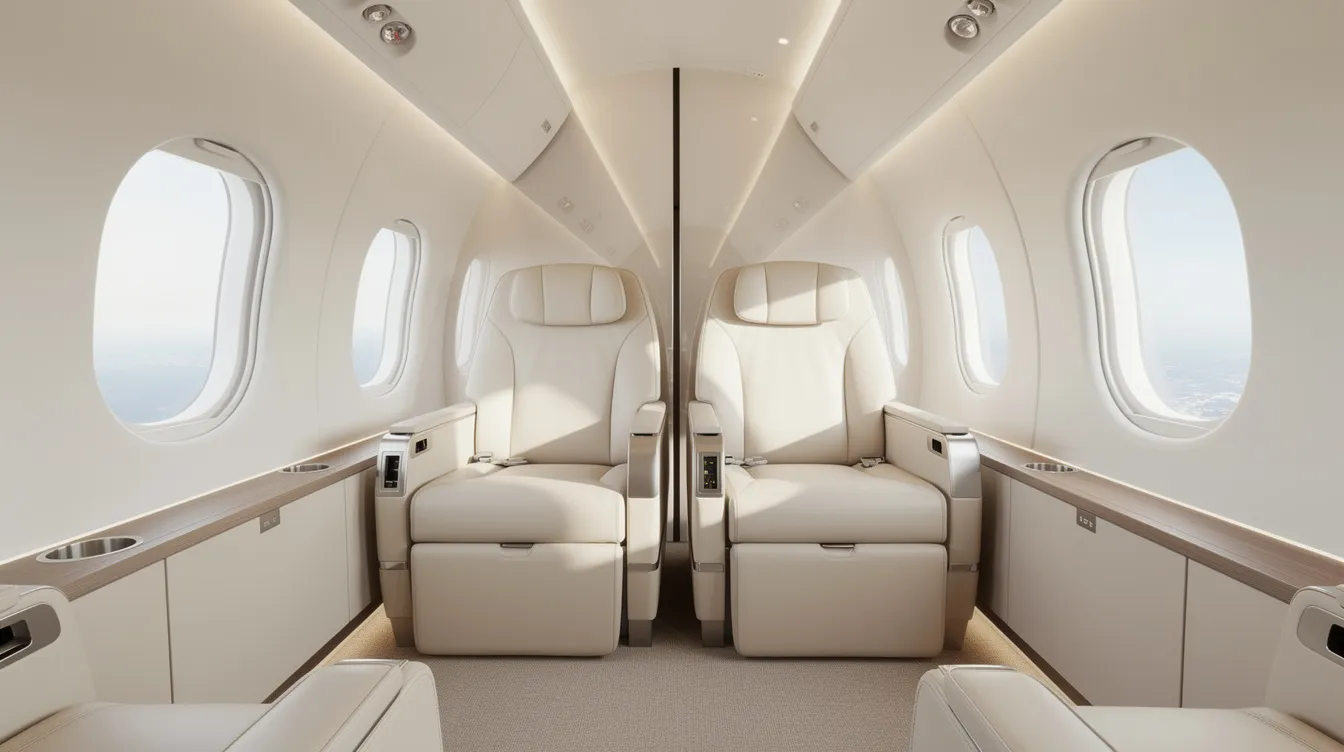
When a 15-person executive team needs to reach a secondary airport two hours away, commercial first class becomes a logistical puzzle. Connections, security queues, and rigid schedules turn a short flight into a half-day ordeal. The Embraer E-Jet family offers a different calculus entirely-one built around point-to-point precision, cabin-wide privacy, and the kind of schedule flexibility that turns travel time into productive time.
Executive Overview: Why the Embraer E-Jet Family Matters for BlackJet Members
The Embraer E-Jet family includes four core models-E170, E175, E190, and E195-plus the next-generation E-Jet E2 family. In commercial layouts, this aircraft family can accommodate 70 to 122 passengers, covering sectors of roughly two to four hours across domestic and international routes. For BlackJet members, these jets occupy a category that smaller business jets simply cannot: large-group private travel without compromise.
Consider the math. A board of directors numbering twelve, plus support staff and luggage, overwhelms a super-midsize cabin. Booking multiple smaller jets splits the group, doubles the cost, and eliminates the collaborative advantage of traveling together. An E-Jet configured in an all-business layout seats 40 to 60 in spacious comfort, consolidating the journey at a fraction of the per-seat cost compared to chartering three separate aircraft. E-Jets are widely used in corporate shuttles and incentive trips for precisely this reason.
BlackJet's jet card programs-including 25-hour and 50-hour options-allow members to apply prepaid hours across multiple cabin classes, and its broader premium private jet card services extend that flexibility across a curated fleet and membership tiers. Where available, regional jet categories give clients access to E-Jet-class capacity through the same digital booking tools and 24/7 support they rely on for lighter aircraft.
The sections ahead explore what makes this jet family distinctive: four-abreast seating that eliminates middle seats, the operational flexibility to use shorter runways than mainline carriers require, a strong safety and certification record, and compatibility with BlackJet's carbon-neutral commitment.
From ERJ to E-Jet: Evolution of Embraer's Regional Jet Family
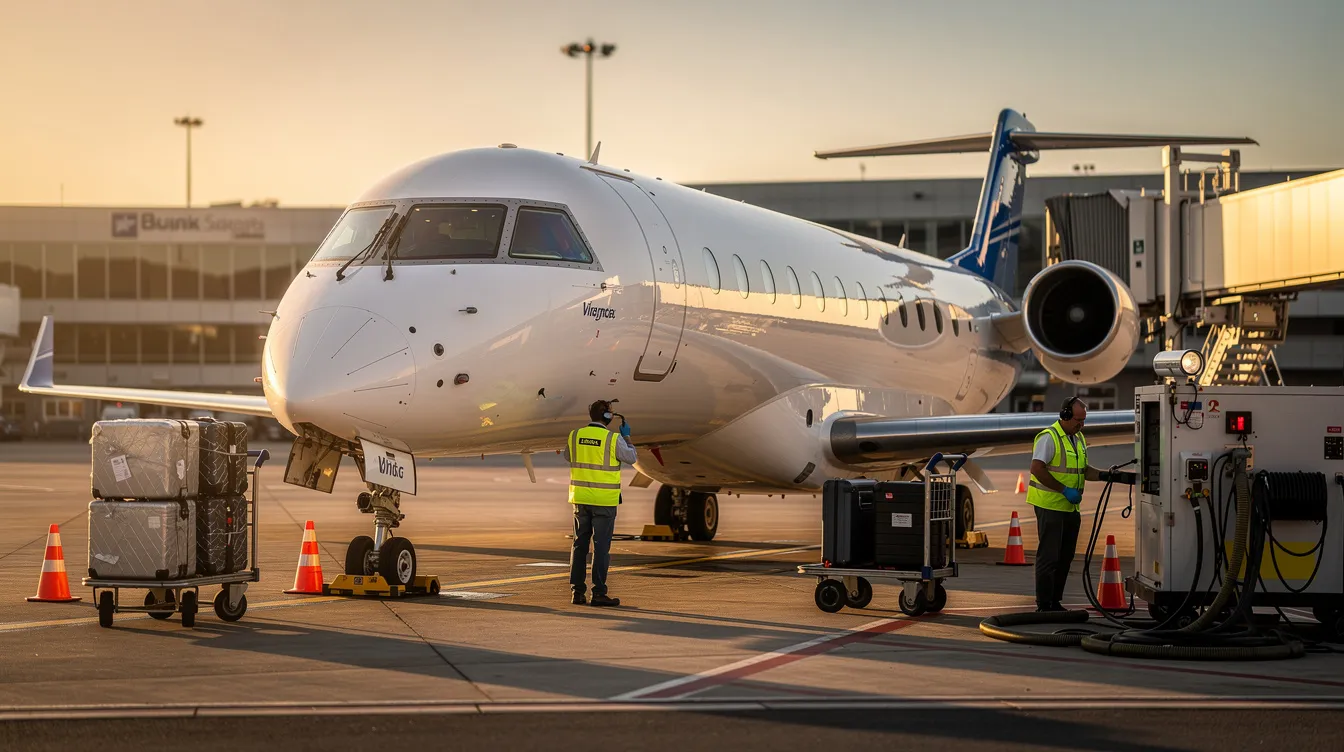
The Embraer E-Jet story begins with its predecessor. The Brazilian aerospace manufacturer launched the ERJ series-ERJ-135, ERJ-140, and ERJ-145-in the mid-1990s, with the ERJ-145's first flight on 11 August 1995 and commercial service entry in 1997. These smaller regional jets proved the market for jet-powered short-haul operations but lacked the cabin width and range to compete on routes demanding 70-plus seats, just as very light and light jets dominate the segment for travelers prioritizing the cheapest private aircraft options over maximum capacity.
Embraer, the company behind the program, launched the E-Jet program between 1997 and 1999 to fill the gap between aging turboprops and larger narrowbodies on thinner routes. Key milestones include:
February 2002: The first e-jet prototype-the E170-flew from são josé dos Campos, Brazil
March 2004: First E170 deliveries completed; LOT Polish Airlines operated the first airline commercial e-jet flight on March 17, 2004, on the Warsaw–Vienna route
2005–2006: E175, E190, and E195 entered service progressively with global operators
The four original models complement rather than replace the ERJ series, covering distinct seat and range niches. This e-jet series also underpins later Embraer products of direct interest to private clients, including the Lineage 1000 business jet and the newer e-jet E2 family introduced in the 2010s.
Technical Snapshot: Core Models in the Embraer E-Jet Family
Each model in the e jet family targets a specific operational niche, in the same way that entry-level VLJs and turboprops occupy the market for the cheapest private jet options for shorter, lighter missions. The family includes 12 variants across four models, sharing an 89% commonality in design and components that facilitates lower operating costs, easier maintenance, manufacturing efficiency, and streamlined crew training.
Model | Typical Seats | Max Seats | Approx. Range | Engines | Primary Role |
|---|
E170 | ~72 (single-class) | 78 | ~3,300–3,500 km | 2× GE CF34-8E | Thin regional routes |
E175 | 76–88 | 88 (high-density) | ~3,700–4,100 km | GE CF34-8E5 | North American regional fleets |
E190 | 98–114 | 114 (single-class) | ~4,200 km | GE CF34-10E | Regional/mainline crossover |
E195 | 108–118 | ~124 | ~4,000 km | GE CF34-10E | High-density regional routes |
The E170 typically seats around 72 passengers in a single-class configuration and excels on routes serving smaller airports. The E175 has a maximum capacity of 88 passengers in high-density configuration and dominates the North American regional market. SkyWest Airlines alone operates 263 E-Jets as of June 2025. The E190 can carry up to 114 passengers in a single-class configuration with its stretched fuselage, while the E195 offers a passenger capacity of 108 to 118 depending on configuration, competing directly with larger variants of narrowbody aircraft on high-density routes.
The E190 and E195 have stretched fuselage designs and seat 100 to 124-plus passengers, making them the workhorses for airlines needing to serve low-to-medium-demand routes while increasing flight frequencies. The family is popular among airlines for its operational flexibility and is powered by twin GE CF34 fuel-efficient engines across all first-generation variants.
For large group private travel, commercial interiors can be reconfigured into business-class-only or corporate shuttle layouts suitable for charter missions, transforming a regional aircraft into a premium private experience that rivals other private jet options for 50 passengers.
The E-Jet E2 Family: Second-Generation Efficiency and Performance
Embraer introduced the E-Jet E2 family program in 2013, targeting lower operating costs and a stronger sustainability profile. The E2 generation provides improved fuel efficiency and reduced emissions through three core technology upgrades:
New engines: Pratt & Whitney PW1000G geared turbofan engines replace the CF34s, delivering 17–25% lower fuel burn per seat
Redesigned wings: Higher aspect-ratio wings with improved aerodynamics and increased wing span enhance cruise performance at Mach 0.82
Updated avionics: Enhanced fly-by-wire systems improve flight performance and reduce maintenance burden
E-Jet E2 models entered service in 2018, with the E190-E2 certified in February 2018 and entering commercial operations with Widerøe that April. The E195-E2 followed with certification in April 2019 and first delivery to Azul. The E175-E2 remains delayed, primarily due to U.S. scope clause constraints.
The E-Jet E2 offers a larger passenger capacity than earlier models, with the E195-E2 seating up to 146 in high-density layouts, positioning it near the lower end of aircraft typically evaluated when planning charter flights for around 100 passengers. Maintenance cost per seat drops 15–25%, and the noise footprint shrinks significantly. Embraer flew the E195-E2 on 100% Sustainable Aviation Fuel in 2022, demonstrating compatibility with next-generation fuel standards.
For BlackJet members, these efficiency improvements matter directly, especially when evaluated alongside the cost structures explained in our jet card pricing guide. Combined with BlackJet's carbon-neutral flight commitment, an E2-equipped charter mission can deliver meaningful reductions in environmental footprint per passenger-particularly on high-load group movements where every seat is filled.
Cabin Experience and Comfort: What E-Jets Feel Like on a Private Charter
Step aboard a privately configured embraer e jet and the first thing you notice is space. Unlike commercial aircraft cramming six seats across a narrow fuselage, this plane uses a "double-bubble" fuselage cross-section with four abreast seating in a 2-2 arrangement. There is no middle seat. Every passenger sits in either a window or an aisle position.
Passengers prefer E-Jets for their 2+2 seating layout with no middle seat, and the cabin specifications reinforce that preference:
Oversized windows measuring 185 square inches, among the largest in regional aviation
Stand-up headroom throughout the cabin, enabled by the double-bubble fuselage design
Spacious seating with eliminated under-seat support rails, freeing legroom beneath each seat
Wide aisle allowing comfortable movement and in-cabin service
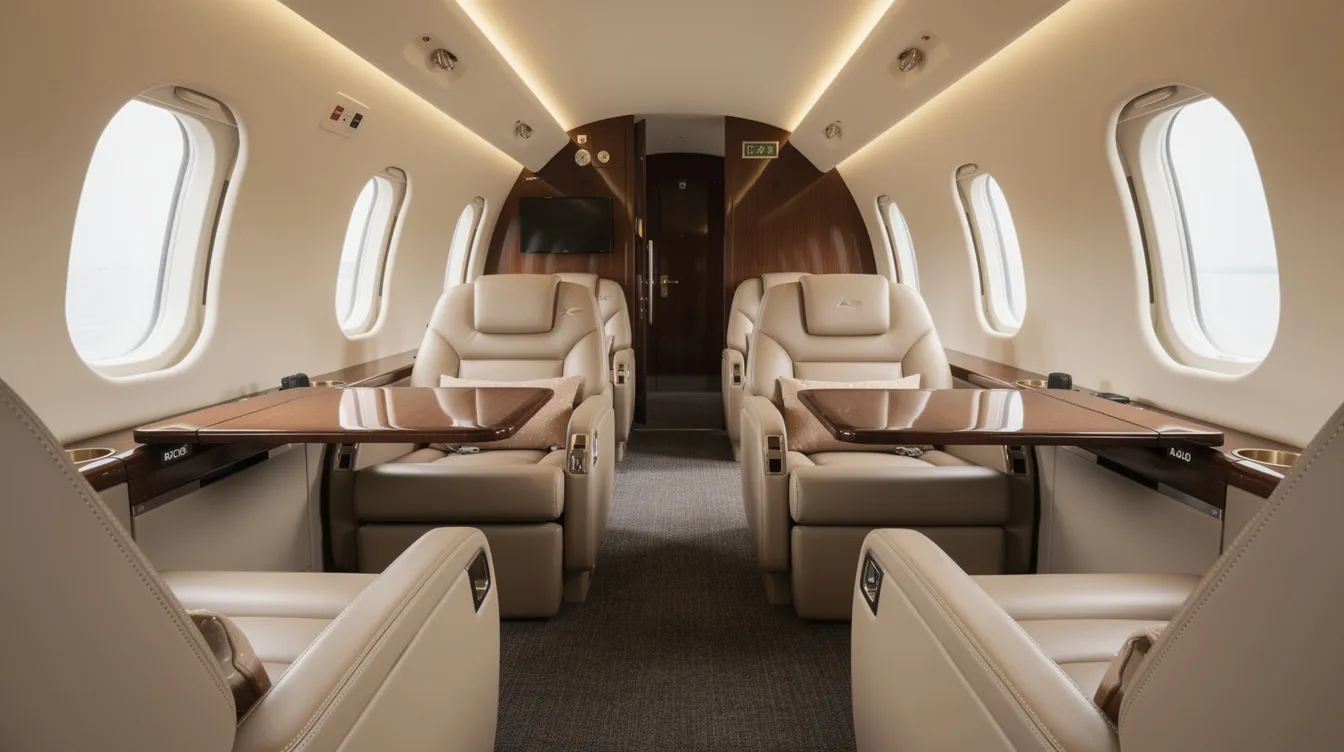
In a charter context, E-Jet cabins can be arranged as all-business layouts with 38–42 inches of pitch, or bespoke configurations with club-seating zones for meetings and social areas. Reliable inflight connectivity, tailored catering, and custom branding-headrest covers, onboard amenities-transform the cabin into a mobile extension of a company's culture.
Compared to a traditional super-midsize business jet carrying eight to twelve or even the top 16-seat private jet options, an E-Jet charter gives groups of 20 to 50 the ability to move around the cabin, hold impromptu discussions, and arrive together-benefits that no configuration of smaller jets can replicate.
Operational History, Safety Profile, and Reliability of the E-Jet Family
Over 1,600 E-Jets have been built since 2004, and as of December 2024, over 700 remain in active service with airlines across the world. The scale of this fleet provides extensive operational data and a mature support ecosystem.
Early operational milestones shaped the aircraft's reputation:
LOT Polish Airlines, as the launch carrier, flew the first airline E170 route in March 2004
Air Canada adopted the E175 extensively; by July 2020, Air Canada had flown 25 million passengers on E175s
The E190's longest flight covered 2,694 nautical miles on November 6, 2008
Airlink inaugurated service to Saint Helena on October 14, 2017, using an E190, demonstrating the type's ability to reach remote destinations.
E-Jets are designed for regional airline operations and larger regional jets, and they operate efficiently from shorter runways such as London City Airport. The family allows airlines to open new routes with lower demand, and E-Jets are utilized for both domestic and international routes spanning every inhabited continent. Incident records across the family also include events during takeoff and landing.
The E-Jet family is known for high dispatch reliability-Embraer cites figures approaching 99.9% mission completion. Across the fleet, approximately 22 notable incidents have occurred, including nine hull losses and events such as an emergency landing, a ratio that compares favorably to global standards when measured against total flight hours. Regulatory oversight from the FAA, EASA, and ANAC Brazil ensures continuous airworthiness through mandatory directives and design improvements.
BlackJet partners exclusively with operators whose aircraft meet strict safety and audit standards, including third-party certifications, a philosophy shared by the top private jet companies in today’s market. Every E-Jet available through BlackJet's network undergoes maintenance verification, crew experience screening, and operational review, delivering the peace of mind that defines safe private jet travel and aligns with the protections outlined in our guide to the best jet cards for frequent flyers.
Cargo, Freighters, and the Rise of E-Jet Conversions
Embraer launched its passenger-to-freighter conversion program in March 2022, creating the E190F and E195F to fill a gap between large turboprop freighters and narrowbody cargo aircraft. For private and corporate clients, this development matters when complex itineraries require moving equipment alongside people.
Key specifications and milestones:
E190F payload: approximately 10,700 kg with a flight range of roughly 2,590 nautical miles
E195F payload: approximately 12,300 kg, with flexible pallet and container loading
First commercial operations: Bridges Air Cargo, based in Malta, began flying the E190F freighter in Europe in March 2026, with a second aircraft activated in June 2026
For BlackJet clients organizing major events-motorsport, fashion productions, film shoots-the ability to coordinate passenger E-Jet charters alongside E190F cargo movements through partner operators provides integrated logistics, especially when combined with strategies for buying a seat on a private jet for smaller VIP groups or support staff. A crew flies together on a configured E190 while staging equipment, wardrobe, or technical gear travels on an E190F to the same secondary airport.
These freighter conversions also extend the lifecycle of older airframes, repurposing first-generation E-Jets in a production role rather than retiring them-a meaningful contribution to sustainable aviation manufacturing practices and a complement to flexible access models like Flexjet’s jet card programs.
Business Jet Derivatives and Special Missions: Lineage 1000 and Beyond
The Embraer E-Jet platform's versatility extends into full-fledged business aviation. The Lineage 1000 and 1000E, announced in May 2006 and first delivered in December 2008, are business jet derivatives of the E190 that bridge the gap between traditional large-cabin jets and converted airliners.
The Lineage 1000E offers:
Range: up to approximately 4,200 nautical miles, sufficient for transatlantic operations
Cabin: multiple zones including lounge, dining, and private suite, configured for up to 19 passengers in VVIP layouts
Engines: GE CF34-10E variants, the same powerful engines proven across the E190 fleet
Beyond the Lineage, E-Jet-based special missions variants serve governments and corporations worldwide. The Brazilian Air Force operates the VC-2 (E190PR) as a VIP transport, in service since 2009. Corporate shuttle conversions allow companies to move large teams on long routes between headquarters and production facilities, while individual executives might pair that solution with a 100-hour jet card cost strategy for more frequent, smaller-group travel.
For BlackJet members accustomed to Gulfstream or Global-class aircraft, the Lineage represents an alternative for scenarios requiring widebody-style cabin volume on a single-aisle footprint-pan-European roadshows, family celebrations spanning multiple time zones, or any mission where space and range must coexist, especially when comparing it with other private jet options for 20 passengers.
How E-Jets Fit into BlackJet's Jet Card Model and Fleet Strategy
BlackJet's jet card programs provide prepaid hours across multiple cabin classes, managed through digital booking tools with real-time operational support, with specific options like the BlackJet 25+ Hour Jet Card designed for frequent travelers who value predictable pricing. The E-Jet category sits at the top of the capacity spectrum-reserved for missions where passenger count, luggage volume, or event requirements exceed what even a large-cabin business jet can handle, and where alternatives like the best private jet for 15 passengers are no longer sufficient.
Common E-Jet charter scenarios through BlackJet include:
Corporate team travel: Shuttles between financial hubs for quarterly meetings or strategy sessions
Sports and entertainment: Full team movements with equipment flew to the regional airports nearest to the venues directly
Incentive and family events: Coast-to-coast group travel where everyone arrives together
Production logistics: Film, music, and fashion crew movements coordinated with cargo operations
The economics are compelling. An E-Jet charter carrying 30 passengers on a three-hour sector can undercut per-seat commercial business class pricing while delivering a fully private, schedule-flexible experience, sitting between smaller aircraft and the cost structure of charter planes for 100 passengers. American Airlines and other mainline carriers cannot offer departure from a private terminal at an hour chosen by the client.
Option | Typical Group Size | Schedule Control | Privacy | Cost per Seat (Relative) |
|---|
Commercial Business Class | Any | None | Low | Medium |
Multiple Business Jets | 8–16 per aircraft | Full | High | High |
E-Jet Charter (BlackJet) | 20–60 | Full | Full | Medium-Low |
Understanding how E-Jet pricing benchmarks against other access models is easier when you review a comprehensive private jet price list and options guide.
BlackJet's technology layer integrates E-Jet options alongside lighter aircraft in a single quoting interface. Carbon offsetting applies automatically to every flight segment, and dedicated advisors ensure that cabin configuration, catering, and ground logistics align with each client's specifications, whether you're comparing E-Jet economics to the cost to charter a small plane or stepping up from lighter aircraft.
Conclusion: Embraer E-Jet Family as a Strategic Asset in Private Aviation
The Embraer E-Jet family stands as a transformative option for private and corporate travelers seeking to balance capacity, comfort, and operational efficiency. With its spacious cabins, flexible configurations, and proven reliability in the skies, the E-Jet offers a unique blend of commercial jet performance and private jet exclusivity. For BlackJet members, access to this aircraft category means the ability to move larger groups seamlessly, maintain privacy and schedule control, and benefit from cutting-edge safety and sustainability features.
Whether chartering an E170 for regional executive shuttles or leveraging the enhanced efficiency of the E2 variants for longer missions, the E-Jet family delivers unparalleled value in private aviation. Its integration into BlackJet’s premium jet card programs ensures that discerning travelers can enjoy effortless booking, personalized service, and carbon-neutral flights without compromise.
As travel demands evolve, the Embraer E-Jet family remains a cornerstone of strategic jet access—unlocking new possibilities in productivity, luxury, and environmental responsibility. Discover how BlackJet can elevate your group travel experience with seamless private jet access to the skies on an Embraer E-Jet.


 Sign up with google
 Sign up with Apple