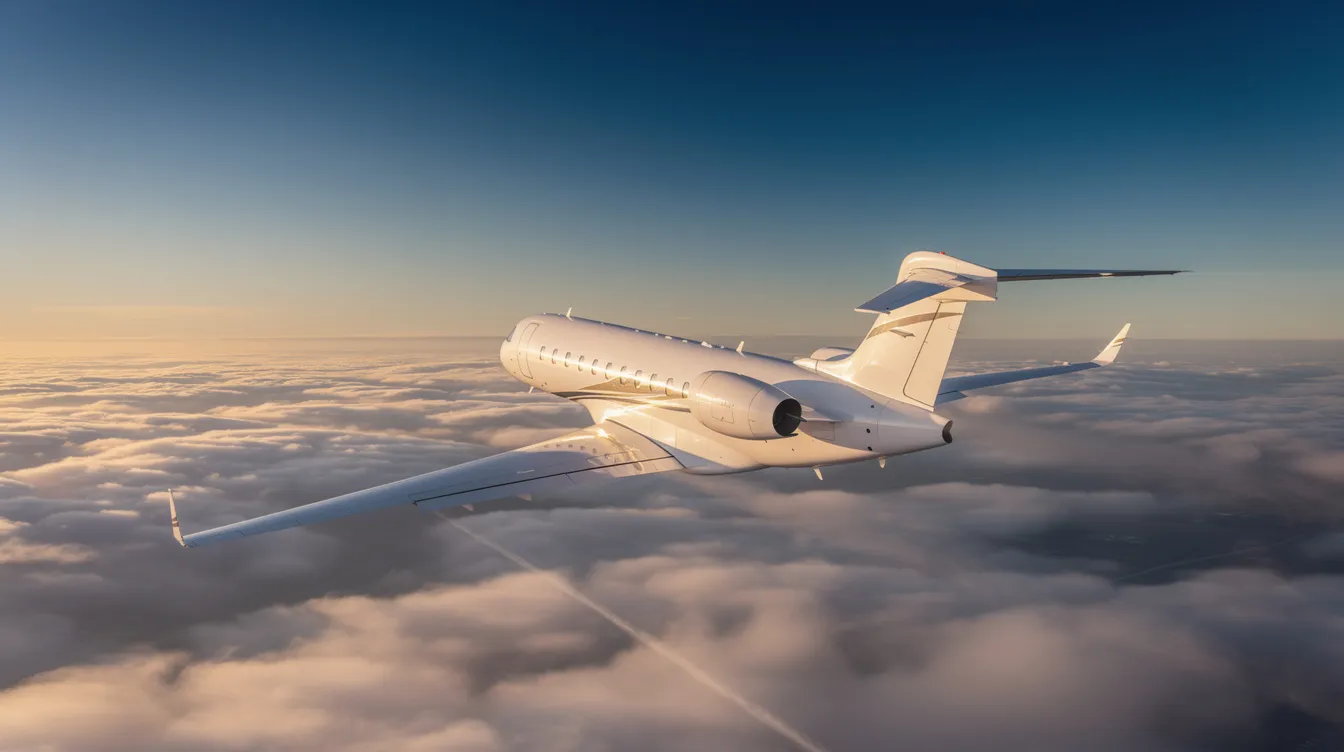
Why Gulfstream Models Matter for High-Performance Business Aviation
Consider the difference: a commercial first-class ticket from New York to Dubai routes you through a connection—often London or Frankfurt—adding hours of layovers, security queues, and schedule dependency. A Gulfstream model refers to one of Gulfstream Aerospace’s long-range business jets, spanning the super-midsize G280 to ultra-long-range aircraft such as the G700 and G800, with capabilities reaching 8,200 nautical miles and cruise speeds up to Mach 0.90. That means the same city pair can be flown nonstop, on your schedule, with passengers arriving rested and ready. This is not a marginal upgrade. It is a fundamentally different approach to global mobility.
Gulfstream Aerospace produces a family of business jets engineered for distinct mission profiles, and this guide is built for executives, frequent business flyers, and high-net-worth leisure travelers who want flexible, safe, and luxurious private travel without the capital burden of ownership. Below, you will compare Gulfstream models by range, speed, passenger capacity, cabin class, safety and sustainability advances, special-mission use cases, scale models, and how BlackJet integrates these aircraft into Jet Card membership tiers so members can match the right plane to the right trip. For travelers who fly regionally or internationally multiple times a year, understanding the Gulfstream lineup means making better decisions about nonstop reach, productivity, cabin comfort, and access to mission-specific aircraft through BlackJet rather than buying a jet outright.
Here is how the current Gulfstream model families compare at a glance:
Gulfstream Model | Typical Range (Mach 0.85) | Passengers | High-Speed Cruise |
|---|
G280 | ~3,600 NM | Up to 10 | Mach 0.84 |
G400 | ~4,200 NM | Up to 12 | Mach 0.88 |
G500 | ~5,300 NM | Up to 19 | Mach 0.90 |
G600 | ~6,600 NM | Up to 19 | Mach 0.90 |
G700 | ~7,750 NM | Up to 19 | Mach 0.90 |
G800 | ~8,200 NM | Up to 19 | Mach 0.90 |
Overview of Gulfstream Aerospace and Its Business Jet Lineage
The Gulfstream story begins with Grumman Aircraft Engineering Company, which first flew the propeller-driven Gulfstream I turboprop in 1958. That early aircraft proved that corporate travelers would pay for purpose-built cabin comfort and reliability. By 1966, Grumman had delivered the Gulfstream II—the company's first pure jet—and by 1968 the GII became the first business jet to fly nonstop from the United States to Europe, a milestone that defined the brand's ambition.
Civil aircraft production moved to Savannah, Georgia in 1967, where Gulfstream's manufacturing site remains today. The company was sold to American Jet Industries in 1978 under Allen Paulson, passed through Chrysler's ownership, and was ultimately acquired by General Dynamics in 1999—where it continues to expand its portfolio. Each ownership chapter added investment in development, from the GIV and GV platforms through to the current G500, G600, G700, and G800 generation.
Gulfstream's evolution from propeller-era turboprops to today's high-speed, long-range jets reflects a consistent design philosophy: clean aerodynamic wings, advanced avionics, and continuous range improvements that push the boundaries of nonstop travel. Gulfstream aircraft utilize advanced design philosophies for efficiency and performance—most visibly in the clean wing technology, sculpted winglets, and Rolls-Royce Pearl 700 engines that power the newest models.
What makes this lineage relevant for today's private traveler is continuity of purpose. Whether a G280 or a G800, every Gulfstream model shares the same safety-first engineering culture, the same Savannah-built production standards, and the same commitment to making each flight quieter, more efficient, and longer-reaching than the last.
Gulfstream Today in Numbers
Longest declared maximum range: G800 at ~8,200 NM
Highest maximum operating Mach number: 0.935 (G700/G800)
Maximum cruise altitude: 51,000 ft
Governments served worldwide: 35
New-generation models with Symmetry Flight Deck: G400, G500, G600, G700, G800
Gulfstream Model Families and Aircraft Categories
Gulfstream aircraft models map neatly to the cabin classes BlackJet clients most frequently request. Understanding these categories helps members match their mission—whether a short Caribbean hop, a transcontinental flight to Europe, or a groundbreaking nonstop leg to the far side of the Pacific.
G280 - Super-Midsize Efficiency: With a range of approximately 3,600 NM, the G280 handles regional and transcontinental missions with ease. Think New York to the UK, or Miami to the Caribbean and Mexico with reserves to spare. Ideal for shorter mission profiles where speed and cost efficiency are the priority.
G400 / G500 - Large Cabin, Mid-Long Range: The Gulfstream G400 has a maximum range of 4,200 nautical miles, making it a strong choice for North America to Europe transcon routes. The Gulfstream G500 has a maximum range of 5,300 nautical miles, extending reach to destinations like Canada to Brazil or the Netherlands to the Middle East. Both offer spacious cabins and high-capacity, large-cabin layouts for 16 passengers.
G600 - High-Speed Transatlantic Workhorse: The Gulfstream G600 can travel up to 6,600 nautical miles at Mach 0.85, covering routes like London to Singapore with one stop, or New York to the Middle East nonstop. Its size and range make it a complete solution for most intercontinental itineraries.
G700 / G800 - Flagship Ultralong-Range: These are the longest-range Gulfstream models. The G700's 7,750 NM reach and the G800's 8,200 NM capability mean true global nonstop city pairs. For members holding 25-hour or 50-hour Jet Card programs, these aircraft open every continent without fuel stops.
The choice between chartering a specific model ad hoc and having flexible model access via a Jet Card comes down to predictability. A Jet Card locks in hourly rates, guarantees availability windows, and lets you switch between categories trip by trip—without the stock risk of owning a depreciating asset. BlackJet’s 25+ Hour Jet Card program structures this access with fixed hourly pricing across mid, super-midsize, and large-cabin aircraft.
Longest Range Gulfstream Models: G800 & G700
The Gulfstream G800 is known as the longest-range business jet with a maximum range of 8,200 nautical miles at Mach 0.85. The Gulfstream G700 has a maximum range of 7,750 NM under the same cruise conditions. Both aircraft share a maximum operating Mach number of 0.935—significantly faster than United Airlines or any commercial carrier cruising at Mach 0.80–0.85. The Gulfstream G700 can cruise at a maximum speed of Mach 0.935, and the G700 has a maximum takeoff weight of 48,807 kg, allowing it to carry full passenger loads with fuel for its advertised range, positioning it among the newest flagship private jets redefining long-range business travel.
G800 vs G700 - Key Specifications
G800: ~8,200 NM at Mach 0.85 | ~7,000 NM at Mach 0.90 | Up to 19 passengers | Up to 4 living areas | 16 panoramic oval windows
G700: ~7,750 NM at Mach 0.85 | ~6,650 NM at Mach 0.90 | Up to 19 passengers | Up to 5 living areas | 20 panoramic oval windows
Real-world city pairs these ranges unlock:
Los Angeles to Sydney (~6,500–7,500 NM depending on routing): G800 nonstop; G700 nonstop in favorable winds
New York to Hong Kong (~6,800 NM): Both models nonstop
London to Buenos Aires (~5,900 NM): Either model with generous reserves
Dubai to Lancaster, Pennsylvania (~6,200 NM): Nonstop, no commercial equivalent
BlackJet member scenario: An executive based in New York needs to reach London for a Friday board meeting, then continue to Dubai for an investor dinner the same evening. A G700 departs JFK pre-dawn, lands at Farnborough by early afternoon. After a two-hour meeting on the ground, the same aircraft pushes on to Dubai, arriving by late evening local time. Two major financial centers in one calendar day, zero overnight hotel stays. That is what ultralong-range capability delivers even on shorter individual legs: flexibility in routing, the ability to detour around weather, and higher cruise altitudes for smoother rides.
High-Speed Advantage: Mach 0.90+ and What It Means for You
High-speed cruise capabilities for Gulfstream jets enhance mission efficiency in measurable ways. When a G700 or G600 cruises at Mach 0.90 versus the Mach 0.80–0.85 typical of long-haul airliners, the time savings compound across every segment. On a New York to London leg of roughly 3,450 NM, flying at Mach 0.90 shaves approximately 20–30 minutes compared to Mach 0.85. On longer routes—Dubai to Singapore, or São Paulo to Johannesburg-the savings can reach 30–40 minutes per leg.
The trade-off between high speed and fuel burn is real, but Gulfstream's newer designs mitigate the penalty. Clean wing technology, advanced winglets, and the Pearl 700 engine platform reduce drag and improve specific fuel consumption, allowing members to fly fast without disproportionate cost. For buyers weighing whether to own or access aircraft via membership, understanding the features of a $20 million private jet helps put these performance gains in financial context. The result is that Mach 0.90 on a G700 is a practical everyday cruise setting, not an emergency sprint.
For BlackJet members, this translates into compressed itineraries: same-day out-and-back meetings between global financial centers, fewer overnight stays that disrupt family life, and the ability to schedule tighter connections at private terminals where ground time is measured in minutes, not hours.
Example time savings at Mach 0.90 vs Mach 0.85:
New York–London: ~25 minutes saved
Dubai–Singapore: ~20 minutes saved
Los Angeles–Tokyo: ~30 minutes saved
Miami–São Paulo, Brazil: ~15 minutes saved
Cabin Experience Across Gulfstream Models: Living Areas, Light, and Sleep
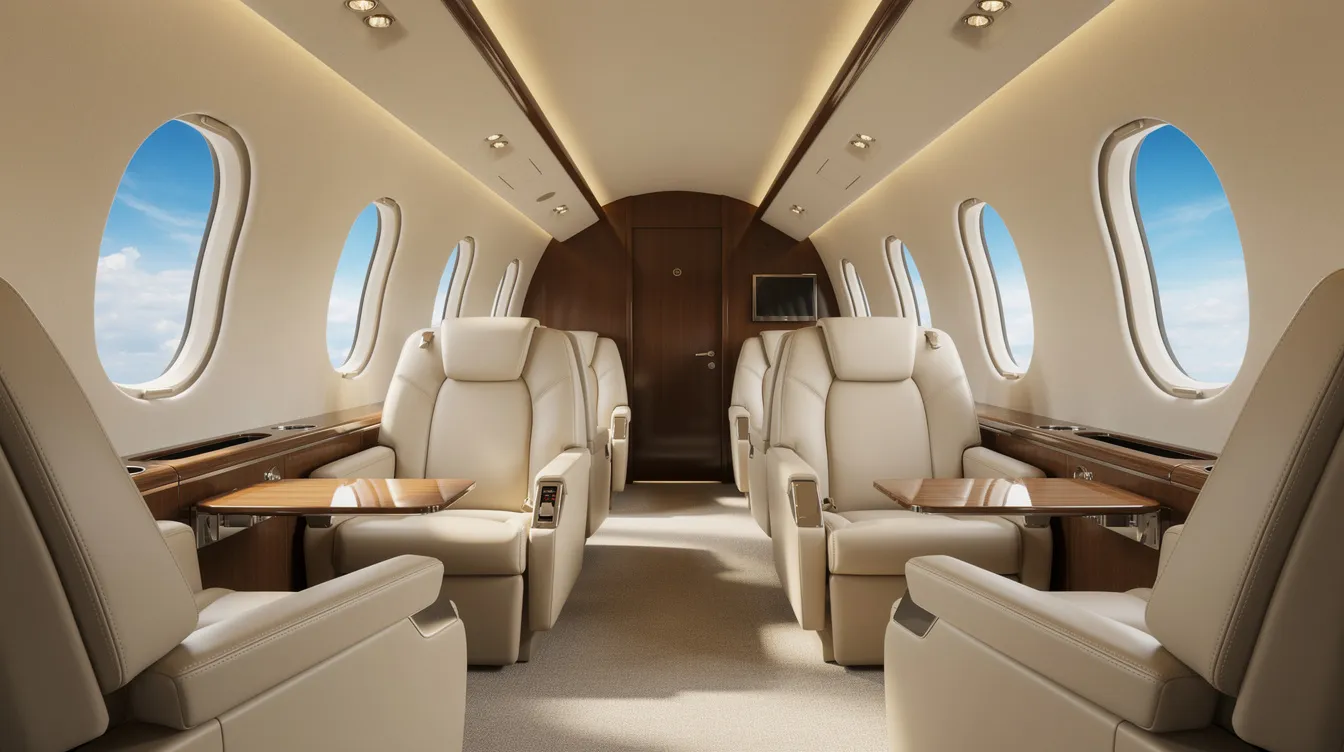
Gulfstream's cabin philosophy treats the aircraft interior as a series of distinct living spaces rather than a single tube of seats. Cabin designs across Gulfstream models include multiple living areas for luxury—from two on super-midsize jets to up to five on the G700 and G800. For larger groups, these layouts directly support private jet missions for 15 passengers that require both workspace and true sleeping capacity. The G700 features up to five living areas in its cabin: a forward lounge, conference and dining zone, entertainment area, private stateroom, and crew rest space. This allows passengers to work, dine, and sleep in genuinely separate environments while helping owners or operators create a cabin layout matched to passenger preferences or mission needs.
The G700 includes 20 panoramic oval windows—the most of any Gulfstream—flooding the cabin with natural light and expanding the subjective sense of space. Smaller models like the G400 carry ten large windows, still offering a dramatic advantage over the porthole-size openings on many competitors.
Work
Conference tables with power and connectivity for full productivity on 6–15 hour legs
G700 handcrafted seats that convert into beds, allowing seamless transitions between work sessions and rest
Rest
Up to 13 sleeping berths on ultralong-range layouts; 5–6 on super-midsize configurations
Dedicated staterooms with closing doors on the G700 and G800, creating genuine privacy
Well-being
Gulfstream aircraft are equipped with class-leading low cabin altitudes for passenger comfort. The G700 cabin altitude is 866 m at 12,497 m cruise altitude-significantly lower than commercial jets, reducing fatigue and jet lag
The G700 offers 100% fresh, plasma-ionized air every two to three minutes, never recirculated
Sound levels inside the cabin are among the lowest in business aviation, allowing uninterrupted sleep on overnight segments
For BlackJet clients flying long-range private jets on 10-plus-hour missions, these are not amenities—they are performance tools. You arrive in condition to step directly into a boardroom or onto a site visit.
Avionics and Safety: Symmetry Flight Deck and Vision Systems
The Gulfstream Symmetry Flight Deck features active-control sidesticks and advanced touchscreens, replacing traditional yokes and steam-gauge displays with an intuitive pilot interface. This cockpit architecture—standard on the G400, G500, G600, G700, and G800—reduces pilot workload through Phase-of-Flight automation, which handles repetitive tasks based on current flight conditions.
Vision systems are where Gulfstream separates itself from nearly every competitor. Combined Vision Systems merge synthetic terrain imagery with enhanced flight vision from infrared sensors, creating a 3D representation of terrain and runways on dual head-up displays. The practical benefit: pilots can safely approach airports in low-visibility conditions that would force airlines to divert, expanding the number of airports accessible to your mission.
Predictive Landing Performance Systems display real-time stopping distance data, factoring in runway conditions, aircraft weight, and approach speed. This reduces runway overrun risk—a concern at shorter or wet runways that smaller regional airports often present.
Key Gulfstream safety technologies every frequent flyer should know:
Active-control sidesticks with tactile feedback
Dual head-up displays with Combined Vision Systems
Synthetic Vision providing complete terrain awareness
Predictive Landing Performance for real-time stopping calculations
Phase-of-Flight automation reducing human error
51,000 ft service ceiling, well above commercial traffic and most weather
BlackJet sources operators holding top-tier safety certifications—ARGUS Platinum, Wyvern Wingman, IS-BAO Stage II/III-and prioritizes partners flying modern aircraft equipped with these avionics suites.
Sustainability Advancements in the New Gulfstream Fleet
Gulfstream's next-generation fleet achieves 33% fuel-efficiency gains compared to legacy models on equivalent missions. On a 3,000 NM leg at Mach 0.85, a G400 burns roughly one-third less fuel than the G450 it replaces—a meaningful reduction in both operating cost and environmental impact, and aligned with how the latest-generation private jets prioritize efficiency alongside speed and comfort.
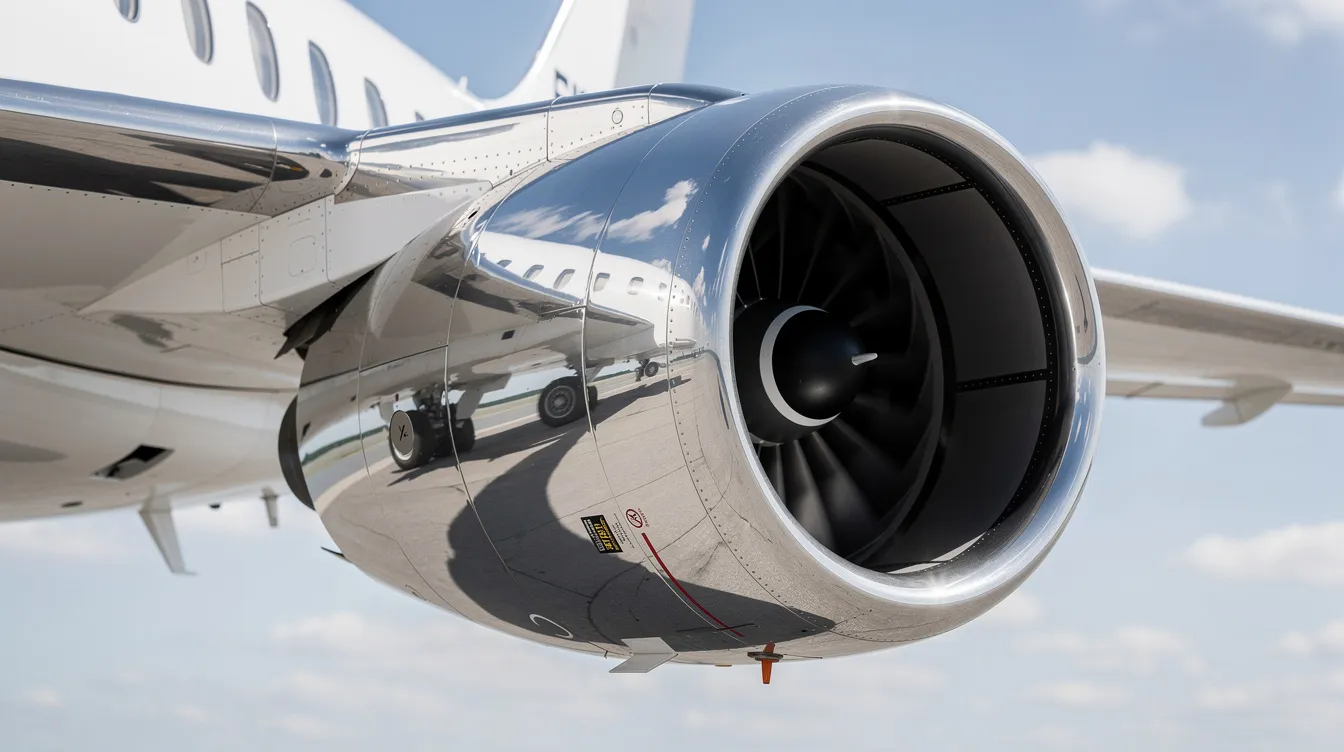
Gulfstream's aerodynamic design supports fuel-efficient flight through clean wing technology, advanced winglets, and fuselage refinements that cut parasitic drag. Gulfstream aircraft feature Rolls-Royce Pearl 700 engines on the G700 and G800, and Pratt & Whitney PW812GA engines on the G400—both platforms optimized for lower emissions and full compatibility with sustainable aviation fuel blends. When compared with the most expensive private jets in the world, these platforms balance ultra-luxury expectations with measurable sustainability gains. Gulfstream has used SAF on milestone flights, including the G400's first flight in August 2024.
Sustainability pillars in the new Gulfstream fleet:
Aircraft efficiency: Clean wing design, reduced drag, lighter structures deliver up to 33% improvement in fuel burn per mission
SAF-readiness: All current-production Gulfstream engines are approved for SAF blends, reducing lifecycle carbon emissions without sacrificing range or high-speed performance
BlackJet carbon offset approach: Every BlackJet flight is carbon offset by default—at no additional cost to the member. Placing members on newer, more efficient Gulfstream aircraft further lowers the environmental footprint of each journey
Government and Special Mission Gulfstream Models
Gulfstream aircraft are used by 35 governments worldwide, with approximately 200 aircraft serving military and government roles globally. The C-37A and C-37B, based on the G550 airframe, serve as executive transport for senior U.S. government officials. Other nations use modified G650 and G600 variants for heads-of-state transport, allowing leaders to reach destinations from the UK to Canada to the Netherlands without reliance on commercial schedules.
Government mission types extend well beyond executive transport. Modified Gulfstream platforms perform medical evacuation, atmospheric research, intelligence and surveillance reconnaissance, and airborne early warning duties. These are roles where failure is not an option—where range, reliability, and the ability to fly above adverse weather are existential requirements, not preferences, similar to how the largest private jets for sale and charter are built to support complex global itineraries for corporate and state users.
While BlackJet does not operate government-configured aircraft, the same core airframes, safety philosophies, and production standards underpin privately configured models. When a government trusts a Gulfstream to carry a head of state across the Atlantic, it validates the platform for every private mission that follows.
C-37A/B (G550-based): U.S. government executive transport
G650-based variants: Heads-of-state transport for multiple nations
Special mission G550/G600: Surveillance, reconnaissance, and atmospheric research
Gulfstream Scale Models and Collectibles for Enthusiasts
Beyond the full-size jet, the Gulfstream model has a dedicated following among aviation enthusiasts and collectors who add detailed replicas to their offices and homes.
Popular product example: A 1/200 scale NG Models Gulfstream C-37B USAF replica—available on Amazon and specialty aviation sites—runs around the $150 price point. These are display-quality pieces built with accurate livery, registration markings, and proportional detail, and often complement office spaces where decision-makers also evaluate BlackJet’s premium private jet services and Jet Card programs.
OEM and broker use: Physical models and cabin mock-ups are often used to help prospective buyers or charter clients visualize cabin layouts, seating configurations, and living areas before committing to a specific aircraft model. They are especially useful when comparing different private jet sizes and cabin classes for a given mission profile. You can order these from dedicated aviation model retailers and simply add to cart for delivery.
BlackJet's focus: BlackJet's priority is access, not selling collectibles. However, these scale models can help members better understand the aircraft categories they select in the app, making the choice between a super-midsize and ultralong-range cabin more tangible. For a deeper look at airplane models across manufacturers, explore our dedicated guide.
How Gulfstream Models Fit into BlackJet Jet Card and Charter Solutions
BlackJet integrates multiple Gulfstream aircraft models into its network rather than tying members to a single tail number or operator. This means a member's 50-hour Jet Card can access a G280 for a Tuesday meeting circuit through the Caribbean and Mexico, then a G700 for a Friday departure to Europe—all under the same membership, with consistent safety standards and transparent pricing that aligns with broader jet card pricing structures and benefits.
The contrast with ownership is stark. Buying a Gulfstream jet involves capital outlay often exceeding $70 million for a G700-class aircraft, plus annual crew salaries, hangar fees, insurance, and maintenance. For travelers primarily focused on economics, there are also more affordable private aircraft options that can be accessed via charter or Jet Cards without full ownership. With BlackJet's Jet Card, you pay predictable hourly rates, carry no asset risk, and gain the flexibility to choose your cabin class per trip. No management headaches. No depreciation.
How a member requests a Gulfstream aircraft through BlackJet:
Define the mission: Enter origin, destination, dates, and passenger count in the BlackJet digital booking platform
Receive options: The platform surfaces available aircraft categories with real-time pricing—from super-midsize through ultralong-range
Select your category: Choose the Gulfstream model family that fits your range, size, and comfort needs
Confirm with concierge: BlackJet's 24/7 support team can recommend the optimal model based on baggage requirements, runway constraints, and schedule preferences
Fly: Arrive at the private terminal; your aircraft, crew, and ground services are ready. Complete the trip, and your Jet Card hours are debited accordingly

Choosing the Right Gulfstream Model for Your Mission
Selecting the right Gulfstream model starts with four variables: trip distance, passenger count, work-versus-rest priorities, and airport constraints. Here is a simple decision framework that complements broader guides on choosing among private jet size categories:
Trip distance: Short haul (under 2,000 NM) favors the G280 for efficiency. Transcontinental (2,000–4,500 NM) suits the G400 or G500. Intercontinental (4,500–6,600 NM) calls for the G600. Ultralong range (6,600+ NM) demands the G700 or G800, while travelers with tighter budgets might instead consider the cheapest private jet options for regional missions.
Passenger count and baggage: Traveling with a team of 12 carrying golf equipment or ski gear? The large-cabin G600 or G700 offers both the space and baggage volume. For even larger groups approaching airline charters, private jets for up to 50 passengers may be more appropriate. A solo executive or couple on a short hop needs only the G280.
Work vs. rest: If the mission requires a full boardroom setup and separate sleeping quarters for overnight segments, the G700's five living areas are the right choice. For daytime hops, the G500's conference layout is more than sufficient.
Common scenarios and recommended Gulfstream categories:
Board meeting circuit (New York → Chicago → Dallas → New York): G280 or G500-efficiency and speed on domestic legs
Global family vacation (London → Maldives → Bali): G700 or G800—ultralong range with sleeping for the entire family, allowing you to reach remote destinations and expand your options
Investor roadshow (San Francisco → London → Frankfurt → Dubai → Singapore): G600 or G700—high-speed cruise compresses the schedule across four time zones in under a week
BlackJet advisors serve as partners who translate your itinerary into an optimal aircraft recommendation, balancing cost, speed, and comfort. For travelers exploring options beyond whole-aircraft charter, understanding how to buy a seat on a private jet can further expand accessible mission profiles. The success of any mission depends on matching the right aircraft to the right route.
Safety, Certification, and Operational Standards on Gulfstream Flights
A modern Gulfstream airframe is only part of the safety equation. Operator standards, pilot experience, and maintenance regimes are equally critical. BlackJet requires partner operators to hold third-party safety certifications that represent the highest tier in business aviation, making safety a non-negotiable priority for every flight delivered to members, comparable to the benchmarks used to evaluate top private jet companies worldwide.
Advanced Gulfstream avionics—Symmetry Flight Deck, combined vision systems, predictive landing performance—interact with strict operating procedures to maximize safety from taxi to landing. But technology alone is not enough. BlackJet's operational support layer includes real-time flight tracking, weather monitoring, and 24/7 dispatch that helps crews use the complete performance envelope of Gulfstream models safely, even when routing around unexpected terrain or weather systems.
What BlackJet checks before approving a Gulfstream operator for your flight:
ARGUS Platinum or Wyvern Wingman certification
IS-BAO Stage II or III compliance
Pilot minimum flight hours and type-specific experience on the expected Gulfstream model
Maintenance records and airworthiness status received and verified before dispatch
Insurance coverage meeting or exceeding industry benchmarks
FAQs About Gulfstream Models and BlackJet Access
Which Gulfstream model has the longest range? The Gulfstream G800 holds the title with a maximum range of approximately 8,200 nautical miles at Mach 0.85—enough to connect virtually any two cities on Earth nonstop.
How many passengers can sleep on a G700? Up to 13 passengers can sleep on a G700 in certain cabin layouts, thanks to handcrafted seats that convert into beds and a dedicated stateroom with a closing door.
Can I request a specific Gulfstream model with my Jet Card? Yes. BlackJet members can request a specific aircraft category or model when booking. Availability is subject to fleet positioning, but the concierge team works to match your preference.
How do long-range capabilities affect pricing? Larger, longer-range aircraft like the G700 and G800 carry higher hourly rates than super-midsize models. However, nonstop routing can reduce total trip cost by eliminating fuel stops, crew overnight fees, and landing charges at intermediate airports. Understanding overall jet card pricing and cost drivers also helps forecast the budget impact of choosing longer-range Gulfstream models.
Are Gulfstream flights with BlackJet carbon neutral? Yes. BlackJet offsets carbon emissions on every flight at no extra cost to members. Pairing offsets with newer, fuel-efficient Gulfstream models—built with clean wing technology and next-generation engines—further reduces the environmental impact.
How far in advance do I need to book? Peak-season international travel on ultralong-range aircraft benefits from 48–72 hours' notice. Domestic and super-midsize flights can often be confirmed with as little as 24 hours' lead time. The earlier you start the booking process, the more options are available.
What is the future of Gulfstream's lineup? The G400 is expected to enter service after completing its current flight test and certification program, with deliveries anticipated in the near future. Gulfstream continues investing in development to expand its model range further, which will influence how jet card programs for frequent flyers structure access to new-generation aircraft.
Next Steps: Exploring Gulfstream Access with BlackJet
Gulfstream models represent a strategic asset for global travelers: unmatched range, high-speed performance, advanced cabins, and a safety pedigree validated by decades of private and government service. Thanks to the breadth of the Gulfstream family, there is an aircraft for every mission—from a short domestic leg to a nonstop trans-Pacific crossing.
With BlackJet, you access this capability without the complexity of ownership. No hangar leases, no crew management, no depreciation—just the right jet, delivered to the right terminal, at the right time, often via flexible 25-hour Jet Card solutions tailored to your annual flying profile.
Schedule a brief consultation with a BlackJet advisor to discuss your travel patterns and identify which Gulfstream categories fit your needs, whether you’re flying between global hubs or arranging private jet charters from cities like Karachi
Request a sample itinerary—for example, New York–London–Dubai on a long-range Gulfstream—with transparent pricing and timing
Explore BlackJet Jet Card options that include access to Gulfstream aircraft across multiple cabin classes, from super-midsize to ultra-long-range
Discover how BlackJet can reshape the way you travel. The world is within reach—on your terms.


 Sign up with google
 Sign up with Apple