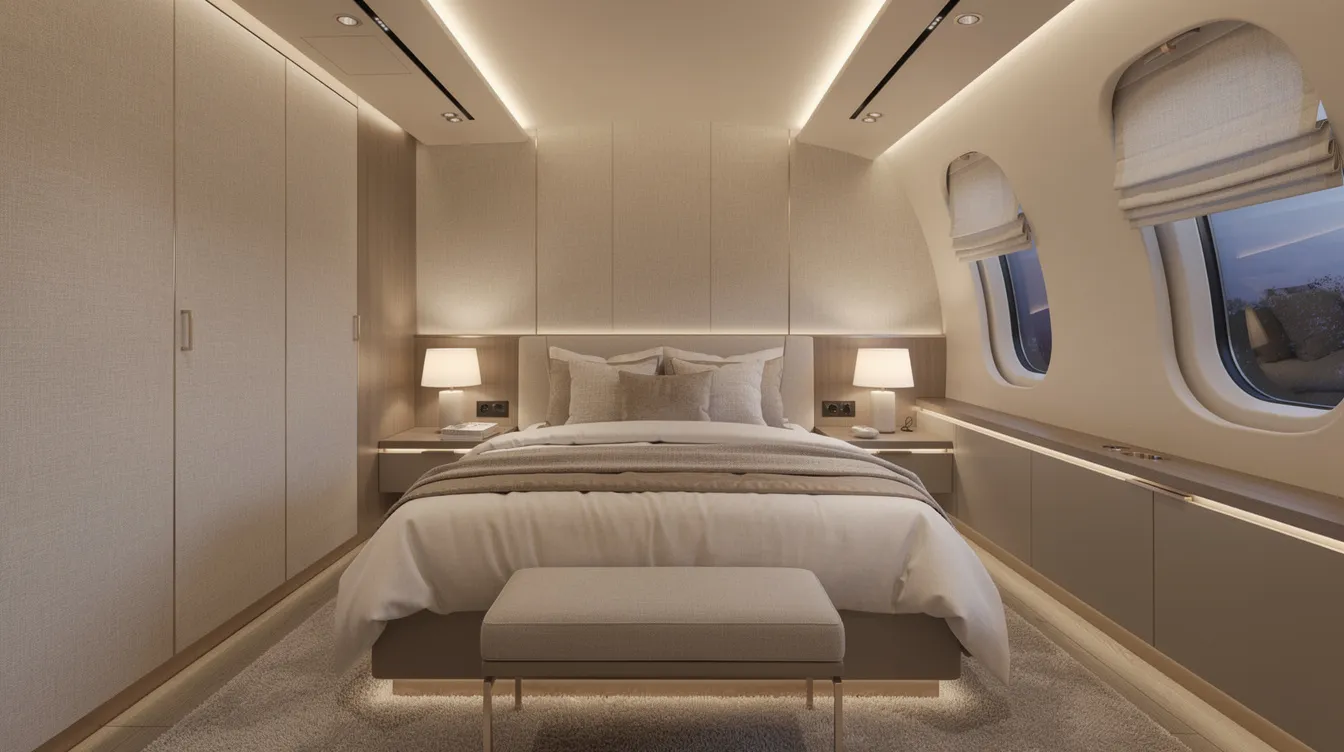
For executives managing global portfolios, founders closing international deals, and UHNW families crossing continents, time remains the scarcest resource. Private planes with beds convert what would otherwise be exhausting red-eye journeys into opportunities for restful sleep and sharp arrivals. Consider the significant difference: a commercial New York-to-London flight involves security queues, fixed schedules, and shared cabin noise, adding 10-12 hours to the door-to-door time. A bed-equipped private jet departs from a private terminal, flies direct in roughly 6.5 hours, and delivers passengers refreshed for immediate meetings.
This isn’t vanity luxury. It’s a strategic tool for intercontinental flights where arriving at your destination feeling alert can determine the outcome of an acquisition negotiation or board presentation.
Key Takeaways
A private plane with a bed transforms overnight flights into productive rest, saving 4-6 hours compared to commercial first class on routes like New York–London, while allowing passengers to arrive boardroom-ready.
True private jet bedrooms with enclosed suites are available on select aircraft, including the Gulfstream G650ER, Bombardier Global 7500, and Boeing Business Jet variants, while many other private jets offer lie-flat seats or convertible divans.
All sleeping areas must meet stringent safety certification standards, including 16G impact testing and fire-retardant materials, ensuring beds function as both comfort zones and survival areas.
Charter costs for bed-equipped ultra-long-range jets typically range from $13,000 to $16,000 per flight hour, with bizliners commanding $18,000 to $25,000+ per hour.
Modern private aviation increasingly emphasizes sustainability through carbon offset programs and Sustainable Aviation Fuel blends up to 30% on select routes.
Why a Private Plane with a Bed Is a Strategic Advantage
The mathematics of private aviation favors those who value productive hours over ticket prices. On a San Francisco–Shanghai sector, private jet travel eliminates the 3-4 hours lost to airport procedures on each end while providing comfortable sleeping arrangements that commercial flights cannot match.
Consider a practical scenario: a CEO departs Teterboro at 22:00 aboard a Bombardier Global 7500, sleeps six uninterrupted hours in the principal suite with the cabin dimmed to 68°F, and lands at London Farnborough around 09:30 local time. She proceeds directly to acquisition talks, having experienced quality sleep equivalent to a hotel night. The same journey on commercial first class—even with lie-flat seats—typically yields 2-3 hours of fragmented rest amid meal services, announcements, and neighboring passengers.
Private jets offer direct routing that saves 1-2 hours on transatlantic sectors alone. Combined with higher cruising altitudes than commercial flights and lower cabin altitudes (around 4,000 feet versus 8,000 feet on commercial aircraft), passengers experience up to 50% less dehydration and fatigue. These technical advantages transform long-haul flights from endurance tests into recovery periods.
The core pillars of modern business aviation extend beyond comfort. Safety certification ensures all beds withstand significant impact forces. Advanced climate control maintains optimal humidity. And carbon-neutral operations, enabled by newer aircraft and offsetting programs, address ESG demands from environmentally conscious executives.
Do Private Planes Really Have Beds and Bedrooms?
Understanding the distinction between “having a bed” and “having a bedroom” prevents booking disappointments. Light jets typically offer only reclining seats. Many super midsize jets provide lie-flat divans. Only select long-range jets and VIP airliners feature true private bedrooms with doors, permanent beds, and sometimes ensuite bathrooms.
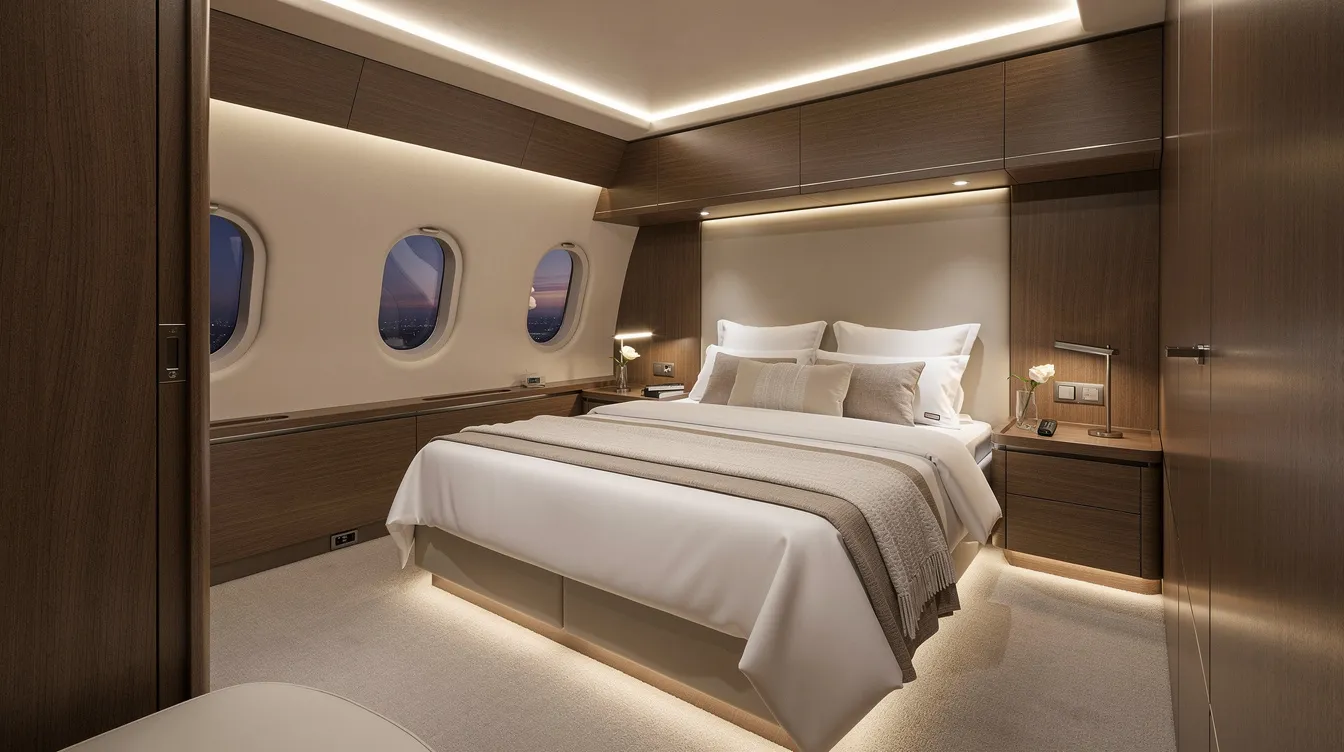
Private jet bedrooms are fully enclosed spaces designed for comfortable sleep during long journeys. They combine comfort, privacy, and functionality in a compact cabin space. These bedrooms typically feature full-size beds with high-quality bedding, soft lighting, and soundproofing to ensure restful sleep even at altitude. Many long-range jets and VIP airliners include built-in storage, wardrobes, and sometimes a small workspace, allowing passengers to travel without sacrificing convenience. Custom lighting and climate controls are standard on most private jet bedroom layouts, allowing passengers to create the ideal environment for sleep or relaxation. Altogether, these bedrooms provide a private retreat in the air, offering a level of comfort and exclusivity comparable to a five-star hotel suite.
Full bedrooms typically appear on missions exceeding 5-7 hours: New York–London, Miami–Buenos Aires, Dubai–Singapore, and Hong Kong–Sydney. Interior layouts vary dramatically by owner—one G650ER might feature three lie-flat divans, while another might include a master suite with separate sleeping quarters.
Confirming the exact sleeping configuration before booking is essential. All sleeping positions must be approved and equipped with certified seat belts that meet crashworthiness standards under FAA Part 25 and EASA regulations.
Types of Sleep Options on a Private Plane
A private plane with a bed can mean three distinct tiers: fully reclining seats, convertible beds, or a dedicated bedroom suite. Midsize and super midsize jets offer more facilities, such as larger cabins, additional lounge areas, and enhanced sleeping arrangements, making them ideal for longer flights and increased passenger comfort. The right choice depends on sector length, passenger count, and privacy requirements, and understanding the different types of private jets available helps align sleeping options with the right airframe. Technology factors—noise levels, cabin altitude, custom lighting systems—dramatically affect how restorative each option feels. Many private jets with beds also offer additional amenities such as entertainment systems, gourmet meals, and climate control to further enhance the sleep and travel experience. For discerning travelers, the top 10 best private jets in the world showcase how leading models integrate these sleep-focused features with range and performance.
Fully Reclining and Lie-Flat Seats
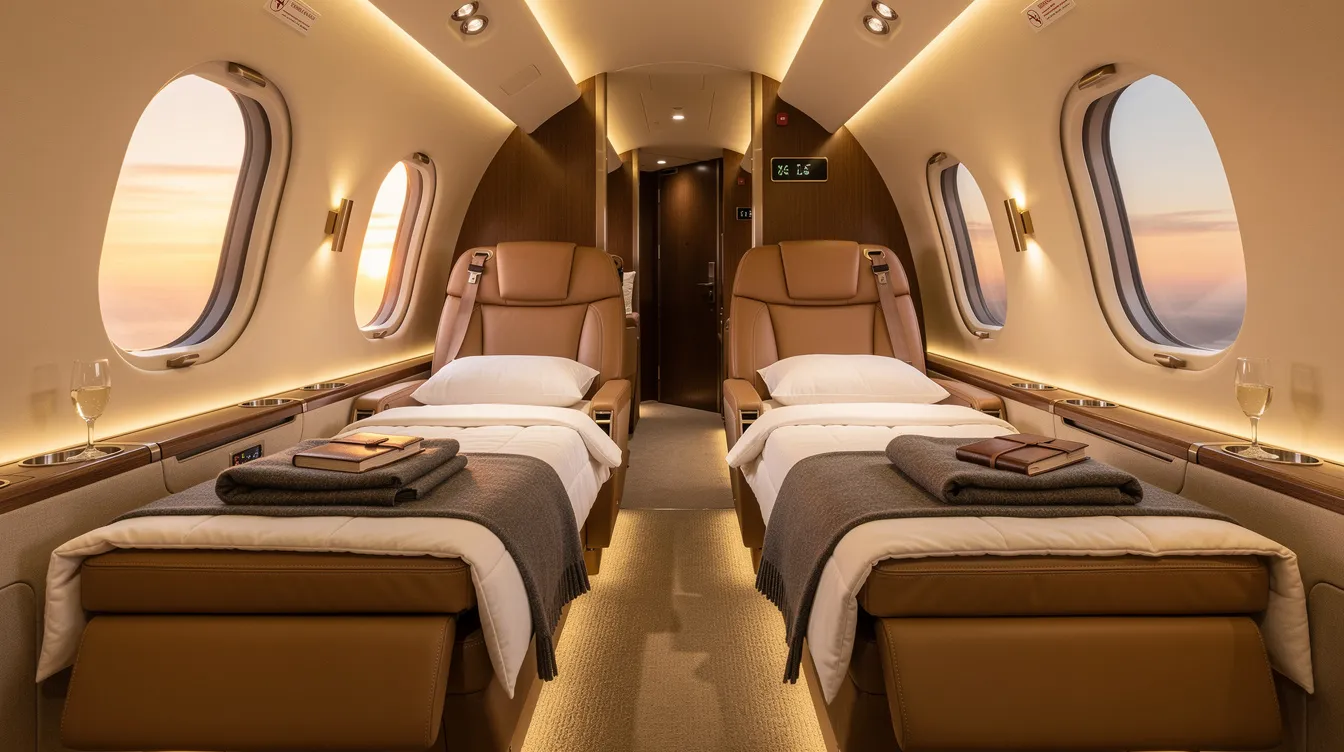
Many super midsize jets, such as the Bombardier Challenger 650, feature wide cabins with comfortable sleeping surfaces, including divans and seats that recline deeply or convert into 6-foot lie-flat berths. These are ideal for longer flights of 3-6 hours, such as Chicago–San Francisco, where passengers need a few hours of comfortable sleep rather than a full night.
Compared to commercial business class, private cabins deliver quieter environments (under 50 dB) with no interruptions from other passengers. High-density foam cushioning and cabin pressure around 4,500-6,000 feet equivalent reduce jet lag compared to airline cabins. These seats remain certified for takeoff and landing, making them the safest position during turbulence. Advanced systems such as low-altitude cabin pressure and circadian rhythm lighting help regulate sleep cycles on private jets.
Convertible Divans and Sofa-Style Beds
A medium-sized jet like the Embraer Praetor 600 or Cessna Citation Latitude typically features side-facing divans that convert into beds for 1-2 passengers. These sleeping areas provide more space than reclining seats but less privacy than enclosed rooms.
Typical bed dimensions run 75-80 inches long, narrower than a standard double bed. The cabin crew deploys hotel-quality, high-thread-count linens and sleep kits after takeoff, transforming daytime seating into nighttime berths. Divans used during takeoff and landing must be properly belted and comply with crashworthiness standards. This convertible seating approach maximizes daytime capacity while enabling restful sleep on overnight sectors.
True Private Bedrooms and Suites
A jet with a bedroom features a fully enclosed cabin with a fixed bed (often a queen-size), a door, dedicated storage, and sometimes a private bathroom with a shower. Aircraft commonly offering such private suites include:
Gulfstream G650ER: 7,500 nm range, featuring an aft master suite with a queen bed and soundproofed cabin
Bombardier Global 7500: 7,700 nm range, offering a four-zone layout including a principal suite with a permanent queen bed and an ensuite bathroom with a stand-up shower
Dassault Falcon 8X: 6,450 nm range, with a flexible aft double bed configuration
Airbus ACJ320neo: 6,000 nm range, equipped with a master bedroom featuring king-size beds and a private bathroom
Embraer Lineage 1000E: offers a master bedroom with a queen-size bed and a flexible cabin layout for separate living and sleeping areas
Boeing Business Jet (BBJ): can be configured to include multiple bedrooms, often featuring master suites with king-size beds
These layouts enable nonstop flights like Los Angeles–Shanghai or London–Buenos Aires. A typical ultra-long-range configuration might include a forward club section for meetings, a mid-cabin dining area, and an aft master bedroom with a wardrobe, 4K screen, and an ensuite bathroom. For larger groups, selecting the best private jet for 20 passengers or exploring top 16-seat private jet options for comfort and convenience ensures ample seating and dedicated rest areas while maintaining range and efficiency. These suites often feature additional amenities such as advanced entertainment systems, gourmet meals, and climate control to maximize comfort and convenience.
Private Jet Customization: Tailoring Your In-Flight Sleep Experience
One of the defining advantages of private aviation is the ability to customize every aspect of your journey—including how and where you sleep. Unlike commercial flights, where sleeping arrangements are fixed and often limited to reclining seats or shared cabin spaces, private jets offer a world of possibilities for those seeking true comfort on long-haul flights. Even travelers purchasing just a single seat on a private jet can access more personalized cabin environments than most first-class commercial products.
Customization begins with the choice of sleeping configuration. Whether you require a full-size bed for a restful night’s sleep, a private bedroom for complete privacy, or separate sleeping quarters for family members or colleagues, private jets can be tailored to your exact preferences. This flexibility allows passengers to create a comfortable environment that supports both relaxation and productivity, making a significant difference in how you arrive at your destination.
Private jet interiors can be outfitted with plush bedding, adjustable lighting, and climate controls, all designed to enhance the in-flight experience. Owners and charter clients can specify everything from the firmness of the mattress to the style of linens and the layout of the sleeping area. For those traveling with teams or families, multiple private bedrooms or partitioned sleeping zones can be incorporated, ensuring everyone enjoys restful sleep without compromise, even when using private jets configured for up to 50 passengers.
The ability to personalize your sleeping arrangements is more than a luxury—it’s a strategic asset. By allowing passengers to sleep comfortably and wake refreshed, private jets offer a level of well-being and readiness that commercial flights simply cannot match. Whether you’re preparing for a business meeting or seeking to maximize recovery on a long journey, the right customization ensures your private jet delivers the ultimate in comfort and performance above the clouds.
Design, Comfort, and Technology in Onboard Bedrooms
Bed Materials and Comfort Features
High-end materials include Egyptian cotton sheets (often 300+ thread count), down or hypoallergenic pillows, memory-foam mattresses, and plush bedding with satin sheets. The materials used in private jet bedrooms are often of the finest quality, including soft leather upholstery. Custom toppers cater to owner preferences. Built-in storage—wardrobes, overhead cabinets with fabric linings, under-bed compartments—keeps personal items secure. Every fixed element must be certified to withstand significant G-forces.
Lighting, Climate, and Noise Management
Modern private jet bedrooms use multi-zone LED lighting with presets for dining, relaxation, and sleep. Circadian-rhythm programs adjust color temperature (warm 2,700K for sleep, cool 6,500K for wake) during long-haul travel.
Independent climate control allows cooler temperatures for sleep while maintaining warmer settings elsewhere. The ability to customize the bedroom environment, including lighting and temperature, enhances passenger comfort. Soundproofing with acoustic insulation, double-pane windows, and dampened door seals keeps noise levels far below those in commercial cabins. High-end jets incorporate soundproofing technology, ensuring that external noise does not disturb passengers' rest. On a 10-hour Dubai–London sector, these systems enable 6-7 hours of a near-unbroken restful journey while engines operate outside the fuselage.
Lower cabin altitude and improved humidity reduce dehydration, headaches, and jet lag—particularly on routes exceeding 8 hours —ensuring passengers arrive at their destination well-rested.
Connectivity and In-Suite Technology
Long-range jets now offer high-speed satellite internet (often exceeding 15 Mbps), allowing passengers to work from bed, join encrypted video calls, or stream content. Integrated control systems—touchscreens or phone apps—manage blinds, adjustable lighting, temperature, and “do not disturb” indicators.
Suite entertainment includes large 4K displays, premium audio, and on-demand libraries. All electronics comply with aviation safety standards. Some operators encourage designated “sleep windows” where technology dims automatically, protecting rest while maximizing the in-flight experience.
Safety, Certification, and Regulations for Sleeping Onboard
Genuine luxury travel in aviation starts with safety. Every bed, divan, and mattress must meet strict regulatory standards before flying, and the same philosophy underpins the broader safety standards of private jet travel.
Certification of Beds, Divans, and Cabins
Berths and divans undergo dynamic testing—including 16G forward impact tests—for certification during takeoff and landing. Flame-retardant upholstery, curtains, and bedding comply with standards for heat release, smoke density, and toxicity.
Some side-facing divans are certified only for cruise, requiring passengers to use forward-facing certified seats during departure and arrival. Post-delivery modifications to private bedrooms must undergo supplemental type certification, not informal refits.
Operational Protocols and Best Practices
Professional operators monitor turbulence forecasts and may ask passengers to return to belted positions mid-sleep. Bedroom doors remain operable from outside for emergency access. Standard safety equipment includes smoke detectors, emergency lighting, and clear evacuation routes.
Cabin crew on long-range flights receive training in emergency medical response, decompression procedures, and fire management—critical capabilities when passengers sleep comfortably in separate compartments.
Costs: Chartering vs Owning a Private Plane with a Bed
Accessing aircraft with beds and full bedrooms represents a significant investment. For frequent business travelers, the calculation extends beyond cost per hour to include time saved and productivity preserved, which is why many opt for structured solutions like the BlackJet 25+ Hour Jet Card, a 50-hour jet card for flexible access, or a 100-hour private jet card program to lock in predictable access and pricing.
Chartering a Bed-Equipped Private Jet
Light jets and super midsize jets with lie-flat seats: $2,000–$10,000 per hour, suitable for routes such as New York to Miami and London to Geneva.
Ultra-long-range jets with bedrooms: $13,500 – $16,000 per hour, ideal for flights such as New York to London and Los Angeles to Tokyo.
VIP airliners (bizliners): $20,000 – $25,000+ per hour, used for multi-city delegation tours and 100-passenger charters.
Travelers evaluating these options often research the cost to charter a small private plane, the overall costs and considerations of private jet rentals, and the broader fundamentals of private jet charter pricing. Full-service platforms like BlackJet’s premium private aviation service streamline quoting and aircraft selection across these categories.
A typical New York–London round-trip on a G650ER (about 7 hours each way) runs into the low-six-figure range, including positioning and handling fees. Charter avoids capital outlay, depreciation, and maintenance risk—ideal for those flying fewer than 150-200 hours annually, especially when you weigh these advantages against commercial travel using a thorough cost comparison of chartering a private jet.
Owning or Co-Owning a Jet with a Bedroom
New ultra-long-range jets with bedroom capability command acquisition costs of $70-$80 million. Top-end Boeing Business Jet or ACJ completions frequently exceed $100 million, depending on interior complexity. Buyers exploring this level of commitment may also evaluate the most affordable private jet options on the market and other budget-friendly private aircraft options before moving up the spectrum, and often turn to premium UK private jets for sale curated by specialist brokers to match mission profile, budget, and cabin requirements.
Annual operating costs for heavy jets range from $500,000 to $4 million or more (crew, fuel, maintenance, insurance, hangar fees), leading some operators to explore private jet leasing structures and providers as an alternative to outright ownership. Buyers comparing ownership paths may look at the largest private jets available for sale alongside top private jets for sale under 10 million before committing to a specific asset. Fractional ownership—purchasing a 1/8 or 1/16 share—offers a middle ground with shared fixed fees plus occupied-hour charges, making it essential to understand both the depreciation of fractional jet ownership and the potential tax benefits of fractional ownership structures.
Sustainability-minded owners can specify SAF contracts and efficient routing policies to reduce environmental impact while maintaining complete comfort, while also consulting a comprehensive private jet price list of costs and access models to align budgets with mission needs.
Long Flights and Productivity: Maximizing Your Time Above the Clouds
When it comes to long-haul flights, productivity and comfort are not just luxuries—they are essential for making the most of your time above the clouds. Private jets offer a transformative solution, providing comfortable sleeping arrangements, private suites, and all the amenities needed to stay productive and relaxed during extended journeys. For business travelers, access to a dedicated bedroom suite on a private jet can significantly improve their ability to rest, recharge, and prepare for high-stakes meetings upon arrival.
One of the key factors in choosing the right aircraft for long-range travel is the availability of full bedrooms or separate sleeping quarters. Medium-sized jets like the Bombardier Global are renowned for their private bedrooms and ensuite bathrooms, allowing passengers to sleep comfortably and arrive at their destination feeling refreshed and ready for action. For those requiring even more space and luxury, ultra-long-range jets such as the Boeing Business Jet offer expansive cabins with multiple cabin zones, private suites, and the ultimate in restful sleep and privacy.
Private aviation has evolved to deliver a truly comfortable environment, with many private jets now featuring high-end materials, plush bedding, and custom lighting designed to create the perfect atmosphere for relaxation or productivity. Even light jets, while more compact, can provide comfortable sleeping arrangements with reclining seats or convertible seating, making them a smart choice for shorter long-haul flights where rest remains a priority.
For business travelers looking to maximize productivity during long flights, private jets offer more than just a place to sleep. With amenities such as gourmet meals, comfortable workspaces, and advanced entertainment systems, passengers can work, rest, and unwind in complete comfort. The ability to customize the cabin—whether it’s adjusting the lighting for a restful sleep, selecting the firmness of your mattress, or creating a quiet workspace—ensures that every journey is tailored to your needs.
Investing in private jet travel is also a significant investment in your own well-being and efficiency, especially when you partner with one of the top private jet companies for luxury travel. Frequent flyers can customize their aircraft interiors to include private bedrooms, ensuite bathrooms, and all the amenities required for both comfort and productivity. This level of personalization allows passengers to enjoy a complete comfort experience, making long-haul flights not just bearable, but genuinely enjoyable and restorative.
Planning Your Trip on a Private Plane with a Bed
Choosing the Right Aircraft and Layout
Thoughtful pre-trip planning maximizes the value of onboard beds. Collaboration with your aviation advisor strikes the right balance between private space for principals and communal areas for team discussions.
Align aircraft selection with the mission profile: super midsize jets provide more amenities for 4-6 hour routes; ultra-long-range jets with staterooms serve 7-14 hour legs; bizliners accommodate large delegations requiring multiple cabin zones. For example, travelers based in South Asia might prioritize aircraft and layouts optimized for private jet charters from Karachi to Europe or the Middle East.
Consider passenger mix—families may value separate bedrooms and media zones, while corporate teams prefer conference seating with a single principal suite. Specify minimum bed length, simultaneous sleeping positions, shower requirements, and workspace needs. Request recent interior photos before committing.
Building a Sleep-Focused Flight Schedule
Schedule departures to maximize continuous sleep windows: 22:00-23:30 departures for eastbound transatlantic flights allow 5-7 hours of uninterrupted rest. Cabin crew coordinates catering around planned quiet periods, serving light gourmet meals soon after takeoff.
Treat the flight like a controlled hotel night: change into loungewear, follow pre-sleep routines, and use blackout shades. Adapting cabin lighting gradually before landing helps manage jet lag, ensuring passengers reach their destination refreshed and ready for the business meeting ahead.
Future Trends: Smarter, Greener Private Jet Bedrooms
By the early 2030s, bedroom design on private aircraft will become more personalized, technology-rich, and sustainability-driven.
Adaptive Sleep Technology and Personalization
Emerging features include smart mattresses that adjust firmness mid-flight, temperature-controlled linens, and AI-driven lighting scenes based on passenger chronotype. Integration with personal health apps may align sleep schedules with circadian rhythms.
Cabin-level noise-cancellation and vibration-damping innovations will make future bedrooms feel even more like ground-based master bedrooms. Top-tier operators already experiment with pre-loading preferred pillows, mattress toppers, and scents for regular clients—delivering exceptional comfort through personalization.
Sustainable Materials and Efficient Aircraft
Cabin designers increasingly use low-VOC finishes, recycled fibers, and responsibly sourced woods to reduce environmental impact. Next-generation aircraft like the Gulfstream G800 (8,000 nm range) offer better fuel burn per seat-mile while still providing spacious bedrooms.
Sustainable Aviation Fuel adoption is projected to reach 10-20% globally by 2026, with some operators committing to 30% SAF blends on transatlantic sectors. True modern luxury travel means taking responsibility for the environmental footprint while enjoying a comfortable environment above the clouds.
Elevate your travel—effortlessly. For those who value time as the ultimate currency, bed-equipped private jets transform long-haul flights into strategic advantages. Whether through jet card programs or on-demand charter, access to aircraft with restful journeys and maximum comfort is available on your terms. Explore tailored options for your specific routes and discover how arriving at your destination feeling sharp becomes your new standard.
Frequently Asked Questions About Private Planes with Beds
Is a full bedroom worthwhile on flights under six hours?
For most travelers, enclosed bedrooms deliver the greatest value on overnight or ultra-long-haul flights exceeding 6-7 hours—routes like New York–London or Los Angeles–Honolulu. On 3-5 hour sectors, such as Toronto–Los Angeles, lie-flat seats or convertible divans typically provide sufficient rest. Principals who value absolute privacy or need daytime sleep during meetings en route may still benefit from a bedroom on shorter flights.
Can children safely sleep in private jet beds and bedrooms?
Children can sleep in divans or beds, but safety rules apply. They must use approved restraints during takeoff, landing, and turbulence—often requiring child seats or harnesses on certified seats. Infants typically travel in approved car seats secured to cabin seats, moving to beds only at cruise altitude when the crew confirms it’s safe. Discuss ages and requirements with the operator in advance.
How far in advance should I book a private plane with a bedroom?
For popular long-haul corridors during peak periods (Christmas, Davos, Monaco Grand Prix, Art Basel Miami), booking 4-8 weeks ahead improves aircraft selection. Outside peak seasons, 7-14 days may secure an ultra-long-range jet with lie-flat beds, though enclosed bedrooms and showers remain limited. Last-minute bookings are possible but may require flexibility on timing or a specific aircraft model.
Do private jet bedrooms usually include a shower?
Not all bedrooms include showers. Many ultra-long-range jets (Global 7500, certain G650ER configurations) and most bizliners can be specified with an ensuite or nearby shower room. Installing a shower affects weight, water capacity, and layout—some owners choose spacious bathrooms without showers instead. Charter clients should request a “confirmed shower” in writing if mid-flight freshening is essential.
Can I work effectively from the bedroom, or is it only for sleep?
Many modern bedrooms double as private offices, with desks, power outlets, fast Wi-Fi, and multi-position seating. Some aircraft feature fold-out tables that allow passengers to make confidential calls and review documents away from the main cabin. Coordinate with the operator to ensure the layout supports both rest and work, especially on flights where alternating between the two is planned.
Conclusion
A private plane with a bed offers more than just a place to sleep—it transforms the entire flying experience by combining ultimate comfort, privacy, and functionality. Whether you need restful sleep, a quiet workspace, or a tranquil retreat, these bedrooms provide a strategic advantage for business travelers and discerning leisure passengers alike. With fully customizable layouts, advanced technology, and high-end amenities, private jet bedrooms ensure you arrive refreshed and ready to face your day.
For those seeking the pinnacle of luxury and convenience in private aviation, services like BlackJet (https://www.blackjet.com/) provide seamless access to a curated fleet of private jets equipped with bedrooms and tailored amenities. BlackJet’s premium private aviation service simplifies booking and offers expert guidance, ensuring you find the right aircraft to match your travel needs. Partnering with experienced providers like BlackJet makes every journey a restful and productive experience above the clouds.


 Sign up with google
 Sign up with Apple