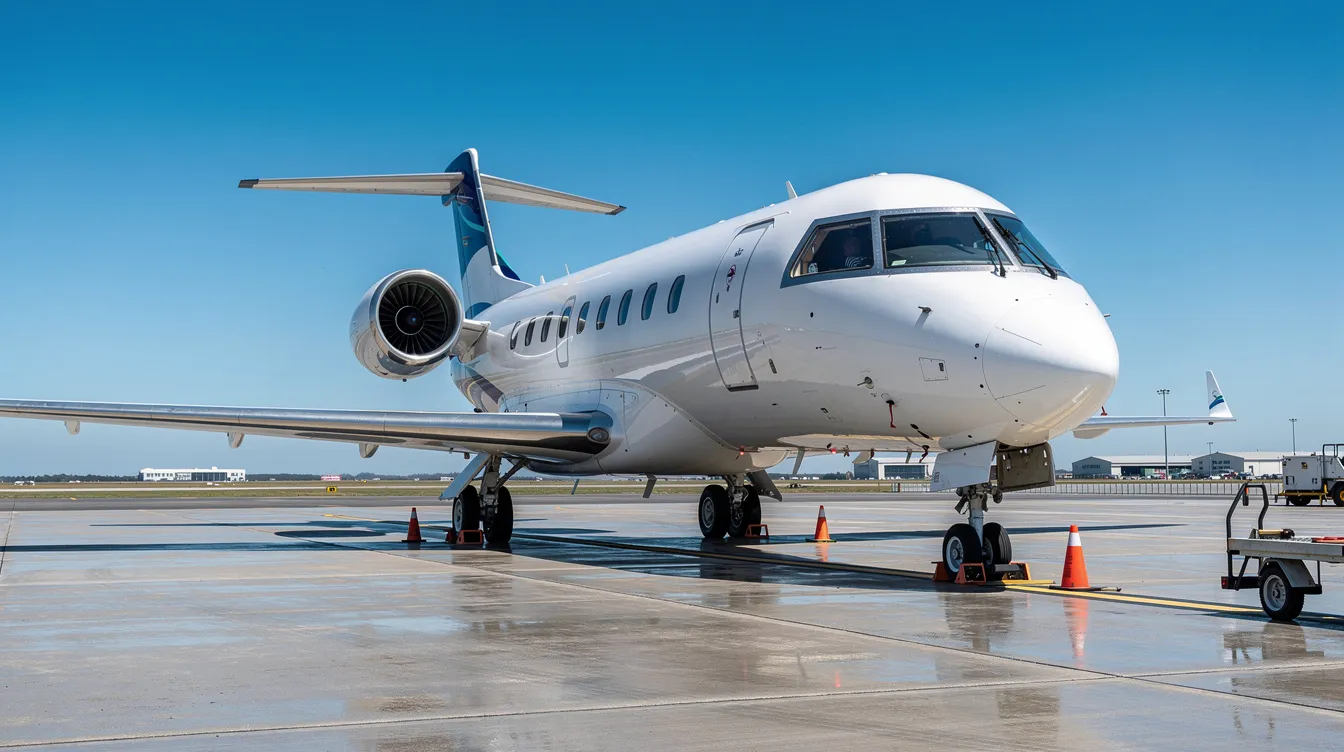
When you need to move 50 to 100 people as a single, cohesive group—without the compromises of commercial aviation or the complexity of coordinating multiple smaller jets—the Embraer ERJ 190 stands in a class of its own. This guide covers everything from technical performance to per-seat economics, helping you decide whether this aircraft belongs in your next travel program.
Key Takeaways for Busy Private Flyers
The Embraer ERJ 190 is a strategic aircraft for high-capacity private travel. Whether you are organizing corporate shuttles, moving a professional sports team between game cities, or staging an investor roadshow, the E190 fills the gap between smaller business jets and full-size narrow-body airliners with precision.
Group charter capacity: 50–100 passengers in high-comfort private layouts, compared with 97–114 in standard airline configuration. The flexibility to adjust seat pitch and amenities makes it suitable for anything from executive shuttles to incentive trips.
Practical range: The Embraer ERJ 190 has a maximum range of 2,400 nautical miles (~4,445 km), enabling non-stop flights such as New York–Dallas (~1,400 nm), New York–Miami (~1,100 nm), London–Athens (~1,250 nm), and Dubai–Istanbul (~1,550 nm).
Per-seat value: The aircraft delivers impressive economics when compared to chartering four or five midsize business jets for the same group. Depending on route and configuration, per-seat costs can rival or beat commercial business class fares.
Hourly charter pricing: Embraer 190 charter rates start around $14,000 per flight hour, with the average hourly rental rate for an E190 sitting at approximately $14,850. BlackJet's team provides customized, all-in proposals for every mission.
BlackJet member benefits: Carbon-neutral flights at no additional cost, operators curated for top safety ratings (Wyvern Wingman, ARGUS Platinum), and 24/7 trip support from request through wheels-down.
Overview of the Embraer ERJ 190 and the E‑Jet Family
The Embraer ERJ 190—also known simply as the Embraer 190 or E190-is a twin-engine, single aisle aircraft and a core member of Embraer's E-Jet family. It was designed to bridge regional jets and mainline narrow-bodies, and it does so with mainline capabilities that belie its regional roots.
The E jet family spans four models: E170, E175, E190, and E195. The ERJ 190 sits between the smaller E170/E175 variants and the larger E195, offering a capacity sweet spot for routes where bigger Boeing or Airbus equipment would be oversized.
Embraer launched the E-Jet program in February 1999 to fill a market gap. The E190's first flight took place on March 12, 2004, and it entered service with JetBlue—the launch customer—in November 2005. Its 2+2 cabin layout and the absence of middle seats transformed the passenger experience on one-to-three-hour routes.
High parts commonality across E-Jets (approximately 85–90%) simplifies maintenance and supports strong reliability. Airlines and operators benefit from shared tooling, training, and spares pools.
The E190 is designed for short to medium-haul routes of 300 to 1,500 nautical miles, making it ideal for corporate shuttles and regional group movements. It typically connects smaller cities to major airline hubs and serves as a replacement for older regional jets and smaller narrow-body aircraft. It is particularly compelling for frequency-sensitive markets.
Compared to larger narrow-bodies like the Boeing 737 or Airbus A320 with their 3+3 seating, the ERJ 190 offers a distinctly different passenger experience—wider seats per row, no middle seats, and quieter cabins-while still being powered by modern turbofans (the GE CF34 family) rather than older or heavier engine platforms. The aircraft is larger than traditional regional jets but smaller than mainline narrow-bodies, sitting precisely where many group charter missions need it.
Technical Specifications and Performance of the Embraer 190
Understanding the numbers behind the ERJ 190 helps you evaluate whether it fits your mission profile. Here are the specifications that matter most for private charter planning.
Specification | Value |
|---|
Overall length | 38.7 meters |
Wing span | ~28.72 m (94 ft 3 in) with winglets |
Cabin height | ~2.00 m (6 ft 7 in) |
Cabin width | ~2.74 m (9 ft) |
Maximum takeoff weight | 51,800 kg (~114,000 lb) |
Engines | 2× General Electric CF34-10E turbofans |
Maximum cruise speed | Mach 0.82 (~890 km/h) |
Typical cruise | Mach 0.78–0.80 |
Maximum altitude | 41,000 feet |
Standard maximum range | ~2,400 nautical miles |
Extended range variants | Up to ~2,850 nautical miles |
Passenger capacity (single class) | Up to 114 |
Two-class configuration | ~98–100 seats |
The E190 cruises comfortably at Mach 0.78–0.80 in normal operations, translating to roughly 500–530 knots. Maximum speed reaches Mach 0.82 (~890 km/h), keeping block times competitive with larger jets on overlapping routes.
Extended range variants of the E190 can reach up to 2,850 nautical miles, opening longer routes such as transatlantic positioning or deep intra-European legs. The longest recorded flight of an E190 was 2,694 nautical miles. Notably, the remote island of Saint Helena is served by this aircraft type, demonstrating its ability to operate into unique and constrained destinations.
The two General Electric CF34-10E engines are among the key advantages of the platform. They deliver better efficiency and lower noise signatures than older regional turbofans, contributing directly to the aircraft's impressive economics on missions under three hours.
Runway performance is another strength. The E190 can operate from shorter runways than larger jets—takeoff field lengths start around 2,056 meters at standard weight. Certain configurations are certified for steep approach operations at airports like London City, which matters enormously for private charters targeting secondary airports closer to final destinations.
Cabin Layout, Comfort, and Onboard Experience
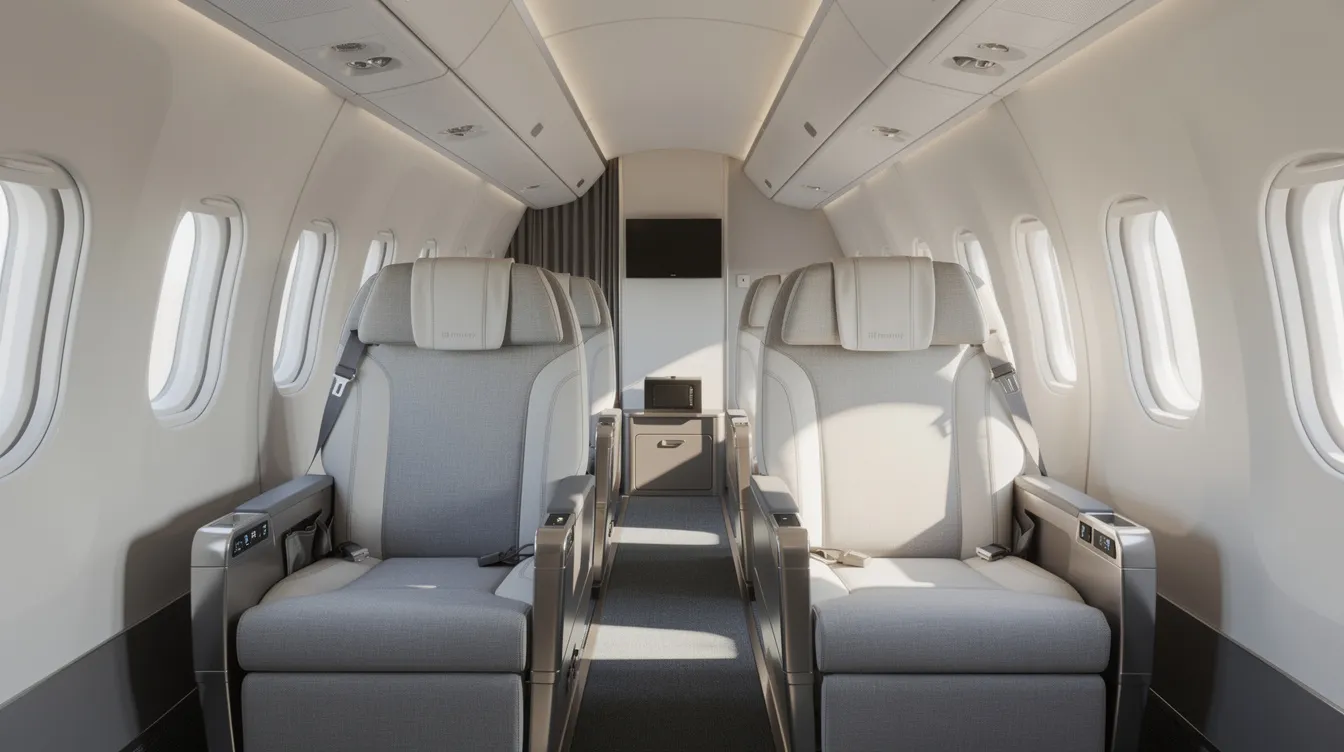
The ERJ 190 is a regional aircraft that delivers a mainline-style passenger experience. Its 2+2 seating configuration with no middle seats is the single most cited comfort advantage among passengers who have flown the type.
Standard airline layouts seat 97–114 passengers. In private or corporate shuttle configuration, operators typically install 50–100 seats with generous seat pitch—often 34 to 38 inches—compared with the 30–32 inches common on regional airlines. The E190 can carry up to 100 passengers in a two-class configuration while still offering one of the most spacious interiors in its class.
The cabin height is approximately 2 meters (6 ft 7 in), allowing most adults to stand comfortably. Overhead bin volume is roughly 0.06 m³ per passenger, and total underfloor cargo capacity reaches approximately 22.6 m³-enough to carry equipment, sports gear, or production materials alongside personal luggage.
Large windows provide more natural light than older aircraft, and the cabin is designed for a quieter experience with modern insulation. Many E190s in the charter fleet are equipped with LED lighting, in-seat power (USB and AC), and optional Wi-Fi and streaming IFE systems.
For BlackJet members, the onboard experience extends to bespoke catering—imagine a New York–Chicago breakfast shuttle with a curated menu—branded cabin touches for corporate clients, and privacy zones where configuration allows separation of executives or VIP guests, all while retaining the core advantages that define the cost of chartering a small plane versus commercial service, even when exploring the cheapest private jet options for smaller missions.
Special needs and accessibility are handled through advance coordination with BlackJet's support team. Whether you need space for medical equipment, oversized sports gear, or mobility accommodations, the E190's spacious interiors and generous cargo hold provide flexibility that smaller jets simply cannot match.
Impressive Economics: Why the ERJ 190 Works for Large Private Groups
The Embraer ERJ 190 delivers impressive economics for groups of 50–100 passengers—a range where it consistently outperforms both commercial business class and the alternative of splitting a group across multiple smaller private jets.
Consider this scenario: 80 executives traveling New York–Chicago (~700 nm each way, ~2 hours per leg). Chartering a single Embraer 190 at approximately $14,850 per hour yields a round-trip base cost near $59,400. Spread across 80 seats, that is roughly $743 per person—comparable to a last-minute commercial business class fare, with the privacy, schedule control, and group travel benefits of a fully chartered aircraft—very much in line with the dynamics explored in our guide to charter plane costs for 100 passengers. The alternative—four to five super-mid jets at $6,000–$8,000 per hour each-would cost $96,000–$128,000 for the same mission, with added complexity of coordinating multiple crews, slots, and ground handling.
Offering customers a higher-density but comfortable seating layout (70–90 seats with 34-inch pitch) spreads the total charter cost across more passengers while preserving a private, fully chartered environment—no strangers on board, no security lines, no connections.
The E190 has a lower fuel burn on shorter routes compared to larger aircraft, especially when benchmarked against some of the cheapest private aircraft options. Fuel consumption runs approximately 300–340 gallons per hour at cruise, and crew costs for a single aircraft are a fraction of what four separate flight crews would require.
BlackJet uses global market data and its vetted operator network to secure competitively priced Embraer 190 lift, passing savings and pricing predictability to Jet Card members who understand jet card pricing structures and value locked-in hourly rates.
That said, the E190's economics may suffer on very thin routes due to higher trip costs relative to a half-empty cabin. When passenger counts drop below 40, stepping down to an E170 or E175 may be more efficient. When counts exceed 110 or routes stretch beyond 2,400 nm, a larger narrow-body like an Airbus A320 becomes the better tool. BlackJet advises on right-sizing for every mission, including when full ownership-with its additional private jet pilot and crew costs—or a different size category of private jet makes more sense than charter.
Embraer 190 vs Other Regional and Narrow‑Body Jets
Discerning travelers compare the ERJ 190 not only to other members of the E jet family but also to aircraft like the Airbus A220 and Boeing 737-700. The differences are more than cosmetic.
The E190's 2+2 layout means no middle seats on any flight. The A220-100 uses a 2+3 arrangement, and the 737-700 uses 3+3. On two-to-three-hour flights—the E190's sweet spot-this distinction directly affects passenger comfort and willingness to travel.
In terms of range, the ERJ 190's maximum range of approximately 2,400 nautical miles covers the vast majority of regional and medium-haul itineraries. Larger narrow-bodies offer more range but at higher operating costs and with access to fewer airports.
Airport access is where the E190 truly separates itself. Its performance and size allow operations at more secondary and regional airports than larger narrow-bodies—think Teterboro instead of JFK, or Farnborough instead of Heathrow. This means shorter ground transfers and faster turnarounds for your group.
For groups of 30–60 passengers, smaller regional jets like the E170 or E175 may be better suited, offering lower fuel burn and simpler ground handling. BlackJet advises members on the optimal aircraft for every passenger count and route.
Scope clauses in North America restrict the E190's operation by regional airline partners of major carriers, which has historically limited its presence in domestic fleets operated by regional airlines. In the charter and private market, however, these restrictions do not apply, making the E190 freely available for group movements.
Many operators and charter clients favor the Embraer ERJ 190 within the E jet family for its balance of capacity, comfort, and operating cost. Air Canada and numerous other airlines have operated the type on mainline routes, a testament to its versatility.
Popular Routes and Use Cases for the ERJ 190 in Private Aviation
The Embraer 190 is a workhorse for premium group movements across North America, Europe, and the Middle East. Its range and runway flexibility open routes that larger jets cannot efficiently serve.
Sample routes within the E190's reach: New York–Miami (~1,100 nm, ~2.5 hrs), New York–Dallas (~1,400 nm, ~3 hrs), Chicago–Denver (~920 nm, ~2.5 hrs), London–Athens (~1,250 nm, ~3 hrs), Paris–Marrakesh (~1,200 nm, ~3 hrs), and Dubai–Cairo (~1,400 nm, ~3.5 hrs).
Corporate shuttle use cases dominate: weekly Silicon Valley–Seattle transfers for tech teams, London–Frankfurt runs for financial service firms, or short hops between manufacturing hubs. These scheduled group movements prioritize productivity and schedule control over everything else.
Sports and entertainment charters represent another major segment. Professional teams move between league cities with equipment and support staff on board, while touring artists and production crews travel with instruments and staging gear—all accommodated by the E190's generous underfloor cargo hold, or by alternative private jets for around 50 passengers when mission profiles call for different aircraft.
Incentive trips and large VIP events are natural fits: a Mediterranean wedding with 70 guests, an investor roadshow hitting three European capitals in four days, or a large family reunion in the Caribbean—similar to the itineraries highlighted in our overview of top private jets for 30 passengers and our guide to the best private jet for 15 passengers. The aircraft flew countless such missions in the years since it entered service.
Special missions—emergency evacuations, humanitarian deployments, or rapid repatriation flights—benefit from the E190's capacity, range, and ability to operate into constrained airports where speed of turnaround is critical.

Safety, Reliability, and Environmental Performance of the ERJ 190
BlackJet leads with safety and environmental stewardship when sourcing Embraer ERJ 190 aircraft for members. This is non-negotiable.
The E-Jet family has accumulated millions of flight hours worldwide, operated by dozens of airlines under FAA, EASA, and ANAC oversight. While no aircraft type is entirely free of accidents, the E190's safety record is strong, and incidents have been relatively rare—typically attributable to maintenance or procedural factors rather than design flaws. For broader context on aircraft safety, see our guide to the safest passenger planes.
Its fly-by-wire system enhances flight safety and operational efficiency, providing envelope protection that reduces pilot workload and prevents exceedances. Combined with predictive maintenance diagnostics, these systems contribute to the type's industry-leading dispatch reliability.
BlackJet's operator vetting prioritizes crews and operators with IS-BAO, Wyvern Wingman, or ARGUS Platinum credentials. The fleet delivered to BlackJet members meets or exceeds the latest airworthiness directives—including recent FAA-mandated inspections of overheat detection system components on certain ERJ 190-100 variants.
On environmental performance, the E190's modern wings and engines compare favorably with older regional and narrow-body jets on CO₂ per seat-mile. The E190-E2 generation, featuring a new engine (Pratt & Whitney PW1900G geared turbofan), a larger wing, a larger horizontal stabilizer, and redesigned wings, delivers approximately 17% improved efficiency over the original—good news for sustainability-minded travelers.
BlackJet's carbon-neutral policy automatically offsets every Embraer 190 flight hour for Jet Card members through certified climate projects, from verified reforestation to renewable energy initiatives, and is a core part of our broader premium private jet card and charter programs. Learn more about our approach to green private aviation.
Chartering an Embraer ERJ 190 with BlackJet
BlackJet is not an on-demand broker. Our Jet Card membership model, including the BlackJet 25+ Hour Jet Card, provides predictable access, transparent pricing, and consistent service standards—whether you are booking a light jet for four or an Embraer ERJ 190 for eighty.
BlackJet sources Embraer ERJ 190 and other E-Jet aircraft from a vetted global network rather than owning the fleet. This ensures flexibility in region, availability, and configuration without locking members into a single operator's limitations, and allows us to match each trip with the most suitable option across the full range of private jet sizes.
The process starts with defining your route, passenger count, preferred dates, and desired cabin layout—all-business, mixed classes, or high-density comfortable shuttle. BlackJet's team handles the rest.
Every proposal includes aircraft details, operator safety credentials, sample catering menus, Wi-Fi availability, and estimated block times—giving your travel or finance team everything needed to make an informed decision.
Concierge support extends to airport selection (choosing Teterboro vs. JFK, Farnborough vs. Heathrow), ground transportation coordination, and branded check-in signage if requested. The intended result is a seamless door-to-door experience.
When the ERJ 190 is not the perfect fit—too large, too small, or wrong range—BlackJet's team suggests alternatives, from long-range private jets to the best private jets for 20 passengers, focused 16-seat private jet options, or larger Airbus or Boeing narrow-bodies.
Embraer 190 Pricing, Cost Drivers, and Jet Card Advantages
Pricing an Embraer 190 charter is best understood in terms of total mission value rather than a single hourly rate, much like evaluating any private jet price list and options or broader private jet charter pricing. For large groups, per-seat value is where the real story emerges.
Primary cost drivers include: flight hours and distance, positioning legs (deadhead flights to reach your departure airport), airport and handling fees, crew duty time and overnights, seasonality, and notice period—similar to the variables outlined when assessing whether chartering a private jet is worth it and in broader discussions of what charter flights really mean. Landing fees vary by airport, with major hubs charging more than secondary facilities. Fuel surcharges are tied to current fuel prices and can shift week to week. Total trip cost depends on route, operator, and services selected.
Example itinerary: 70 passengers, Los Angeles–Denver return over two days (~850 nm each way). Estimated all-in cost: $70,000–$90,000 depending on operator, ground time, and services. That translates to roughly $1,000–$1,285 per seat round-trip-often less than two same-day commercial business class tickets on that route — when you understand the broader costs of renting a private jet and how private jet charter pricing compares with the cost of a 12-seater private jet for smaller groups. Final quotes depend on live market conditions.
Onboard services—premium catering, Wi-Fi upgrades, cabin branding, dedicated ground staff—affect the final costs. BlackJet itemizes every element so you see exactly where your budget goes.
BlackJet's Jet Card model offers prepaid hours, priority access during peak periods, and more predictable pricing structures for frequent corporate flyers, similar to the best jet cards for frequent flyers available in the market. Compare this directly with the economics of ad-hoc charter to see where membership pays for itself.
Every proposal is transparent and itemized, allowing finance teams to compare the Embraer ERJ 190 option directly with commercial group fares or the cost of multiple smaller jets.
How BlackJet's Technology and Support Simplify ERJ 190 Trips
Large-group private flights involve complex logistics—manifests, catering for dozens, multi-leg routing, and regulatory paperwork. BlackJet's digital tools and dedicated team are built to handle exactly this.
BlackJet's online and mobile booking interface lets members request an Embraer 190 or other aircraft by route, dates, and passenger count, then review curated options from vetted operators. The platform is designed for speed without sacrificing detail.
Real-time support is available 24/7: schedule changes, last-minute passenger additions, catering adjustments, or disruption management. If weather closes an airport or a meeting runs long, your flight desk responds in minutes—not hours.
Itineraries, manifests, contracts, and insurance certificates are shared securely through the platform, reducing email clutter for corporate travel managers and keeping sensitive information protected.
Sample scenario: a company planning a three-city European investor roadshow on an Embraer 190 (London → Frankfurt → Milan). BlackJet coordinates multi-leg routing, overnight crew planning, catering changes per city, and ground transfers—keeping the schedule on track while the team focuses on the roadshow itself.
Post-flight reporting includes a summary of flight hours used (for Jet Card members), sustainability impact data, and service feedback to refine future trips.
FAQ: Embraer ERJ 190 Charters with BlackJet
Here are the questions BlackJet's team hears most often from customers considering an ERJ 190 group charter.
How many passengers can the Embraer ERJ 190 comfortably carry on a BlackJet charter? The E190 can carry up to 114 passengers in a maximum-density airline layout. For private group charters, BlackJet recommends 50–100 passengers depending on desired legroom, amenity space, and whether you need room for equipment or cargo. Adjusting seat pitch from 30 to 36 inches meaningfully changes the experience and the capacity.
What is the luggage capacity on an Embraer 190? The underfloor cargo hold offers approximately 22.6 m³ of volume, plus overhead bins and under-seat storage. For bulky items—sports gear, instruments, medical equipment—advance planning with BlackJet ensures proper loading and weight distribution.
Is Wi-Fi available on all Embraer ERJ 190 flights? Many but not all E190 aircraft in the charter market are equipped with Wi-Fi. BlackJet can guarantee connectivity when it is required, specifying this at booking so the sourced aircraft meets your needs.
How far in advance should I book an ERJ 190 for a large event? During peak seasons (summer, holidays, major sporting events), several weeks to months of lead time is advisable for the best aircraft selection and pricing. Off-peak periods or less in-demand airports may allow shorter notice.
Can the Embraer 190 access smaller regional airports near my destination? Yes. The E190 is suited for operations at airports with shorter runways, and it can access many secondary airports that larger narrow-bodies cannot. BlackJet evaluates suitability on a case-by-case basis—for example, recommending White Plains over JFK in New York, or Biggin Hill over Heathrow in London.
Is the Embraer ERJ 190 suitable for VIP-level service, or should I choose a dedicated business jet? The E190 excels as a high-comfort shuttle for groups. For ultra-luxury requirements—private bedrooms, dedicated salons, bespoke interiors—a purpose-built VIP aircraft like the Embraer Lineage 1000 may be more appropriate, though at significantly higher cost. BlackJet recommends the right tool for every mission.
Conclusion: When the Embraer ERJ 190 Is the Right Choice
The Embraer ERJ 190 offers a rare combination of capacity, comfort, range, and impressive economics for 50–100 passenger missions. It is the aircraft that fills the gap when smaller business jets are too small and full narrow-bodies are too much.
Ideal for corporate shuttles, sports and entertainment travel, incentive trips, and large VIP events on routes up to about 2,400 nautical miles.
BlackJet's differentiators—safety-first operator selection, carbon-neutral flights, advanced booking technology, and around-the-clock human support—ensure that the experience matches the aircraft's capabilities. Learn more about our carbon-neutral flights and Jet Card membership benefits.
Discover how BlackJet can tailor an Embraer ERJ 190 or other E-Jet solution to your specific travel program or upcoming event. Speak with our team to explore what premier group travel looks like when every detail is handled for you. For more on aircraft sizing, see our guide to private jet sizes and explore options for long-range private jets.


 Sign up with google
 Sign up with Apple