Introduction
For business executives and high-net-worth individuals who operate across continents, time is the single most valuable asset. Intercontinental private jets exist to protect it. Here's what you need to know about the aircraft, costs, cabin experience, and access models that make nonstop global travel a strategic advantage rather than a logistical burden.
The Strategic Power of Intercontinental Private Jets
Consider a typical commercial itinerary from New York to Tokyo. With a connection through Los Angeles or San Francisco, door-to-door flight time stretches to 18–22 hours. Factor in check-in queues, layovers, and ground transportation on both ends, and you're looking at nearly a full day lost. A nonstop intercontinental flight on a Global 7500 or Gulfstream G650ER cuts that to roughly 14–15 hours, with private terminal processing adding just 20–30 minutes on the ground.
That gap widens when you account for access. Private jet travel typically allows access to thousands of airports not regularly served by commercial airlines - over 5,000 worldwide versus roughly 500 with scheduled carriers. This means business travelers can fly into Teterboro instead of JFK, Farnborough instead of Heathrow, or Haneda instead of Narita, shaving hours off ground transfers and enabling same-day business meetings across continents.
Intercontinental private jets reduce travel stress and enhance productivity by offering nonstop global connectivity. BlackJet makes this capability available through its Jet Card programs - a carbon-neutral private aviation solution that unlocks intercontinental missions without the capital, depreciation, or management burden of ownership, with additional membership options detailed in its premium private jet card programs. Lower cabin altitude reduces jet lag, real-time flight tracking keeps clients informed, and guaranteed access to long-range and ultra-long-range jets ensures aircraft availability when it matters most.
What Counts as an Intercontinental Private Jet?
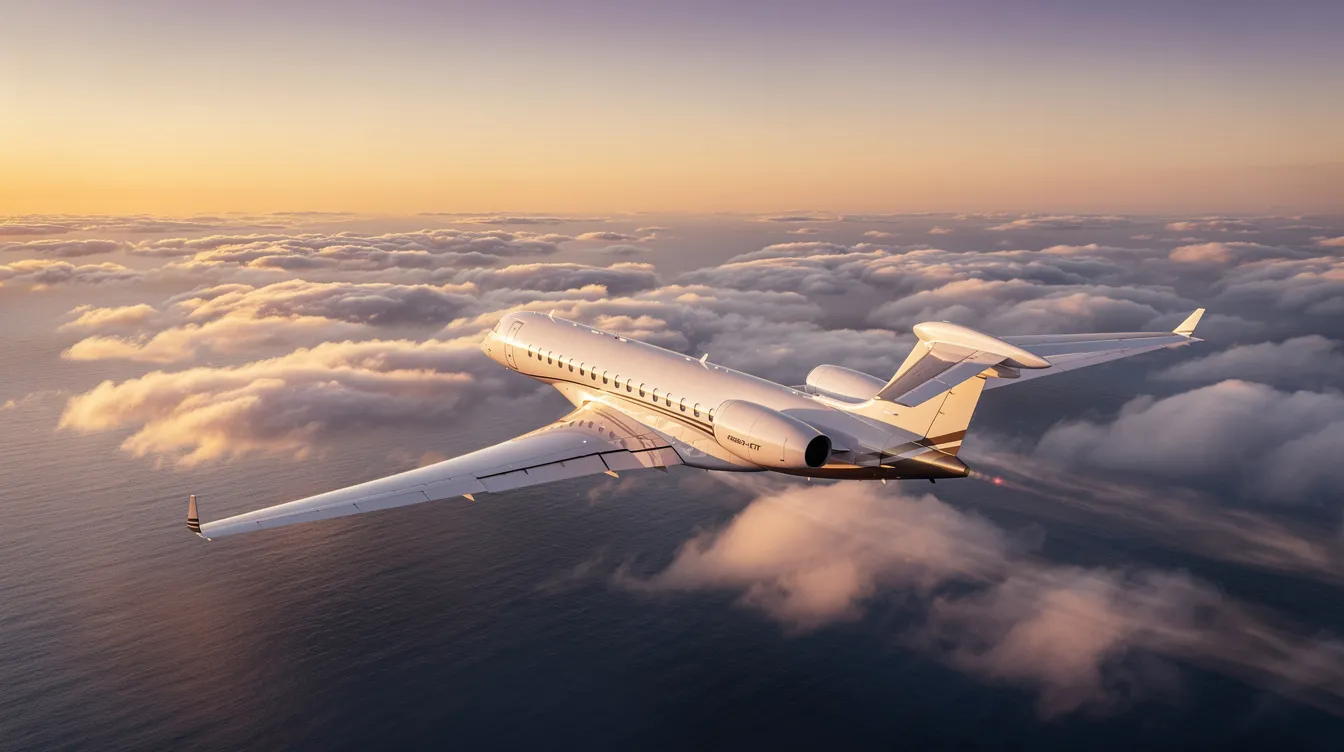
Intercontinental private jets are long-range and ultra-long-range aircraft capable of covering 5,500 to 8,000 nautical miles nonstop. They typically accommodate 10 to 18 passengers in multi-zone cabins with full-service galleys, lie-flat sleeping, and dedicated work areas.
The hierarchy of aircraft type matters here:
Very light jets and light jets: Under ~2,500 nm. Built for regional hops - not intercontinental missions.
Midsize and super midsize jets: ~3,500–5,500 nm. Capable of US coast-to-coast or shorter transatlantic crossings, but often requiring fuel or baggage trade-offs.
Long range private jets: ~4,000–6,500 nm. Covering routes like Paris–New York or London–Dubai, similar to the capabilities highlighted in our guide to the best long range private jets for sale.
Ultra long range jets: ~6,000–8,000 nm. Purpose-built for true global reach.
Specific aircraft size and flight range examples bring this to life. The Bombardier Global 7500 has a range of 7,700 nautical miles - enough for New York–Hong Kong or Los Angeles–Sydney. The Gulfstream G650ER achieves approximately 7,500 nautical miles, connecting New York to Dubai nonstop. The Dassault Falcon 8X covers roughly 6,450 nautical miles, making Paris–Tokyo feasible.
One critical caveat: published maximum range assumes ideal conditions. In real operations, headwinds, alternate airport requirements, and passenger count typically reduce usable range by 5–15%. How many passengers you bring, and how much baggage they carry, directly affects whether a given route can be flown nonstop on a particular long-range aircraft. Some owners configure cabins for fewer seats - trading passenger capacity for more beds and privacy.
Why Travelers Choose Intercontinental Private Jets Over Commercial First Class
Picture this: a CFO departs London at 20:00, settles into a fully flat bed on a Global 7500, and lands in Singapore at 17:00 local time - rested, showered, and ready for a board meeting. On commercial flights, the same route often involves two stops, cramped connections, and arriving at an impractical hour. The difference isn't marginal. It's transformational.
The strategic advantages stack up quickly:
Time recaptured: No TSA lines, no long connections, direct routings. Flying from private terminals allows bypassing long security lines and terminal congestion.
Privacy: Private jets provide a discreet environment for high-level executives to conduct confidential meetings and deal negotiations at altitude.
Flexibility: Passengers enjoy flexibility in departure scheduling and can utilize smaller airports closer to their actual departure and arrival airports.
Compressed trips: Intercontinental private jet charter often allows business travelers and leisure travelers alike to compress a 3-day trip into 36–48 hours, preserving days of executive productivity, especially when using some of the largest private jets for sale and charter.
Consider the math differently. Six commercial first-class tickets on a long-haul transatlantic route might run $60,000–$90,000 - without the privacy, schedule control, or direct access to secondary airports. A single long-range jet, allowing passengers to work, sleep, and meet in private, often delivers greater total value for the group. With BlackJet Jet Cards, clients gain predictable pricing and guaranteed aircraft availability for complex global itineraries.
Key Performance Metrics: Range, Speed, Comfort, and Jet Lag
Three variables determine whether an intercontinental route can be flown nonstop: range in nautical miles, cruise speed, and payload. Routes like New York–Johannesburg (~6,990 nm) or Dubai–Melbourne (~6,500 nm) demand ultra-long-range aircraft with proven endurance.
Cruise speeds for intercontinental jets range from Mach 0.85 to Mach 0.94. Most long flights are flown at Mach 0.85–0.90 for fuel efficiency, but aircraft like the Global 8000 and Gulfstream G700 can push to Mach 0.925–0.94 when schedule pressure justifies higher fuel burn. Intercontinental private jets often cruise at altitudes up to 51,000 feet, above most weather and commercial traffic.
Cabin altitude is where private aviation separates decisively from commercial flying. Commercial airliners pressurize cabins to the equivalent of 7,000–8,000 feet. Modern jets maintain a cabin altitude of 4,000 to 4,850 feet - and the Global 8000 targets as low as 2,691 feet. Advanced cabin pressurization in private jets reduces jet lag and fatigue, and when paired with higher humidity, quieter cabins under 50–52 dB, and dynamic LED lighting tuned to circadian rhythms, passengers arrive after 12–17 hours of flight time measurably more rested.
The spacious cabin and advanced technology on flagship jets - lie-flat beds, separate quiet zones, ultra-quiet insulation - directly influence whether a 15-hour mission ends in productive meetings or recovery days, and mirror many of the innovations found on the most expensive private jets. BlackJet's ops team models winds aloft and alternates to confirm nonstop feasibility while preserving fuel reserves.
Flagship Intercontinental Private Jets You Can Access with BlackJet
BlackJet members access a curated network of long-range and ultra-long-range jets through Jet Cards - no tail number ownership required. Here are the marquee aircraft capabilities available for intercontinental missions:
Bombardier Global 7500: The Bombardier Global 7500 has a range of 7,700 nautical miles, seats up to 19 passengers across four distinct zones, and excels on routes like New York–Hong Kong, Los Angeles–Sydney, and London–Singapore. Modern intercontinental jets feature segmented living spaces for work and relaxation, and the Global 7500 exemplifies this with dedicated lounge, dining, sleeping, and crew areas.
Bombardier Global 8000 (entering service mid-2020s): Targeted at 8,000 nm with cruise speeds up to Mach 0.94–0.95, designed to fly nonstop on missions like Dubai–Los Angeles or Singapore–San Francisco.
Gulfstream G650ER / G700: The G650ER achieves approximately 7,500 nautical miles. Both models offer very wide cabin size, low cabin altitude (~3,000–4,000 ft), and are favored by Fortune 500 leadership teams. The Gulfstream G800 can reach approximately 8,000 nautical miles.
Dassault Falcon 8X / 10X (10X expected circa 2026): French tri-jet engineering delivers excellent short-runway performance, with ranges of ~6,450–7,500 nm - ideal where runway length is a constraint.
BlackJet's aircraft matrix also includes larger aircraft and VIP airliners like the Boeing Business Jet and Airbus ACJ for groups of 20–50, serving large cabin aircraft needs on roadshows and government missions, aligning with the options described in our guide to the best private jet for 20 passengers. BlackJet does not promote a single manufacturer; advisors match aircraft features to mission profile, passenger count, and required range.

Cabin Experience on 10–17 Hour Missions
Intercontinental private jets are designed as flying residences and offices, not just transport. Aircraft like the Global 7500 and G700 offer four distinct zones - lounge, conference/dining, private suite, and crew rest - configured for the same route purpose whether it's an overnight crossing or a daytime working flight.
Concrete amenities on ultra-long-range aircraft include many of the comforts emphasized in our overview of the best features of a 20 million dollar private jet:
Full-size lie-flat beds for 6–8 passengers
En-suite shower on select models
4K entertainment screens
High-speed satellite Wi-Fi - Ka-band connectivity strong enough for video conferencing, enabling uninterrupted business operations during flights
Fully equipped galleys for multi-course gourmet catering
Cabin configuration can be tailored to specific missions. Overnight business flights place a meeting area forward and a quiet sleeping cabin aft. Family trips may include a children's media zone, a private parental suite, and pet-friendly arrangements. Sports or film teams use mixed configurations with more seats and flexible luggage storage.
Baggage capacity matters on long-range jets: most allow 1,500–2,500 lb of luggage, covering checked cases, golf clubs, skis, and equipment for 10–14 people, an important consideration when evaluating the best 10 million dollar private jet options. BlackJet coordinates catering preferences, dietary requirements, and cabin configurations in advance via its digital platform and concierge team, ensuring the cabin feels purpose-built for the specific travelers stepping on board.
Popular Intercontinental Private Jet Routes and Aircraft Pairings
Demand for private intercontinental missions has surged since 2020, particularly among executives, founders, and multi-home families connecting North America, Europe, the Middle East, and Asia-Pacific, many of whom are considering the capabilities of a 15 million dollar private jet as part of their long-term travel strategy. Seasonal patterns show increased flights between Europe and the US in summer, while Middle East–Asia routes spike in Q4.
High-demand routes with typical flight times and recommended aircraft:
Route | Flight Time | Recommended Aircraft |
|---|
New York – London (Luton/Farnborough) | 6–7 hrs | Global 6000, Falcon 8X, G550 |
Los Angeles – Tokyo (Haneda) | 11–12 hrs | G650ER, Global 7500 |
London – Dubai | 6.5–7 hrs | Long-range or ultra-long-range jets |
Dubai – Melbourne | 13–14 hrs | G800, Global 8000 |
New York – Johannesburg | ~15 hrs | Global 7500, G650ER |
Common private jet routes include New York to London for transatlantic private jet travel, while Los Angeles to Sydney and Dubai to Melbourne are popular intercontinental routes frequently flown by private jets. London to Dubai is a common route for private jet travel connecting Europe and the Gulf.
Season and winds can add 30–90 minutes to transpacific and polar routes, which makes routing choices and even the cheapest private jet options a key part of overall trip planning for cost-conscious travelers. BlackJet's operations team plans routing and departure times to minimize impact. The ability to use smaller airports - Farnborough instead of Heathrow, Haneda instead of Narita - shortens ground transfers for international flights and improves privacy. Empty leg flights on these same routes can save travelers up to 75% on private jet travel when schedules align.
Costs, Jet Cards, and Comparing Access Models for Intercontinental Flying
Charter pricing for ultra-long-range jets ranges from $5,000 to $50,000 per hour, depending on aircraft type, age, configuration, and market conditions, fitting within the broader context outlined in our private jet price list guide. Hedging on chartering costs can range significantly based on flight duration and fixed fees. Long-range jets typically fall in the $9,000–$14,000 per hour band, while ultra-long-range aircraft command $15,000–$25,000+ per hour.
Sample one-way mission costs using 2025–2026 pricing:
New York–London (long-rangejet): ~$80,000–$110,000
Los Angeles–Tokyo (ultra long range jet): ~$160,000–$220,000
Dubai–Melbourne (ultra long range jet): ~$190,000–$260,000+
Round-trip intercontinental missions typically cost between $160,000 and $400,000. Factors influencing pricing include aircraft type, route length, and crew duty limits.
Three primary access models exist for intercontinental flying, each with its own pricing structure explained further in our guide to understanding jet card cost:
Full ownership: $60–75M acquisition plus $3–5M/year in operating costs (crew, maintenance, insurance). Only makes financial sense above ~300–400 hours annually - and carries high operational costs and depreciation risk.
On-demand charter: Maximum flexibility, but many private jet operators offer variable pricing with no guaranteed availability during peak periods or high-profile events. Conventional jet fuel surcharges and positioning fees can add 25–40% to base costs, and offerings vary widely among the top private jet companies.
BlackJet Jet Cards: Prepaid 25- or 50-hour blocks with fixed hourly rates by cabin class, including the flexible BlackJet 25+ Hour Jet Card. Guaranteed access, no asset risk, lower operating costs versus ownership, and bundled private jet services like ground handling and carbon offsets.
Booking at least 1 to 3 weeks in advance helps secure optimal pricing and suitable aircraft for intercontinental routes, a best practice echoed in our overview of the best jet cards for frequent flyers. Jet Cards simplify budgeting for frequent travelers by locking in known rates and eliminating repositioning surprises, and our detailed guide to jet card pricing structures explains how those rates are built.
Safety, Ground Handling, and Global Operations on Long-Haul Flights
Intercontinental private flights involve layers of complexity that domestic charters don't: overflight permits, oceanic procedures, ETOPS/EDTO considerations, crew duty limits, and diversion airport planning. In business aviation, Safety Management Systems are crucial for verifying operator safety ratings in private jet bookings. BlackJet's certified operator partners handle all of this.
Safety frameworks BlackJet requires of private jet operators include:
FAA Part 135 certification (or equivalent)
Third-party audits via ARGUS or Wyvern
Recurrent training programs
Type-rated, experienced crews for aircraft like the Global 7500 and G650ER
Ground handling at FBOs is coordinated end-to-end: dedicated private terminals with tailored security screening, fast-track customs and immigration (often 10–30 minutes), and line crews managing fueling, de-icing, and ramp safety.
Example: an intercontinental flight from Toronto to Zurich where BlackJet arranges synchronized ground transportation, catering, pet clearances, and luggage handling at both ends - with real-time monitoring for weather or slot changes. Optimized flight planning reduces fuel consumption significantly on theselong-rangee missions, and BlackJet's 24/7 operations desk tracks every leg, proactively managing weather reroutes, ATC delays, and crew rest constraints to prioritize safety over rigid schedules.
Sustainability and Carbon-Neutral Intercontinental Private Jet Travel
Environmental impact is an important consideration, as private aviation has a higher carbon footprint per passenger than commercial airlines. A 14-hour transpacific flight emits about 100–120 metric tons of CO₂, consuming 10,000–12,000 gallons of fuel. This reality demands a transparent approach.
Modern long-range and ultra-long-range jets mitigate impact through several means. Modern jets use efficient high-bypass turbofan engines, advanced aerodynamics, winglets, and lighter composite materials that improve fuel efficiency per seat-mile compared with older-generation aircraft.
Sustainable aviation fuel represents the most significant near-term lever. SAF, produced from renewable feedstocks, is compatible with existing jets and reduces lifecycle CO₂ emissions by 50–80% compared with conventional jet fuel. Uptake is growing at hubs like Los Angeles, London, Amsterdam, and Singapore - though availability remains inconsistent globally.
BlackJet's commitment to sustainability is straightforward: every flight is automatically carbon-neutral via verified offset projects - reforestation, clean energy, and community programs - at no additional cost to members, even on some of the most expensive private jet options. Carbon offset programs help balance unavoidable greenhouse gas emissions from flights, with SAF arranged where operationally available. BlackJet provides emissions summaries on request,t so corporate clients can integrate private jet travel into ESG and sustainability reporting, aligning intercontinental private jet use with broader corporate climate strategies.

Choosing the Right Aircraft Type and Cabin Class for Your Mission
Mission profile - not prestige - should determine the right aircraft. Passenger count, route length, runway constraints, and budget all factor into whether you need a super midsize jet, a long-range jet, or an ultra-long-range aircraft.
Clear guidelines by scenario:
4–6 passengers, US East Coast to Western Europe (e.g., New York–Paris): A long range jet handles this efficiently. A super midsize may work if a fuel stop is acceptable, balancing cost and time.
8–12 passengers, New York–Tokyo or London–Johannesburg: Ultra-long-range jets are essential to avoid stops and maximize comfort and productivity for business executives on demanding schedules.
Corporate roadshow, 20–40 passengers, New York–London–Dubai: Consider VIP airliners (BBJ/ACJ) with conference rooms and multiple sleeping areas.
How many passengers can ultra-long-range jets carry? Typical cabin layouts seat 10–13 in comfort-focused configurations, up to 18–19 in denser arrangements. More passengers generally means fewer beds and tighter personal space - a critical trade-off on 12+ hour flights.
BlackJet advisors review a client's 12–24 month travel pattern - number of annual intercontinental trips, average passenger count, preferred airports - to recommend the ideal combination of aircraft types and Jet Card tier, whether that's a 50-hour jet card or a larger commitment.
FAQ: Intercontinental Private Jet Travel with BlackJet
How far can an intercontinental private jet fly nonstop?
Ultra-long-range jets fly 6,000 to 8,000 nautical miles nonstop. The Bombardier Global 7500 covers 7,700 nm (New York–Hong Kong), while the Gulfstream G800 can reach approximately 8,000 nm (Dubai–Los Angeles).
How many passengers can we bring, and how does that affect range?
Ultra-long-range jets typically accommodate 10 to 18 passengers. Higher passenger and baggage loads can reduce usable range by 5–15%, potentially requiring a fuel stop on marginal routes. Cabin altitude in ultra-long-range jets is maintained at 4,000 to 4,850 feet regardless of loading.
How much notice do I need to book an intercontinental flight?
Booking requires 1 to 3 weeks' advance notice for most missions, and travelers considering a100-hourr jet card often plan their annual flying pattern around this window. Around major events, 5–7 days is advisable. Booking processes for intercontinental private jets involve selecting aircraft and reviewing contract terms. Clients can request quotes via online forms or customer service, with payment options including card and bank transfer during booking, similar to how major providers structure their NetJets jet card costs and programs. Booking involves entering origin, destination, dates, and passenger count. Some platforms allow users to compare aircraft and pricing for transparency.
Are private jets really better for jet lag?
Yes. Low cabin altitude, higher humidity, quiet cabins, lie-flat beds, and tailored departure times aligned to circadian rhythms measurably reduce fatigue on long-haul flights.
Are BlackJet intercontinental flights carbon neutral?
Every BlackJet flight is automatically carbon-neutral through verified offset projects, with sustainable aviation fuel arranged where available. Emissions documentation is provided for corporate ESG reporting.
Do I need to be a Jet Card member to fly intercontinental with BlackJet?
Jet Card membership is the primary route to predictable, global access with guaranteed aircraft availability. Limited ad-hoc options may exist, but membership delivers the consistency that intercontinental private travel demands.
Conclusion: Elevate Your Global Travel with BlackJet Intercontinental Private Jets
Intercontinental private jets redefine the boundaries of global travel, transforming long-haul journeys from exhausting endeavors into seamless, productive experiences. For executives, entrepreneurs, and discerning travelers who value time, privacy, and flexibility, these aircraft offer unmatched advantages over commercial first class and regional jets. With BlackJet’s Jet Card programs, you gain effortless access to a curated fleet of ultra-long-range jets featuring advanced safety certifications, cutting-edge technology, and sustainable travel commitments—all without the burdens of ownership.
Whether you’re flying nonstop from New York to Tokyo, London to Dubai, or Dubai to Melbourne, BlackJet ensures every detail is meticulously managed—from real-time flight support and premium catering to carbon-neutral operations. The strategic value lies not just in the flight itself but in the time saved, the privacy preserved, and the productivity enabled while airborne.
Discover how BlackJet can elevate your intercontinental travel with guaranteed aircraft availability, transparent pricing, and a commitment to sustainability. Explore our Jet Card options today and experience private aviation that truly moves you beyond borders.


 Sign up with google
 Sign up with Apple


