Private aviation transforms family travel from an exercise in logistics into a strategic advantage. For a family of four, the question isn’t simply “which airplane should we buy?”—it’s about matching the aircraft's capabilities to your real-world missions while optimizing for time, comfort, and total cost.
Key Takeaways
For families of four, private flying delivers what commercial aviation cannot: direct access to over 5,000 U.S. public airports versus the approximately 500 served by major carriers, saving 2–4 hours per trip through eliminated connections, security lines, and ground transfers. Consider a New York to Aspen ski trip—commercial routing through Denver adds layovers, checked bag fees, and logistics stress. A light jet flies nonstop in under four hours, landing minutes from the slopes.
For most families, the best plan falls into one of two categories:
A high-utility piston single like the Cessna 182 Skylane or Beechcraft Bonanza A36 for owner-pilots flying 100–200 hours annually on 300–700 nm regional trips
On-demand access to turboprops and light jets via a jet card like BlackJet’s, eliminating ownership complexity while unlocking multiple aircraft categories
What matters more than seat count is useful load (800–1,200 lbs to carry two adults, two children, car seats, and vacation luggage), cabin space, and comfort with club seating, room for gear, and your mission profile—whether that’s weekend getaways of 300 nm or longer family trips exceeding 1,000 nm.
Typical cruise speeds for family aircraft range from 130 to 170 knots, with ranges of 600 to 900 nautical miles including reserves, accommodating various family travel needs.
BlackJet Jet Card programs give families cost-effective, carbon-neutral access across aircraft categories without the 20–30% annual depreciation and six-figure fixed costs of full aircraft ownership, supported by transparent jet card pricing structures that clarify hourly rates and fees. This article covers the best family planes in the piston category, when turboprops and very light jets make sense, detailed cost comparisons, advanced safety features, carbon offset programs, and practical tips for families seeking comfort in the air.

What “Best Plane for a Family of 4” Really Means
Selecting the best family airplane isn’t about picking a famous model—it’s about matching aircraft to real-world missions. A family flying 300 nm weekend hops to a lake house has fundamentally different needs than one flying 1,000+ nm cross-country vacations twice a year.
Families evolve. Young children become teenagers with sports equipment. Weekend bags become ski gear, camping gear, and strollers. This is why useful load and interior flexibility matter more than the four seats printed on a spec sheet. Many six-seat family planes like the Piper Cherokee Six actually fly most comfortably with four occupants plus generous baggage compartments.
Your mission profile shapes everything: typical leg distances (400–600 nm versus 800+ nm), departure and arrival airports (short grass strips versus major hubs), and climate considerations like mountain density altitude or coastal weather. High-wing aircraft like the Cessna 182 are preferred for children because they offer better downward visibility and shade from the sun during flight.
The contrast between owner-pilot family planes and private jet access models is significant. Many families fly fewer than 100 hours annually—well below the 150–200 hour threshold where full ownership becomes cost-effective. For these families, BlackJet’s jet card model provides access without capital tie-up, especially when they closely evaluate jet card cost per hour against full ownership expenses.
Key Criteria for Choosing a Plane for a Family of 4
Before falling in love with a specific aircraft, families should score their needs across comfort, safety, range, and budget. Here’s what matters most:
Useful Load Targets
A realistic family vacation flight plan requires 800–1,200 lbs of payload capacity:
Two adults: 360 lbs
Two children: 100–160 lbs
Luggage and gear: 150–250 lbs
Full fuel for IFR reserves: varies by aircraft
Family-friendly aircraft often feature spacious baggage compartments or fold-down rear seats to enhance flexibility for carrying vacation gear.
Cabin Layout and Comfort
Cabin size and comfort are critical for family flying, with many family-appropriate aircraft seating up to six passengers but flying comfortably with four, providing extra flexibility. Key metrics include:
Headroom: 48–52 inches
Legroom: 40–44 inches front, 36–40 inches rear
Wide cabin configurations (48+ inches) for car seats
Club seating versus bench arrangements
Models like the Beechcraft A36 Bonanza and Piper Cherokee Six feature large rear doors, facilitating easier loading of children and luggage.
Performance Basics
Family aircraft typically cruise between 130 and 170 knots and have ranges spanning 600 to 900 nautical miles, including necessary reserves. For context:
Pistons: 130–180 knots cruise speed
Turboprops: 260–330 knots
Light jets: 380–450 knots
Aircraft equipped with 2-4-2 seating layouts are ideal for families of four, allowing for convenient seating arrangements—though this applies primarily to larger aircraft or commercial options, and is more analogous to configurations on large private jets for around 20 passengers than to typical family pistons. Delta Air Lines is frequently chosen by families for its reliability, service, and quality in-flight entertainment when commercial travel is necessary, while larger groups might instead charter private jets for up to 50 passengers to stay together on one aircraft.
Runway Performance
High-wing aircraft like the Cessna 182 and utility types like the Cessna 206 Stationair excel at shorter or unpaved strips, opening access to remote destinations unreachable by commercial flights.
Operational Costs
Costs bucket into:
Fixed (30–50% of total): hangar space, insurance, inspections
Variable: fuel costs, maintenance, reserves
Aircraft ownership typically entails expenses amounting to 1.5 to 2 times the initial purchase price over a period of 5 to 10 years, encompassing maintenance, hangar fees, and insurance costs.
Safety and Avionics
Modern safety features such as autopilot, GPS, and whole-airframe parachute systems enhance family comfort and reduce pilot workload during flights. Parents flying with children prioritize modern avionics with synthetic vision, traffic alerts, and terrain warnings.
Best Piston Singles for a Family of 4
Four- and six-seat piston singles remain the backbone of family aviation for owner-pilots doing 200–600 nm trips. The best family planes in this category offer reasonable performance, decent speed, and cost efficiency that make regular flying practical, echoing the broader considerations outlined in guides to choosing the best personal plane.
Some family aircraft also feature an aft cabin area, providing additional passenger or relaxation space that enhances comfort and versatility for larger family groups or extended trips, similar to layouts compared in overviews of the best small private aircraft for every need. Many “six-seat” family planes—Cherokee Six, Beechcraft Bonanza A36, Cessna 206—are most comfortable with four people plus luggage, giving extra margin for fuel and gear. Let’s examine the leading options.
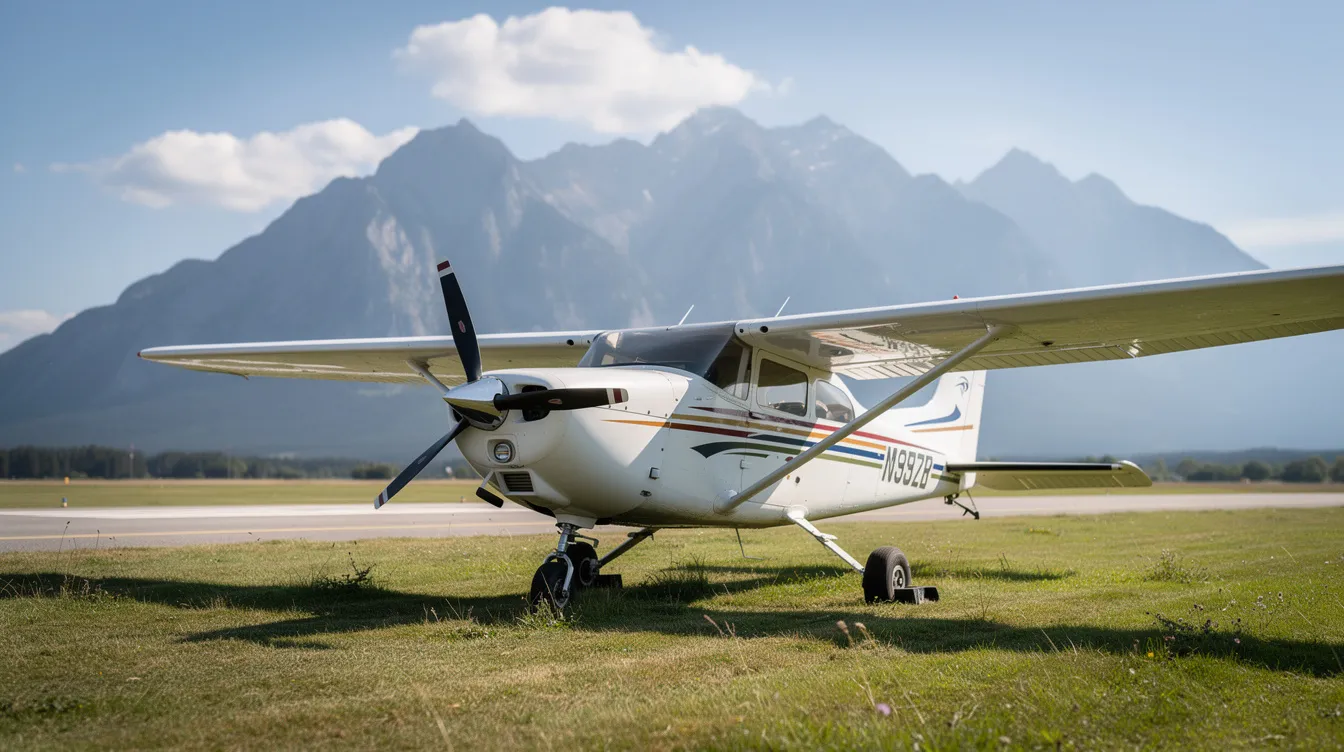
1. Cessna 182 Skylane
The Cessna 182 Skylane earns its reputation as a great family hauler. This high-wing, fixed-gear four-seater cruises at 135–145 knots with a 500–700 nm range and useful load often exceeding 1,000 lbs—numbers that work perfectly for a family of four.
The Cessna 182 Skylane typically cruises at speeds between 135 and 145 knots and has a range of 500 to 700 nautical miles with reserves, making it a versatile option for family travel.
Key advantages:
Stable handling forgiving for instrument-rated private pilot owners
Excellent visibility for multiple passengers
Short-field performance (1,150 ft ground roll) for grass and gravel strips
Roomy cabin with rear barn doors for strollers
2024–2026 used market pricing: $150,000–$300,000, depending on year, avionics, and engine time. Fuel burn runs approximately 12–15 gph at 75% power.
The 182 is the archetypal cost-effective personal aircraft for 200–500 nm trips, though longer cross-country routes may require fuel stops.
2. Cirrus SR22
The Cirrus SR22 represents premium family aviation, cruising 170–185 knots with up to 1,000 nm range—significantly cutting travel time versus slower pistons.
Safety features critical to families:
Cirrus Airframe Parachute System (CAPS)—deployed over 100 times with near-perfect survival rates
Advanced avionics with synthetic vision
Robust crashworthiness design
The Cirrus Airframe Parachute System (CAPS) significantly boosts passenger confidence by providing a whole-airplane recovery parachute system, enhancing safety during travel.
The spacious cabin features side-yoke controls that free up front space, excellent soundproofing, and easy integration of tablets for kids’ entertainment.
Purchase price ranges: Mid-$300,000s for earlier model SR22s to $1M+ for late-model G6 versions. Higher operational costs (approximately $250/hr total) are offset by 30% faster cruise speed than the 182, saving an hour per 500 nm.
The SR22 suits families prioritizing speed, technology, and safety who fly often enough to justify the higher budget.
3. Piper PA-28 and PA-32 (Archer, Dakota, Cherokee Six/Saratoga)
The Piper Cherokee family offers versatility across budgets. The PA-28 (Archer, Dakota) provides a budget-conscious buyer's entry at 120–135 knots, while the PA-32 (Cherokee Six, Lance, Saratoga) delivers a wide cabin best flown with four people and gear.
PA-32 highlights:
Cruise: 145–160 knots
Range: 700–900 nm
Useful load: Often exceeding 1,200 lbs
Huge rear doors for car seats and camping gear
Six-seat configuration with club seating options
Used market pricing: $80,000–$350,000 across the PA-28 and PA-32 lineup. Excellent parts availability and maintenance ecosystem make these cost-effective in the long term.
PA-28s serve as good starter family airplanes; PA-32s become the step-up choice when kids grow, and baggage capacity needs increase.
4. Beechcraft Bonanza A36
The Beechcraft Bonanza A36 sets the benchmark for six-seat family aviation. The Beechcraft A36 Bonanza has a cruise speed of around 170 knots and a maximum range exceeding 800 nautical miles, making it suitable for long-distance family trips.
Why families choose the A36:
Club seating configuration with excellent family interaction
Double rear doors for easy access
Strong, useful load for four passengers plus luggage
High build quality and handling precision
Price ranges: $200,000–$600,000 for 1970–2005 production; newer G36 models command higher prices. Maintenance is more involved than simpler four-seat trainers, but durability justifies the investment.
The A36 represents a top choice for serious cross-country family aviation—a natural step before considering turboprops or private jet access when missions and budget expand. Families should evaluate the safety record of their chosen aircraft, as some models are known for their reliability and strong safety history, with built-in safety features like shoulder harnesses and crashworthy seats.
Other Notable 4-Person Options
Mooney M20 variants: Fast, fuel-efficient at 160–170 knots, consuming less fuel than competitors. Tighter rear seats suit families with smaller children, prioritizing speed and economy—traits also shared by several models featured among top affordable private planes for new aviators.
Rockwell Commander 114: Stylish, wide cabin four-seater emphasizing comfort over raw speed. Good for relaxed family trips where ramp presence matters.
Grumman Tiger: Affordable at $80,000–$150,000, offering decent speed (~135 knots), excellent visibility, and low operational costs for short 200–300 nm adventures, fitting neatly into broader comparisons of the cheapest private aircraft for personal travel.
Each aircraft’s capabilities should be validated against real mission profiles, runway needs, and pilot training levels before any aircraft purchase decision, ideally using structured checklists like those in guides to choosing the best personal plane.
When to Look Beyond Pistons: Turboprops and Light Jets for a Family of 4
Once trips regularly exceed 600–800 nm or schedules become tighter, pressurized turboprops and modern private jets begin to make more sense for family travel. Selecting the right last plane for long-distance family trips is crucial to avoid unnecessary stops and ensure a seamless, non-stop journey, similar to how buyers evaluate categories in comprehensive guides to the best small private aircraft for different missions.
The performance jump is substantial:
Cabin comfort advantages include quieter interiors, pressurization eliminating fatigue, smoother rides above weather, private lavatories, and easier conversation—critical factors on 3–5 hour legs with children.
The contrast in costs is equally stark. Larger aircraft in these categories command $2–8M acquisition prices plus six-figure annual operating costs. For most families flying under 150–200 hours annually, BlackJet’s Jet Card programs deliver access without the capital commitment or complexity.
Turboprops for Family Travel
Pilatus PC-12: The standout single-engine turboprop with:
Large cargo door for sports equipment
Flexible cabin for up to 8 passengers
1,400+ nm range
More space for active families with outdoor gear
Daher TBM 910/960 and Piper M600: Faster, more executive turboprops with pressurized cabins, club seating for 4–6, and cruise speeds above 300 knots—suitable for frequent 800–1,200 nm family trips.
Family benefits:
Ability to fly above most weather
Improved schedule reliability for vacations
Cabins accepting child seats with storage for skis and baby gear
New turboprops typically cost $2–4M+, with meaningful fixed annual costs. BlackJet provides on-demand access without ownership burden, while other travelers may gravitate toward top affordable private planes as an entry point.
Light and Very Light Jets for Families of 4
Very light jets like the Embraer Phenom 100 and Cessna Citation Mustang, plus light jets such as Citation CJ3 and Embraer Phenom 300, deliver jet performance ideal for a family of four and are often evaluated alongside other contenders when comparing the cheapest private jet options.
Typical specifications:
These transform long domestic legs into 2–4 hour non-stops with generous baggage for car seats and strollers, Wi-Fi for streaming, and quieter interiors reducing fatigue.
Owning these jets only makes sense for families flying 200–300+ hours annually. BlackJet enables pay-as-you-fly access at fixed hourly rates across multiple models, leveraging transparent jet card pricing frameworks.
Use cases: New York–Miami family vacations, Los Angeles–Aspen ski trips, or regional holidays where modern private jets bypass commercial congestion entirely.

Aircraft Ownership vs Private Jet Access: What Makes Sense for a Family of 4?
The economic break-even for owning a family airplane versus using private jet access typically sits around 150–200 hours of flying per year, depending on aircraft category, and mirrors patterns shown in broader analyses of private jet pricing and access options.
What Full Ownership of a Family Aircraft Really Costs
2024–2026 Purchase Ranges:
Aircraft | Price Range |
|---|
Cessna 182 | $150,000–$300,000 |
Cirrus SR22 | $300,000–$1,000,000+ |
Piper PA-32 | $150,000–$350,000 |
Beechcraft Bonanza A36 | $200,000–$600,000+ |
Annual Fixed Costs (Before Flying a Single Hour)
Hangar space costs can range from $250 to over $1,000 per month, depending on location, or $3,000–$12,000+ annually
Hull insurance and liability coverage
Database subscriptions
Annual routine maintenance costs for used single-engine planes average between $3,000 to $7,000, depending on the aircraft type
Engine and propeller reserves
Variable Costs Per Hour: Families comparing ownership to Jet Cards should contrast these figures with jet card cost per hour benchmarks.
Aircraft ownership typically incurs costs that are 1.5 to 2 times the acquisition cost over 5 to 10 years, including maintenance, hangar space, and insurance. Many families overestimate how much they will fly their own plane, making chartering a practical option to avoid costly ownership mistakes or pushing them toward the cheapest new plane options to limit capital outlay.
Why Jet Cards and Private Jet Memberships Often Win for Families
BlackJet’s Jet Card model (25-hour and 50-hour programs) allows families to prepay for private jet hours across multiple cabin classes with fixed hourly rates, with options ranging from a 25-hour jet card for occasional flyers to a 50-hour jet card for families with more intensive annual travel.
Jet Card advantages: Families evaluating the best jet cards for frequent flyers will recognize familiar benefits here:
Guaranteed aircraft availability
Transparent pricing with no repositioning fees
No maintenance, crew management, or resale risk
Access to multiple aircraft categories based on trip needs
Chartering often proves more cost-effective for families flying under 150–200 hours annually compared to ownership, which incurs significant fixed costs, especially for those comfortable buying individual seats on private jets rather than committing to full aircraft access.
Jet card access is particularly compelling for families traveling 20–75 hours annually on key routes—New York–Florida, California–Hawaii, or similar. BlackJet’s curated fleet and safety standards ensure families board vetted aircraft and crews every time, and heavier users can explore 100-hour jet card programs when their flying increases.
Airlines that guarantee fee-free family seating can help families avoid extra charges during booking on commercial carriers—but private access eliminates this concern entirely.
Matching Your Family’s Mission Profile to the Right Aircraft Category
The best approach is to “backwards plan” from your family’s real itineraries—weekend lake house trips, annual cross-country vacations, or combined business-plus-family journeys.
Build 2–3 sample flight plans:
400 nm weekend trip
800 nm holiday vacation
International or cross-country hop
Many families benefit from a hybrid approach: a cost-effective owner-flown piston for regional leisure plus BlackJet access for long-range, time-critical, or weather-sensitive missions, mirroring guidance found in broader analyses of the best small private aircraft for every need.
Seasonality matters. Busier months (school holidays, summer) may drive temporary upgrades via BlackJet rather than investing in a larger aircraft that sits idle most of the year.
Short-Haul Weekend Trips (200–400 nm)
Typical routes: Boston–Bar Harbor, Dallas–Santa Fe, regional hops to lake houses or beaches.
Recommended aircraft:
These missions rarely demand pressurization or high speeds, making fuel-efficient family airplanes excellent choices. For non-pilot families, BlackJet matches these trips to very light jets with minimal ground time at private terminals, offering a streamlined alternative to independently buying a seat on a private jet. The Airbus A380 is often cited as suitable for families due to its spacious, quiet cabins and large seats when commercial options are considered for longer international legs.
Medium-Range Family Vacations (400–800 nm)
Examples: New York–Nashville, Chicago–Denver, similar regional routes.
Owner-pilot options:
Cirrus SR22
Beechcraft Bonanza A36
Piper PA-32
Trade-offs exist: pistons are cost-effective but slower and weather-sensitive. Turboprops and light jets via BlackJet offer non-stop, above-weather performance, and families comparing entry-level aircraft often review the cheapest private jet options for travelers before committing.
For younger kids, fewer stops and faster jets make trips feel easier. JetBlue Airways guarantees that children aged 13 and under sit next to an adult on the same reservation, making it family-friendly when commercial travel is necessary, but private options eliminate this concern.
Long-Range and Business-Plus-Family Trips (800+ nm)
Missions: New York–Miami, Los Angeles–Seattle, Toronto–Bahamas.
Distances challenging piston singles due to fuel stops, weather, and fatigue make pressurized turboprops or light jets more appropriate. Families boarding with United Airlines can benefit from their Relax Row feature, which allows a row of three economy seats to transform into a lie-flat surface for comfort, but private jets eliminate these workarounds entirely.
BlackJet enables selection of aircraft category by trip, guaranteed availability, and door-to-door time savings of hours compared with airline first class through programs like the BlackJet 25+ Hour Jet Card.
Safety, Training, and Family Comfort Considerations
Safety is non-negotiable in family aviation, whether flying as an owner-pilot or using private jets via BlackJet.
Recommended pilot milestones for owner-pilots:
Private pilot certificate
Instrument rating
100–200 total hours minimum
Regular recurrent training and emergency procedures practice
Modern safety features in private aviation include autopilot, GPS, ADS-B, angle-of-attack indicators, and whole-airframe parachute systems, which enhance safety and reduce pilot workload.
Aircraft safety features protecting family members:
Whole-airframe parachutes (Cirrus)
Terrain and traffic alerts
Weather radar
Crashworthy seating and shoulder harnesses
BlackJet partners only with operators meeting rigorous commercial aviation safety standards and third-party audits. Families benefit from dual-pilot operations, modern avionics, and well-maintained aircraft without managing these details themselves.
Establish cabin rules for children: seat belt use, headset etiquette, and no interference with cockpit operations. Gradual trip length increases help younger children adapt.

Technology, Sustainability, and the Modern Family Airplane
Modern family planes—whether a 2020 Cirrus SR22 or a Phenom 300 accessed via BlackJet—are increasingly defined by onboard technology and environmental responsibility.
Cabin tech for families:
High-speed Wi-Fi for schoolwork and streaming
Individual charging ports
Cabin management for lighting and temperature
Streaming-capable entertainment
BlackJet’s digital tools:
Sustainability elements:
Sustainable Aviation Fuel (SAF), where available—reducing lifecycle emissions by up to 80%
Carbon offset programs calculate emissions per flight
Investment in verified climate projects
BlackJet ensures every flight can be carbon-neutral via integrated offsets—increasingly important for environmentally conscious families. Emerging hybrid-electric and fully electric regional aircraft may further reduce emissions for short-haul family trips later this decade, a trend also tracked in forward-looking reviews of small private aircraft and sustainability.
Practical Family Travel Tips: Making the Most of Your Flight Plan
Making private family flights smoother requires planning:
Airport and FBO Selection
Choose family-friendly terminals with lounges
Private restrooms and space for kids to move
Easy curbside access to vehicles
Ground Transportation
Packing Guidance
Soft bags for easier loading
Dedicated bags for car seats and boosters
Careful weight and balance planning for owner-pilots
The best aircraft for a family of four varies based on mission profiles, with options like the Cessna 182 Skylane being ideal for short trips and the Cirrus SR22 or Beechcraft Bonanza A36 being better suited for longer cross-country flights
In-Flight Routines
Snacks aligned with time zones
Downloaded entertainment content
Managing sleep for early or red-eye sectors
BlackJet’s concierge teams arrange catering, car seats in ground vehicles, pet accommodations, and customs guidance—reducing friction for parents.
Cost Analysis: Owning a Family Airplane vs Using BlackJet
Cost decisions should account for time saved, flexibility, and opportunity cost of capital locked into one's own plane, themes explored in depth in guides to private jet price lists and access models.
Example comparison over 5 years:
Factor | Cessna 182 Ownership (75 hrs/yr) | BlackJet Light Jet (40 hrs/yr key trips) |
|---|
Acquisition | $200,000 | $0 |
Annual Fixed | $15,000 | $0 |
Variable (5 years) | $56,000 | ~$260,000 |
Resale Value | ~$160,000 | N/A |
Net Cost | ~$175,000 | ~$260,000 |
However, BlackJet delivers jet speeds on longer trips where pistons require multiple stops, hotels near hubs, and lost productivity. Family-friendly aircraft often include generous baggage compartments or fold-down rear seats to enhance flexibility for carrying vacation gear, with a useful load target of 800 to 1,200 lbs for four passengers.
BlackJet’s fixed hourly rates and no-surprise pricing allow families to forecast annual travel budgets clearly—contrasting with fluctuating charter rates and unpredictable maintenance expenses, and aligning closely with best practices outlined in jet card pricing guides.
Many families run a 3–5 year scenario model comparing full ownership, hybrid approaches (piston plus BlackJet), and pure BlackJet access before deciding, often informed by detailed breakdowns of jet card costs and membership pricing.
FAQ: Best Plane and Private Jet Access for a Family of 4
What is the most cost-effective starter airplane for a family of 4?
Older Cessna 172s and Piper PA-28 Archers typically represent the most affordable four-seat starter planes ($80,000–$180,000), suitable for 200–300 nm trips with light baggage, and are frequently highlighted among the cheapest planes for budget-conscious pilots. Many families quickly move up to Cessna 182s or Piper PA-32s once children grow and baggage needs increase, due to better useful load and comfort. For non-pilot families or those flying under 100–150 hours annually, private jet access via BlackJet often proves more practical than ownership—avoiding the significant compromise of capital tied up in a depreciating asset.
Can private jets safely accommodate car seats and child restraints?
Many private jet cabins accept FAA-approved car seats and child harnesses on certain seats, though configurations vary by aircraft type. Families should inform BlackJet in advance about children’s ages and car seat requirements so the team can select suitable aircraft and seating arrangements. Private cabins make installing and checking restraints easier than crowded commercial flights, improving both safety and family comfort for every family member aboard.
How does BlackJet ensure flight safety for families?
BlackJet relies on vetted operators meeting or exceeding Part 135 standards, with dual-pilot crews on jets and recurrent training requirements—key assurances also highlighted in many evaluations of the best jet cards for frequent flyers. Third-party safety ratings and audits—ARGUS Platinum, Wyvern Wingman, IS-BAO—serve as benchmarks for verifying operator quality. Families benefit from standardized safety protocols, modern avionics, and well-maintained aircraft without managing any of these details themselves.
How do carbon offset programs work for private family flights with BlackJet?
BlackJet calculates CO₂ emissions for each flight, and purchases verified carbon credits from projects like reforestation, renewable energy, or methane capture to offset them. Carbon neutrality is built into BlackJet’s offering, allowing families to align frequent air travel with environmental values without independently managing offsets. Where available, Sustainable Aviation Fuel further reduces lifecycle emissions by up to 80% compared to conventional Jet A.
How do I decide between owning a family airplane and using a Jet Card?
Start with an honest estimate of annual flight hours, typical routes, and whether any family member intends to act as pilot in command. Ownership of pistons can make sense above ~100–150 hours annually, while turboprops or jets typically require 200–300+ hours to justify. BlackJet’s Jet Card programs are ideal for families valuing flexibility, access to multiple aircraft categories, and freedom from maintenance or resale risk—especially when flight hours vary year to year. Speaking with a BlackJet advisor to model 3–5 year cost and lifestyle scenarios before committing capital to an aircraft purchase provides the clarity most families need, particularly for those considering a larger 100-hour jet card commitment.
Conclusion: Elevate Family Travel with the Right Aircraft—and the Right Access
There is no single “best” plane for every family of four. Leading piston aircraft choices—such as the Cessna 182, Cirrus SR22, Piper PA-28/PA-32 series, and Beechcraft Bonanza A36—stand out for their suitability to various mission requirements and budget levels. Complex aircraft require more training and experience; simpler fixed-gear models offer accessibility for experienced pilots and newer aviators alike.
As trips get longer, schedules tighten, and expectations for comfort and safety rise, turboprops and light jets accessed through BlackJet increasingly become the superior solution for many families.
The strategic advantage of private aviation is clear: reclaiming hours per trip, accessing airports closer to home and destination, and transforming travel days into relaxed, productive family time.
BlackJet’s pillars—rigorous safety standards, carbon-neutral operations through offsets and SAF, and intuitive technology for booking and support—give families reason to trust the experience, especially when combined with a clear understanding of overall jet card cost structures.
Elevate your family’s travel—effortlessly. With BlackJet, private flight isn’t reserved for a few—it’s accessible on your terms through Jet Card programs featuring rigorous safety, carbon-neutral performance, and unmatched flexibility. Explore BlackJet’s offerings and discover how refined, meaningful travel becomes your new standard.


 Sign up with google
 Sign up with Apple


