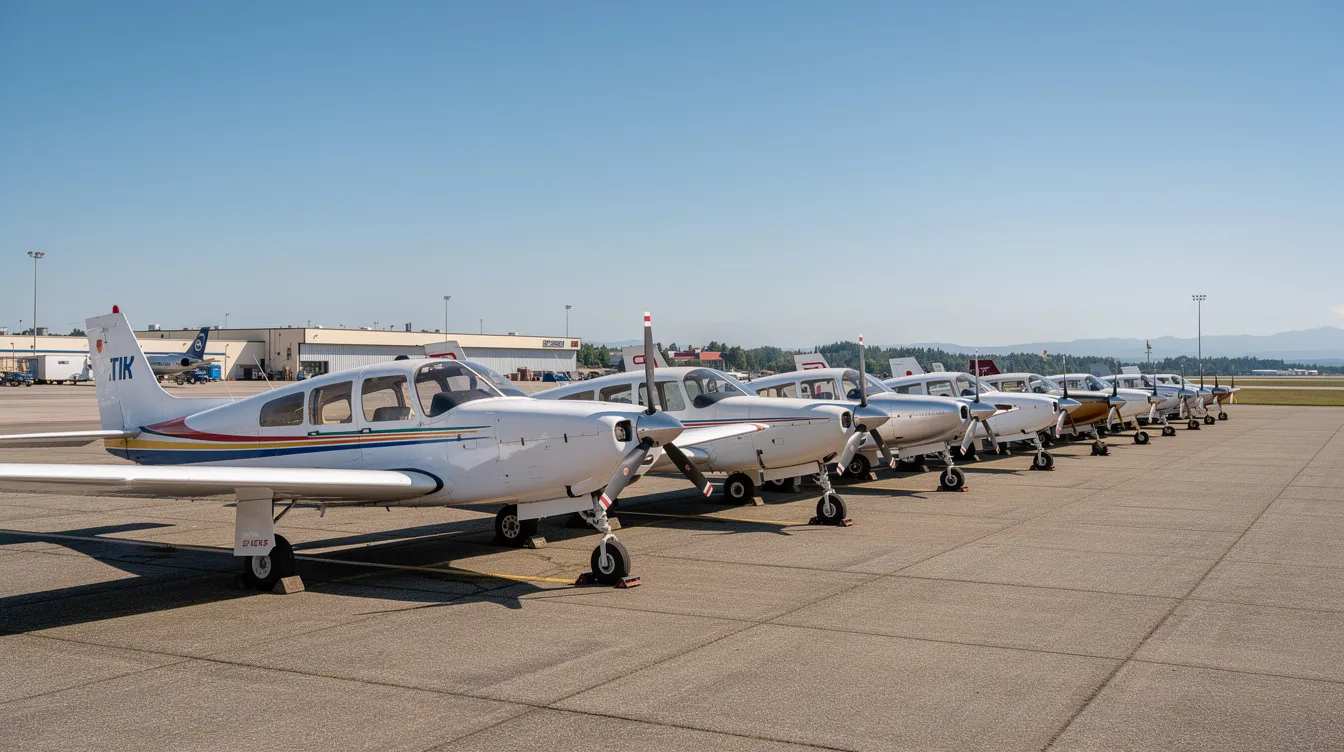
The Cessna 172 Skyhawk is the most produced aircraft in history. Choosing the right one from the active market requires knowing your mission, your budget, and exactly what to look for in the logs. This guide covers pricing, variants, buying criteria, and how piston ownership fits alongside jet access.
Why The Cessna 172 Still Dominates General Aviation
More than 44,000 Cessna 172 Skyhawks have rolled off the line since 1956. The airplane seats four passengers, cruises at 111 knots, and covers a range of 730 nautical miles on a full tank. Early models are powered by a Continental O-300 engine; later variants use Lycoming O-320 or IO-360 powerplants delivering more performance for cross-country flying.
Buyers search for a Cessna Skyhawk for sale because few aircraft match its combination of benign handling, low operating costs, and flexibility. For a pilot flying 300 nm between two regional airports, the Skyhawk saves hours of door-to-door time compared to commercial travel: no security lines, no layovers, and direct access to smaller fields closer to the final destination. Flight schools often sell older aircraft when they upgrade their fleets, making the used market accessible. Listings appear on platforms like Trade-A-Plane and Controller, through brokers, via type clubs such as the Cessna Pilots Association, and from local training academies retiring inventory.
While BlackJet specializes in jet cards and private jet charter, many members started their flying journey in a plane like the Cessna 172. Some still own a Skyhawk for regional hops while using jets for longer or time-sensitive trips.
At a glance: Cessna 172 key specs
Seats: 4
Engine: Continental O-300 (early), Lycoming O-320/IO-360 (later)
Cruise speed: ~111 knots
Range: ~730 nm with reserves
Useful load: ~887 lbs (172S/SP)
Current Cessna Skyhawk Market Overview (Prices, Years, and Typical Inventory)
The current market for the Cessna 172 is supported by strong demand. Cessna 172 Skyhawk prices range from $40,000 to over $675,000 depending on year and equipment. Pricing varies based on the aircraft's generation and avionics configuration. Recent market data shows Cessna 172s typically listed between $219,000 and $449,900, though prices for used Cessna Skyhawks generally range from $40,000 to $300,000 across all vintages. Cessna 172 listings typically stay active for about 112 days.
At any given time, there are roughly 83 Cessna 172 listings available across major platforms; recent data shows 8 Cessna 172 aircraft available in one snapshot. Only a fraction feature fresh engines and updated avionics. U.S.-registered, FAA-certified Skyhawks carry lower compliance costs than European or Latin American imports, where EASA certification and shipping can add tens of thousands.
Market snapshot: price vs. vintage
A 1961 Cessna 172C is available for $69,900; classic 1960s airframes with STOL or float conversions are priced for utility, not cosmetics.
Used Cessna 172 models from the 1970s typically sell for $70,000 to $175,000. A mid-1970s 172M/N with mid-time Lycoming O-320 and legacy IFR radios is a common find.
A 2008 Cessna 172S is priced at $449,900; G1000-equipped models from 2005 to 2010 generally fall between $280,000 and $380,000.
A 2019 Cessna 172S has 1,090 hours total time, representing a low-time airframe; a 1966 Cessna 172 has 2,361 hours total time, illustrating how vintage models accumulate hours over decades.
Aircraft with modern glass cockpits command higher resale values than older models. Avionics upgrades can add value to an airplane's market price.
The capital cost of a Skyhawk is a one-time outlay. For missions requiring speed or range beyond what a piston aircraft delivers, understanding the broader private jet price list, costs, and access models can clarify when a jet card vs. charter approach through BlackJet may prove more rational.
Key Buying Criteria: Complete Logs, Damage History, and Total Time
In piston aircraft, paperwork carries as much weight as new paint. Buyers should inspect complete logbooks to confirm adherence to annual inspections and major repairs. Complete logbooks showing continuous maintenance history enhance aircraft value and make financing and insurance far easier to secure.
Must-check documentation:
Complete logs from first flight or several decades back, covering airframe, engine, propeller, and avionics logbooks. Gaps beyond a few years can hide deferred maintenance or unreported damage.
Clear, well-documented damage history (or written confirmation that none exists), including dates, nature of incident (hangar rash vs. gear-up landing), and certified repair details.
AD compliance entries and recurring inspections, especially for high-time training aircraft above 8,000 AFTT.
Total time for a Cessna 172 averages about 6,715 hours across the fleet. For 2026 buyers, "low" is under 4,000 hours; "moderate" is 4,000 to 8,000; "high" exceeds 10,000. The engine TBO is 2,000 hours.
Pre-purchase inspections should be conducted by a qualified and independent A&P mechanic. Corrosion inspection is vital for older Cessna 172 models that may lack internal protection.
A Skyhawk with 12,000+ hours but meticulous, continuous school maintenance can be a safer buy than a low-time airframe with sketchy records. Incomplete logs reduce resale value and raise insurance premiums, just as patchy records on a business jet would concern BlackJet's safety team or any operator evaluating the best small private aircraft for specific missions.
Avionics, Engines, and Popular Cessna 172 Variants
Not all Skyhawks are alike. Engine variants, panels, and STCs change capability and price. Here are the variants buyers will encounter:
Early models (172 through 172H) with 145 hp Continental O-300: simple, often VFR-only, manual flaps, analog panels. Good for restoration or float operations.
Lycoming O-320-powered 172M/N/P (150-160 hp): the backbone of flight school fleets, durable trainer configuration, basic IFR if radios are installed.
172 Hawk XP and 180 hp conversions with O-360 engines: better climb rate, improved float performance, sometimes equipped with a Hartzell propeller. Fuel burn and parts limits differ from standard models.
Cessna 172S / SP (NAV III) with fuel-injected Lycoming IO-360-L2A and factory Garmin G1000 or G1000 NXi avionics, delivered from the mid-2000s onward. Autopilot options include legacy KAP 140 or modern GFC 700.
Contrast "six-pack" analog panels with glass-cockpit upgrades; ADS-B In/Out is now mandated in USA airspace. When comparing two Cessna Skyhawk for sale listings, new parts limits, installed equipment, and panel generation drive the price gap.
Match variant to mission: a basic VFR trainer needs durability, not a glass cockpit. Hard IFR cross-country flying demands an SP with G1000 and a capable autopilot. BlackJet applies the same logic, categorizing jets by cabin and mission profile so each flight uses the right aircraft.
Use Cases: Training, Personal Travel, and Light Business Flying
The same Cessna 172 airframe serves different roles depending on configuration and owner goals, and it often appears alongside other affordable small aircraft options for budget-conscious pilots.
Primary training: A 1978-1985 172N/P in flight school use, with a mid-time engine, overhauled interior plastics, and basic IFR-certified avionics. Ruggedness and predictable handling outweigh luxury. This is the classic trainer brand.
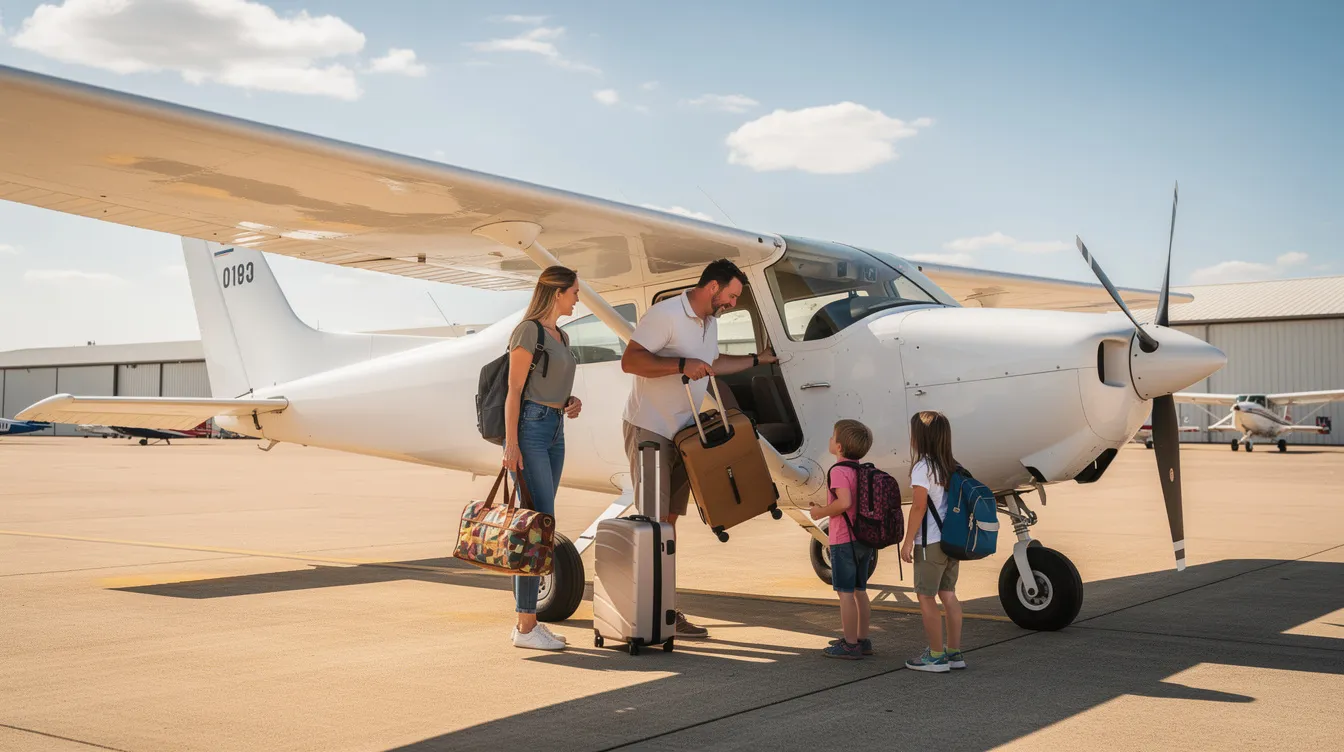
Personal/family travel: A family of three flying a 2005 172SP with leather interior, upgraded GPS, and set for weekend trips of 300-400 nm (Chicago to Nashville, for example). Baggage capacity, climb performance in August heat, and cabin comfort matter here.
Light business flying: An owner-pilot entrepreneur uses a 2016 172S with G1000 NXi to connect regional cities within 400 nm (Dallas to Tulsa, Teterboro to Charleston, WV), saving hours vs. regional airlines. Limitations are real: speed caps at ~120 knots, and winter weather can ground any VFR seller of schedule flexibility.
For trips where cabin space, speed, or weather resilience are critical, a 25-hour or 50-hour jet card through BlackJet’s premium private jet card programs covers what a Skyhawk cannot.
Safety, Maintenance, and Operating Costs
The Cessna 172 has a strong safety record, built on fixed gear, low wing loading, and forgiving stall behavior. Safety still depends on maintenance quality and pilot proficiency.
Annual inspection scope ranges from $2,000-$5,000. A 1975 model may need structural corrosion work, exhaust, and engine mount attention. A 2008 aircraft typically has fewer corrosion issues but may need avionics updates and wiring work.
Common wear items on aging Skyhawks: wing spar corrosion points, exhaust wraps, magnetos, interior plastics, and aging baffles.
Fuel burn runs 8-10 GPH at cruise. At $6.50/gallon avgas, that is $52-$65/hour in fuel alone. Add hangar or tie-down ($2,000-$6,000/year), insurance (~$1,200-$2,000/year), and database subscriptions.
Annual upkeep costs for owning a Cessna 172 range between $15,000 and $30,000 per year, depending on age and how often you fly.
Safety enhancements include engine monitors (JPI, etc.), ADS-B In for traffic/weather overlay, and BRS parachute systems (rare in Skyhawks but available).
For someone flying under 100-150 hours per year, a blend of Skyhawk ownership and a BlackJet jet card for longer or international routes may be more cost-effective than full ownership alone, especially once you understand jet card cost per hour and pricing drivers.
How To Evaluate Listings and Make a Confident Offer
Once basics are clear, the process narrows to comparing specific listings and following a disciplined checklist.
Define mission and budget first: IFR-capable trainer under $150k, or late-model G1000 Skyhawk near $350k. Cessna 172 listings currently range from $69,900 to $449,900.
Filter ads by year, engine time, avionics, and location. Prioritize complete logs and any noted damage history. View each listing with a critical eye; aircraft listings generally stay active for about 112 days, so good airframes move fast.
Shortlist 3-5 aircraft and share specs with a trusted A&P/IA or pre-buy consultant for initial review.
Arrange a pre-buy inspection at a neutral shop: compression checks, borescope of cylinders, airframe corrosion survey on older models.
Use findings to negotiate: deferred maintenance, older paint, or a looming engine overhaul (TT near 2,000 hours SMOH) should reduce the price.
Buyers can explore financing options through CurrencyAir or reference an essential guide to financing an airplane. Financing helps plan purchases based on aircraft age and usage. Lenders prefer aircraft with continuous logbooks, no major structural repairs, and engines within reasonable hours. Buyers can estimate total cost of ownership using the Aircraft Cost Calculator to set realistic expectations before making an offer.
Buy the best-maintained, best-documented Skyhawk you can afford. A cheap airplane with gaps in its logs will cost more in the long run than a ready-to-fly airframe with clean records and a fresh lease on engine life.
Frequently Asked Questions About Cessna Skyhawk For Sale
Q1: What is the typical price range for a used Cessna 172 Skyhawk?
A1: Prices generally range from $40,000 for older or basic models to over $675,000 for newer, fully equipped variants. Most listings fall between $219,000 and $449,900.
Q2: How important are logbooks when buying a Cessna 172?
A2: Complete logbooks are critical. They verify maintenance history, damage records, and compliance with inspections, which affects safety, resale value, and financing eligibility.
Q3: What are the main engine types found in Cessna 172 Skyhawks?
A3: Early models use Continental O-300 engines, while later variants typically have Lycoming O-320 or IO-360 engines, offering improved performance.
Q4: How long do Cessna 172 engines typically last before overhaul?
A4: The engine time between overhauls (TBO) is about 2,000 hours, which is a key factor in evaluating aircraft condition.
Q5: What are typical annual operating costs for owning a Cessna 172?
A5: Annual upkeep ranges from $15,000 to $30,000 depending on aircraft age, usage, and maintenance.
Q6: Can financing be used to purchase a Cessna 172?
A6: Yes, buyers can explore financing options through services like CurrencyAir, which helps plan purchases based on aircraft age and usage.
Q7: How long do Cessna 172 listings usually stay on the market?
A7: Listings typically remain active for about 112 days, with well-maintained and competitively priced aircraft selling faster.
Q8: What avionics upgrades are common and how do they affect price?
A8: Glass cockpit systems like Garmin G1000 or G1000 NXi are popular upgrades that significantly increase resale value and enhance IFR capability.
Q9: How does owning a Cessna 172 complement private jet access?
A9: Many pilots use their Skyhawk for local or regional flights and supplement with private jet cards like BlackJet for longer, faster, or all-weather trips.
Q10: What should buyers look for in a pre-purchase inspection?
A10: Buyers should ensure a qualified A&P mechanic inspects engine condition, corrosion, avionics, and structural integrity to avoid costly surprises.
This FAQ section helps clarify common concerns and complements the detailed guide on choosing the right Cessna Skyhawk for your needs.
From Owning a Skyhawk to Accessing a Jet: Where BlackJet Fits
Many aviators combine piston ownership with on-demand jet access to cover every mission profile.
When a Cessna 172 is ideal: Local and regional hops under 400 nm, fair-weather leisure trips, training flights, and pure flying enjoyment.
When a jet card wins: Same-day multi-city itineraries, coast-to-coast travel, transatlantic flights, or winter operations where pressurization and de-icing capacity are non-negotiable; in these cases, understanding jet card cost and membership pricing structures helps you choose the right program.
BlackJet's offering:
If you are searching for a Cessna Skyhawk for sale, consider pairing your piston aircraft with a BlackJet Jet Card for the missions that demand speed, range, or all-weather capability. Frequent flyers can benchmark options using guides to the 100 hour jet card cost and structure, overall jet card pricing, and even specific providers like NetJets jet card programs and costs or Flexjet jet card pricing and benefits.
You can also explore how a 5 million dollar jet compares to piston ownership and jet cards, when chartering a private jet is worth it versus ownership, and the best cheapest single pilot jets for budget-minded operators. For many pilots, starter aircraft like those covered in the best cheapest planes and economical trainers or broader overviews of the cheapest private aircraft options provide a practical bridge into private aviation.
If full aircraft ownership is not the goal, you can still buy a seat on a private jet through shared and semi-private options while using BlackJet cards tactically. Explore BlackJet Jet Cards and discover how private jet access can complement the freedom of owning your own airplane.


 Sign up with google
 Sign up with Apple