Introduction
This article is intended for aviation enthusiasts, tech-forward early adopters, and private travel professionals interested in the future of personal air mobility. Understanding the Jetson ONE is important as it represents a major shift in how individuals may travel privately and sustainably in the near future. The Jetson ONE is a personal electric vertical takeoff and landing (eVTOL) aircraft, meaning it can take off and land vertically like a helicopter but is powered entirely by electricity.
The era of personal aircraft is no longer a guess about the future—it is here. The Jetson ONE is a single-seat personal electric vertical takeoff and landing aircraft built for short recreational flights, with eight electric motors, vertical takeoff and landing, a top speed of 102 km/h (63 mph), and roughly 20 minutes of flight time without requiring a runway. Founded by Tomasz Patan in the mid-2010s, the pioneering eVTOL company unveiled early Jetson prototype models in Tuscany, Italy, before open pre-orders launched globally. Core specs tell the story: an all-up weight of 86 kg and typical cruise altitudes under 1,500 feet above ground level. Jetson has sold out of 2025 and 2026 vehicle orders, with high demand pushing new delivery slots toward 2027 and 2028—a clear signal that personal aviation has turned a corner.
For tech-forward early adopters, aviation enthusiasts, and BlackJet travelers tracking what comes next in private air travel, Jetson ONE shows how personal air mobility could expand beyond helicopters and traditional fixed-wing aircraft and complements small private aircraft used for personal and business travel. This article looks at its design, flight technology, safety systems, performance, regulatory realities, pricing, real-world use, and how it compares with private jets and jet cards. While BlackJet focuses on jet cards and private jet charter rather than selling eVTOLs, innovations like Jetson ONE matter because they are redefining last-mile mobility and leisure flying, while shaping expectations for more flexible and sustainable private aviation.
Design, Technology, Eight Electric Motors & Performance
Frame and Cockpit Design
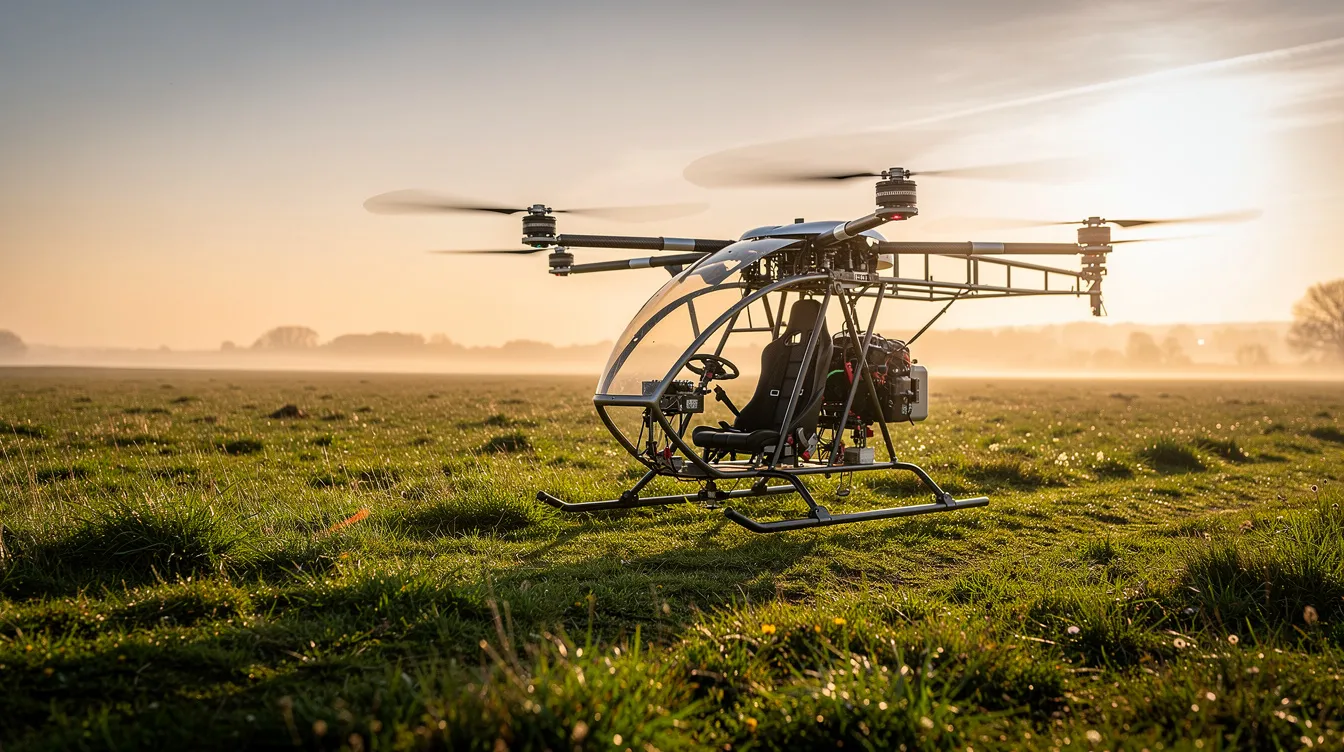
The Jetson ONE looks nothing like a traditional plane or helicopter. It resembles a giant drone with an open cockpit—an exposed aluminium spaceframe paired with carbon-fiber components, integrated roll bars, and a racing-inspired safety cell structure surrounding the pilot.
Propulsion and Power
Propulsion comes from eight electric motors with fixed-pitch propellers mounted on outriggers. This configuration provides redundancy by design. The aircraft uses swappable lithium-ion batteries that produce up to 102 horsepower, and the maximum pilot weight supported is 210 lbs (95 kg). The controls are simplified using a single joystick for flight operation, and the vehicle employs a highly automated system for easy flight control—making the ride closer to piloting a large drone than wrestling with a conventional aircraft. The design aims to make personal flying simpler than traditional helicopters.
Key performance highlights:
Top speed: 102 km/h (~63 mph)
Flight time: ~20 minutes
Empty weight: ~55 kg
All-up weight: 86 kg
Power: 8 brushless electric motors, 102 hp combined
Batteries: Snap-lock removable lithium-ion packs
Maximum pilot weight: 210 lbs (95 kg)
Typical cruise altitude: Under 1,500 feet above ground level
The Jetson ONE is fully electric with zero local emissions and notably quieter than helicopters at low altitude, fitting the broader shift toward sustainable transportation in the skies, much like BlackJet’s premium private jet card programs and charter services are evolving toward more efficient, lower-impact operations.
Safety Systems and Regulatory Considerations
Safety Features
Personal aircraft like the Jetson ONE sit at the intersection of innovation and safety regulation. For wider public adoption, robust protections are non-negotiable. The Jetson ONE includes a ballistic parachute as standard safety equipment, developed in partnership with ParaZero, alongside a pilot harness, obstacle-avoidance aids, and multiple levels of electronic redundancy. It offers a new form of personal flight with safety at its core.
Critically, the aircraft can sustain flight even if one motor fails—the flight computer redistributes thrust among the remaining propellers, preventing a single failure from killing control authority. Operational protocols recommend daylight-only, good-weather flights with pre-flight checks.
Regulatory Status
It is classified as an ultralight aircraft under FAA Part 103, meaning no pilot's license is required to operate it in many areas of the United States. Currently, its use is restricted to low-altitude, mostly unregulated airspace under 200 feet in practice, though the regulatory ceiling extends higher. These rules limit flight over congested areas and require visual meteorological conditions.
Compare this with the rigorous standards BlackJet demands: every private jet flight in our Jet Card programs undergoes third-party safety audits, operator certifications under Part 135, and strict maintenance protocols. As flying cars and eVTOL personal aircraft become more common, regulators will likely introduce dedicated frameworks—and BlackJet will track these changes to advise clients navigating both conventional jets and advanced air mobility.
Ordering, Pricing, and 20 Minutes Real-World Flights
Ordering and Availability
Despite its futuristic appearance, the Jetson ONE is already in limited production with a growing owner-user base taking to the skies, building on prototype development and the first successful flight in Poland. The Jetson ONE costs $128,000 with an $8,000 non-refundable deposit to secure a build slot. Jetson has sold out of 2025 and 2026 vehicles entirely. The earliest shipping year for new orders is 2027, with Jetson ONE orders currently being taken for 2028—an exclusive purchase by any measure, especially when compared with more budget-friendly private aircraft options for new flyers.
In October-era media demonstrations, high-visibility flights in California showcased operations from a residential driveway and along the coastline, bringing the vision of "door-to-sky" commuting closer to reality. Palmer Luckey, the original Oculus founder, took his Jetson ONE for a test flight as part of the broader Jetson ONE user experience; after approximately 50 minutes of training on the ground, he was airborne—validating the concept among tech-forward early adopters excited about what comes next.
Ownership Practicalities
Ownership practicalities are worth noting, particularly when comparing a capital-intensive personal aircraft to more flexible jet card membership pricing structures:
Storage: A small apartment won't work—garage or hangar space is needed
Charging: High-voltage outlets preferred; batteries are removable
Permissions: Local aviation authorities and landowners must sign off on takeoff/landing sites
Insurance: Aviation-grade coverage for ultralight or experimental category
The Jetson ONE is designed to avoid ground traffic entirely, but it remains a recreational personal aircraft with limited utility for general commuting. While BlackJet does not sell Jetson aircraft, we serve a similar clientele—individuals for whom a Jetson ONE is a leisure craft, while a BlackJet Jet Card remains the primary tool for fast regional and intercontinental travel, especially when comparing the best jet card programs for frequent flyers.
Jetson ONE vs Private Jets and Jet Cards
Jetson ONE and private jets both promise freedom from ground delays, but they solve fundamentally different travel problems. The Jetson ONE is a single-seat vehicle capable of short recreational flights at up to 102 km/h—suitable for short-distance commuting and recreational flying, not crossing borders. It is a recreational personal aircraft with limited utility for general commuting.
BlackJet, by contrast, provides access to light, midsize, super-midsize, and large-cabin jets capable of flying multiple passengers thousands of kilometers nonstop, spanning a broad spectrum of cabin classes and budgets outlined in a comprehensive private jet price list and cost breakdown. A Jet Card lets members pre-purchase blocks of hours—say 25 or 50—then book on demand via mobile app or concierge, with fixed rates, guaranteed availability, and safety-vetted operators. No production wait, no fees for crew management, no maintenance risk.
Example scenario: A founder commutes from a countryside estate to a nearby airfield in a Jetson ONE, then boards a BlackJet-arranged super-midsize jet for a nonstop business trip from London to Dubai. Personal aircraft handle the last mile; private jets handle the long haul.
The Future of Personal Aircraft Air Mobility and How BlackJet Fits In
Jetson ONE and similar VTOL personal aircraft signal a change toward individualized, point-to-point air mobility. In parallel, the newest generation of innovative long-range private jets is redefining what’s possible for intercontinental business and leisure travel. Investors continue to fund this space aggressively, and cities like Dubai, Los Angeles, and Singapore are already testing low-altitude corridors. As read in videos and social media comment threads across Facebook and LinkedIn, the public appetite is undeniable—people are excited.
BlackJet's technology platform—digital booking, real-time flight support, and ground transport integration—positions us to interface with emerging modes like personal aircraft when regulations and infrastructure based in key markets mature, while also partnering alongside leading private jet companies worldwide to extend global coverage. For now, the way forward is clear: secure flexible, carbon-neutral private jet access today while the next generation of personal flight develops around the corner.
Private jet access is not merely a luxury—it is a strategic advantage and the backbone of fast, safe, global travel that will dovetail with innovations like Jetson ONE rather than be replaced by them. Explore BlackJet Jet Card membership and discover what seamless air mobility looks like at every altitude.
Frequently Asked Questions About Jetson ONE
Q1: What is the Jetson ONE?
The Jetson ONE is a personal electric vertical takeoff and landing (eVTOL) aircraft designed for short recreational flights. It features eight electric motors, a top speed of 102 km/h, and a flight time of approximately 20 minutes without requiring a runway.
Q2: Do I need a pilot’s license to fly the Jetson ONE?
In many parts of the United States, the Jetson ONE is classified as an ultralight aircraft under FAA Part 103, meaning no pilot’s license is required to operate it, provided flights adhere to regulatory limits such as low altitude and good weather conditions.
Q3: How much does the Jetson ONE cost, and when can I order one?
For many travelers comparing options, it helps to understand the cheapest private jet choices currently available alongside emerging eVTOL pricing.
The Jetson ONE costs $128,000, including an $8,000 non-refundable deposit. Orders are currently being taken for delivery starting in 2027 and 2028, with 2025 and 2026 production slots already sold out.
Q4: What safety features does the Jetson ONE include?
Safety expectations are increasingly shaped by top-tier private jets that combine luxury with advanced protection systems.
Safety is a priority with the Jetson ONE. It includes a ballistic parachute, a racing-inspired safety cell structure, electronic redundancy to sustain flight if one motor fails, and obstacle-avoidance aids.
Q5: How does the Jetson ONE compare to private jets and jet cards?
For many buyers, it sits alongside more traditional options like pre-owned $5 million private jets for regional missions.
While the Jetson ONE is ideal for short-distance recreational flights and last-mile commuting, private jets accessed through Jet Card programs provide long-range, multi-passenger travel with comprehensive safety certifications and carbon-neutral options, offering a strategic advantage for business and luxury travel.
Conclusion: Embracing the Future of Personal and Private Air Travel
The Jetson ONE represents a remarkable leap in personal aviation, combining innovative electric propulsion, lightweight aluminium and carbon fiber design, and advanced safety features to create a new way to experience flight, just as a $15 million long-range private jet redefines comfort and performance. While its 20-minute flight time and single-seat configuration position it as a recreational and last-mile mobility solution, it signals a broader shift toward individualized, sustainable air travel and invites comparison with larger $20 million private jets built for nonstop intercontinental routes. For discerning travelers and business executives, this innovation complements rather than replaces traditional private jets and jet card programs offered by BlackJet, including those benchmarked against NetJets jet card costs and structures.
As personal aircraft like the Jetson ONE gain traction, BlackJet remains committed to providing premier private jet access with unparalleled safety, certification, and carbon-neutral flight options, including advisory support for the most expensive and luxurious private jet experiences. Together, these evolving modes of air mobility promise a seamless, efficient travel experience—from doorstep to destination, whether you’re outfitting a 20-passenger large-cabin private jet for team travel, arranging a 50-passenger VIP charter for events, or exploring a premium private jet for sale in the UK. To learn how BlackJet can elevate your travel and keep you ahead of aviation’s next frontier, explore our exclusive Jet Card membership today.


 Sign up with google
 Sign up with Apple


