United Airlines is raising the bar for commercial premium travel with its new business class, debuting on Boeing 787-9 Dreamliners in 2026. This article explores United Airlines' new business class, focusing on the innovative Polaris Studio suites and how they compare to private jet travel. It's designed for premium travelers, frequent flyers, and anyone considering the latest in luxury air travel. As the premium travel market evolves, understanding the differences between top-tier commercial offerings and private aviation is more important than ever for discerning travelers seeking the best in comfort, privacy, and efficiency.
Overview: United's New Polaris Business Class vs Private Jet Travel
The new cabins rolling out across United's "Elevated" 787-9 fleet represent a genuine inflection point for U.S. airline premium travel. With 64 Polaris business class seats per aircraft—including eight United Polaris Studio suites—plus a redesigned premium economy section and upgraded tech throughout, United is pushing its long-haul product closer to what travelers once associated exclusively with Middle Eastern and Asian carriers. The Polaris update focuses on increasing technology and luxury dining options, from 4K OLED displays to an osetra caviar amuse-bouche.
Yet the gap between even the best business class cabin and private jet travel remains significant. Consider the difference on a San Francisco to Singapore routing. A Polaris Studio passenger arrives at SFO roughly three hours before departure, clears TSA, visits the Polaris lounge, boards with priority, and settles into a suite with privacy doors. Post-arrival: customs, immigration, baggage claim. Total door-to-door overhead beyond flight time: five to seven hours.
A traveler using a 25-hour BlackJet Jet Card arrives at a private terminal 30 minutes before departure, walks directly to the aircraft, and flies in a fully private cabin with custom catering and flexible scheduling—potentially landing closer to their final destination via secondary airports.
The core contrasts:
Privacy: Privacy doors on a suite vs. full-cabin privacy on a private jet
Ground Experience: Polaris lounge access vs. private FBO terminal with no security lines
Scheduling: Fixed airline schedule vs. on-demand departure times
Catering: Standardized menu vs. fully bespoke catering
Cabin Exclusivity: Shared cabin with dozens of passengers vs. an aircraft exclusively yours
BlackJet exists for travelers who see the appeal of what United is building—and want to take it further, offering premium private Jet Card and charter solutions.
What Is United Polaris Business Class in 2026?
United Polaris is the airline's flagship long-haul international business class product, originally launched in 2016 with a staggered configuration of lie-flat beds, direct aisle access, and improved soft products like better bedding and multi-course dining. Over the past decade, incremental updates refined the experience, but 2026 marks the most ambitious redesign yet.
The current brand hierarchy works in layers. Standard United Polaris seats deliver a consistent 1-2-1 experience across United's wide-body fleet. The new Boeing 787-9 "Elevated" aircraft add sliding privacy doors to every business class seat, upgraded materials, and enhanced amenities. At the very front, United Polaris Studio suites function as a "business class plus" product—25% larger, with companion ottomans, caviar service, and 27-inch 4K OLED screens.
Polaris Studio suite is United Airlines' new top-tier business class product, offering 25% more space than standard Polaris suites, enhanced privacy with sliding doors, and upgraded amenities. United Airlines' new business class includes the Polaris Studio suite as the top tier of its international offering.
United has no separate international first class, making Polaris the highest cabin available on international flights. Below it, United Premium Plus bridges the gap between business and economy.
Core inclusions across all Polaris seats:
Lie-flat business class seats with direct aisle access
Access to United Polaris lounges on eligible routes
Priority check-in and expedited baggage handling
Upgraded dining, bedding, and amenity kits
Priority boarding and dedicated flight attendants
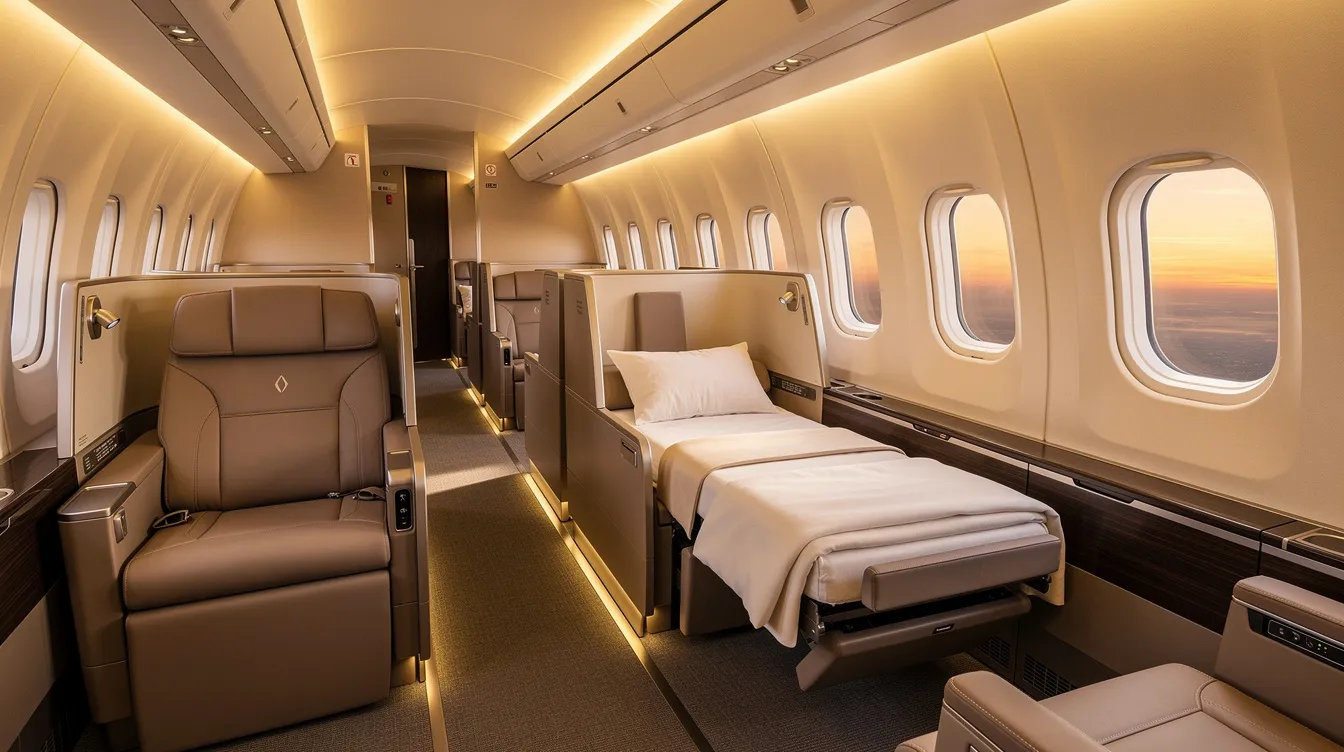
New Boeing 787-9 "Elevated" Cabins: Layout and Configuration
United is introducing new planes at a pace not seen from a U.S. carrier in decades—47 new Boeing 787-9 Dreamliners with the Elevated interior ordered, with approximately 30 in service by the end of 2027. Each features a new layout of 222 total seats configured for maximum premium demand.
The breakdown across the new Boeing 787:
Polaris Studio: 8 suites in the forward cabin, 1-2-1 layout
Standard Polaris: 56 business class seats in a 1-2-1 staggered configuration across two Polaris cabin sections
Premium Plus: 35 seats in five rows, arranged in a 2-3-2 configuration
Economy Plus: 33 seats with extra legroom
Economy: 90 economy seats in a 3-3-3 layout
United's new 787-9s feature 64 Polaris business class seats total—a 33% increase in business class seating compared to older 787-9 configurations. That gain comes at the cost of roughly 35 fewer economy seats, reflecting the airline's strategic tilt toward premium travel.
The business class section splits into two distinct areas. The forward cabin houses the Polaris Studio suites and window-facing reverse herringbone seats—ideal for privacy seekers and solo travelers. The second cabin features herringbone-oriented seats, with center seats that include dividers lowering to bed height, making them a popular choice for couples. Middle seats in this section face the aisle, offering easier access for solo flyers who prioritize convenience.
Budget-conscious travelers wanting more space should target Economy Plus in the United Elevated interior for a meaningful step up from standard economy, while those eyeing private aviation can explore the best small private aircraft for different missions alongside the cheapest private aircraft and budget-friendly options.
Polaris Studio: Business-Class-Plus With Privacy Doors and Caviar Service
Polaris Studio Suite Features
United will introduce eight Polaris Studios in a 1-2-1 layout, positioned in the first two rows of the forward cabin on each Elevated 787-9. These studio suites are reserved for travelers seeking the closest thing to a private jet experience within a commercial aircraft.
Polaris Studio suites are 25% larger than standard Polaris suites, with expanded side consoles, more storage, and companion ottomans equipped with seatbelts in six of the eight suites—allowing a travel partner to sit face-to-face during meals or conversation.
Technology and Entertainment
The technology is substantial. Polaris Studio features a 27-inch 4K OLED touchscreen display—the largest seatback screen on any U.S. airline. Bluetooth connectivity, Qi wireless charging, USB-C ports, and quartzite work surfaces make each suite a functional office. Noise-canceling headphones powered by Meridian technology deliver studio-quality audio.
Dining and Amenities
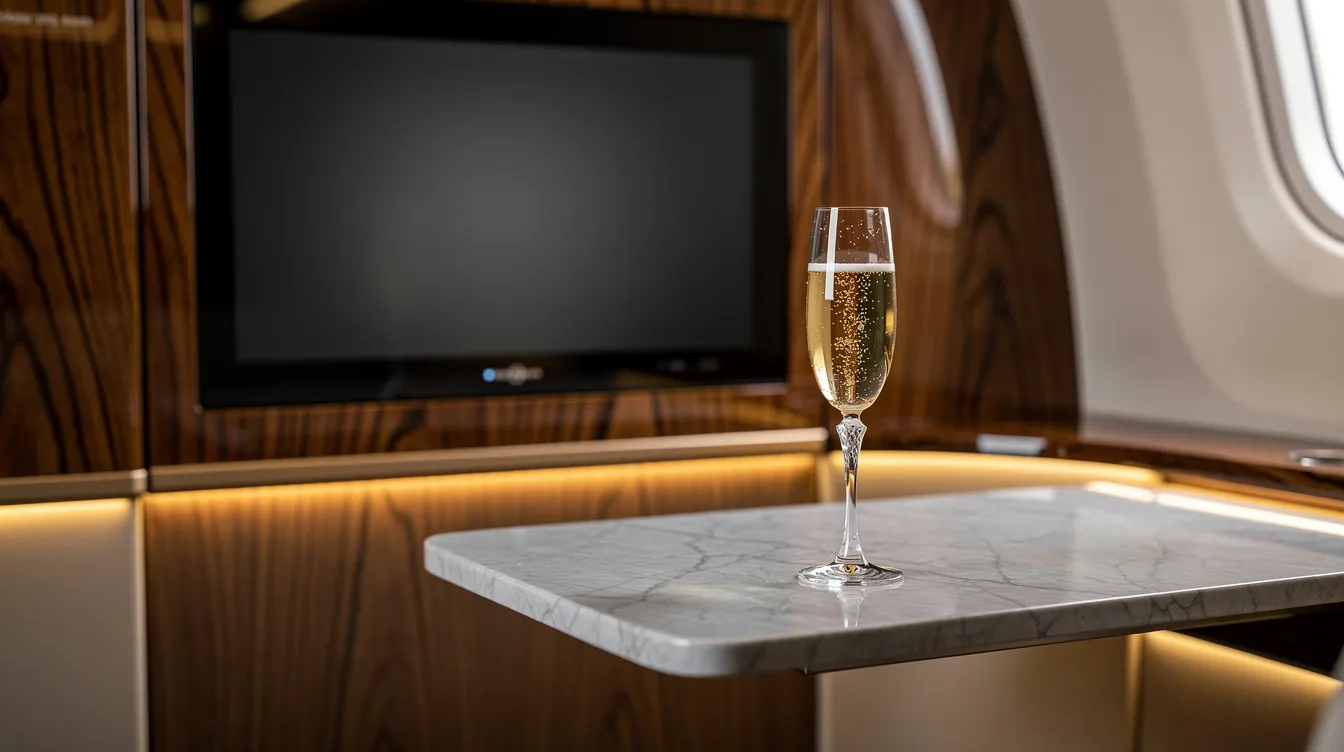
The soft product matches the hardware. Polaris Studio passengers receive exclusive amenity kits, hoodie-style pajamas, an eye mask, a gel pillow, and expanded dining options including a caviar service with premium champagne pairings. New noise-cancelling headphones are provided to every Studio guest.
The gap narrows here—but private jets still offer what no commercial seat can: complete control over cabin configuration, custom chefs, full sound isolation, and a wide spectrum of types of private jets for every traveler plus the freedom to customize your private jet experience to the smallest detail.
New Polaris Business Class Seats With Privacy Doors
Beyond Studio, the remaining 56 standard business class seats on the Elevated 787-9 represent a major upgrade over previous-generation regular Polaris seats. Built on the Adient Ascent platform—widely regarded as one of the best seat designs in global aviation—new Polaris suites include sliding doors for enhanced privacy on every single seat in the business class cabin.
The 1-2-1 configuration ensures aisle access from every position. In the forward cabin, window seat positions face outward, delivering better views and a warmer feel of seclusion. Center seats in the forward section face each other with dividers adjustable to bed height—popular among couples. In the second cabin, center seats face the aisle for easier solo access.
Key Hard-Product Features Across All New Seats
All Polaris seats have Bluetooth-enabled 19-inch 4K OLED displays (4K OLED standard across the cabin)
Six power outlets per suite area: AC, USB-A, USB-C, and wireless charging
Digital seat and lighting controls via a built-in reading light panel
Wood-grain trim, wool-blend fabrics in light gray, and subtle United globe branding
Memory-foam mattress pads and upgraded bedding on longer flights
The enhanced business class emphasizes privacy and larger personal space throughout
The design language is restrained and modern—a warmer feel than United's older interiors, with upgraded tech integrated seamlessly into the seat shell.
For travelers who need to select cabin size based on group composition—light jet for two, super-midsize for six—or even VIP airliners, guidance on understanding private jet sizes and finding the right fit complements BlackJet's range of private jet models and offers flexibility that no fixed commercial layout can match.
Cabin Experience: Wi‑Fi, Entertainment, and In-Flight Amenities
Wi-Fi and Connectivity
United's new 787-9s will feature Starlink Wi-Fi for high-speed connectivity, a significant leap from the airline's historically inconsistent in-flight internet. Free for MileagePlus members, Starlink promises reliable speeds for streaming, video calls, and large file transfers across oceanic routes.
Seatback Entertainment
Screen hierarchy across the Elevated interior:
Cabin Class | Screen Size & Type |
|---|
Polaris Studio | 27-inch 4K OLED |
Standard Polaris | 19-inch 4K OLED |
Premium Plus | 16-inch 4K OLED |
Economy | 13-inch 4K OLED |
All displays support Bluetooth connectivity for personal headphones, eliminating the need for adapter dongles.
Amenity Kits and Comforts
Passengers receive exclusive amenity kits with Perricone MD products in Polaris, along with slippers, an eye mask, and basic skincare. On select long-haul night flights, pajamas are distributed in both Studio and standard Polaris. Polaris cabins feature a self-serve snack bar between meals, stocked with premium packaged snacks, drinks, and rotating items like Tillamook ice cream sundaes.
These upgrades are competitive with top global business class products and echo some of the advances seen in the newest generation of private jets. Flying at higher altitudes also lets private jets cruise above most commercial traffic for smoother, faster routes. But business class still means sharing a cabin with dozens of other travelers. For executives handling confidential work or seeking uninterrupted rest, private jets offer an individualized environment where Wi-Fi, cabin temperature, and service timing are entirely under your control.
Food, Beverage, and New Caviar Service
Dining Upgrades
United has historically faced criticism for inconsistent catering—basic appetizers, middling mains, and forgettable breakfasts. The 2026 strategy signals a deliberate shift. Menus now emphasize regionally influenced tapas service on select routes, improved presentation, and more ambitious ingredient sourcing.
On the Elevated 787-9s, the dining hierarchy adds meaningful differentiation. All Polaris passengers receive an osetra caviar amuse-bouche, while Polaris Studio adds more extensive caviar service with exclusive entrée options and premium champagne pairings. Mid-flight meal options include a galley snack basket and the self-serve bar, with a pre-arrival meal rounding out the sequence.
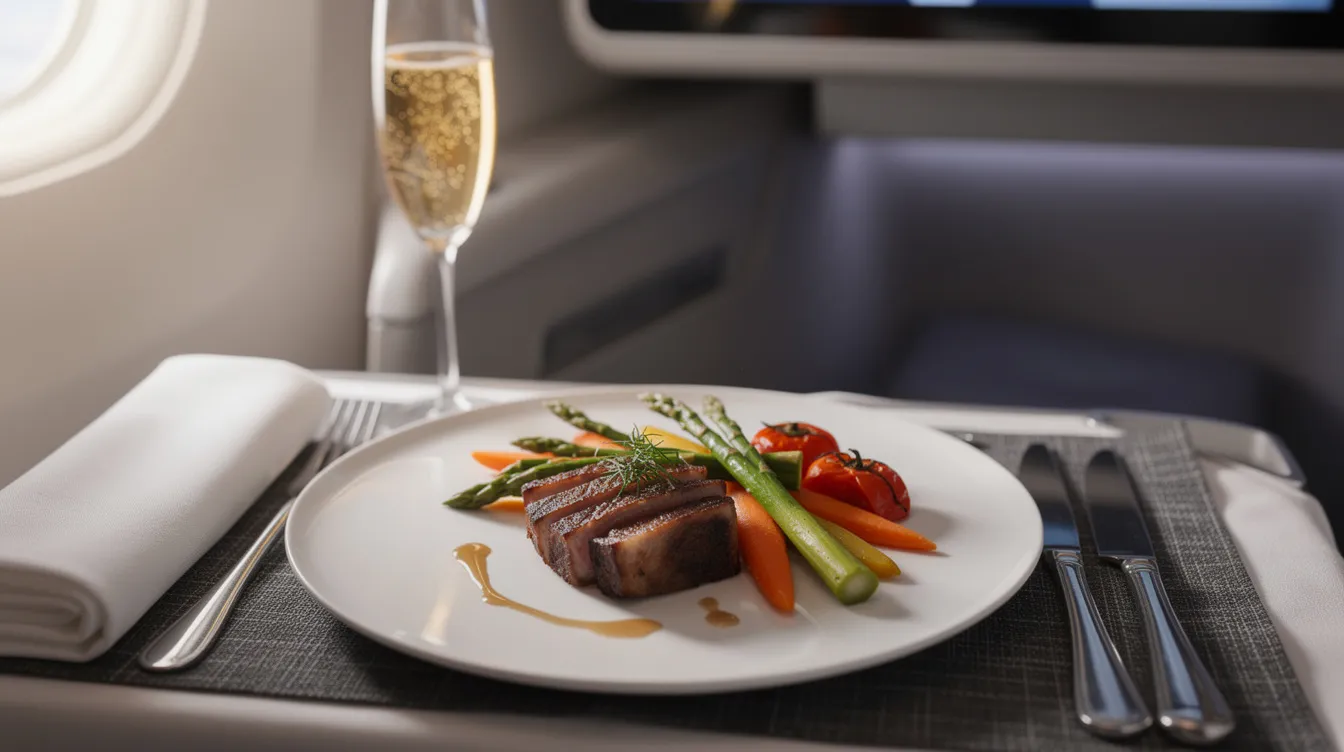
A typical San Francisco to London Polaris dinner might include miso-glazed salmon or braised short rib with seasonal vegetables, a plant-based option, plated desserts, and made-to-order sundaes from the refreshed dessert cart. Meal services in Studio may feature additional courses or bespoke plating.
Caviar Service
All Polaris passengers receive an osetra caviar amuse-bouche, while Polaris Studio guests enjoy a more extensive caviar service with premium champagne pairings and exclusive entrée options.
Comparison to Private Jet Catering
The contrast with private aviation remains clear. With BlackJet, travelers can request fully customized menus—sushi from a specific restaurant, dietary-specific tasting menus, or working lunches timed to their meeting schedule—aboard aircraft that rival the most expensive private jet options for ultra-luxury travel and the top private jets in the world for luxury and performance. Dining options on a private jet aren't drawn from a fixed list; they're built around the traveler.
United's new catering narrows the gap with top carriers, but high-net-worth travelers seeking consistently exceptional dining often graduate to private aviation for exactly this reason.
Premium Plus and Economy Seats in the New Cabins
The refreshed Premium Plus cabin offers 35 recliner seats in a 2-3-2 layout across five rows, featuring upgraded pitch, privacy wings with a built-in reading light, dedicated water bottle and headphone storage, and quartzite cocktail tables. The 16-inch 4K seatback screens with Bluetooth, USB-C, and wireless charging make Premium Plus a legitimate step above standard premium economy on most airlines. Additional amenities include a slot in the tray table for devices and enhanced soft goods.
Economy on the Elevated 787-9 includes 33 Economy Plus seats with extra legroom and 90 standard economy seats. Every economy seat gets a 13-inch 4K OLED screen with Bluetooth and six power outlets per row—a meaningful upgrade for the back of the cabin. A shell-like seat base design minimizes encroachment from reclining passengers ahead, improving comfort on long-haul flights. More seats in premium cabins mean fewer in economy, but those remaining benefit from better tech and materials.
These enhancements make economy tolerable for infrequent travelers. But for frequent flyers or families taking multiple international flights per year, the cumulative stress, fatigue, and lost productivity of commercial travel—even in refreshed cabins—often makes a Jet Card a smarter long-term investment, especially once you understand Jet Card cost and membership pricing in detail and how renting a private jet is priced by the hour and route.
When and Where United's New Boeing 787-9 Business Class Will Fly
United expects approximately 20 Elevated 787-9s in service during 2026, scaling to 30 by the end of 2027—one of the largest wide-body intake periods for a U.S. airline in the next decade, paralleling how newer, more efficient private jets are reshaping long-range travel and how cheaper private jet options are expanding access beyond the ultra-wealthy through strategies to fly private more affordably.
Initial deployment targets United's San Francisco hub. The inaugural international route—SFO to Singapore—launched April 22, 2026, followed shortly by SFO to London Heathrow. By September 2026, every daily flight from SFO to London, Singapore, and Zurich is expected to feature the new cabins. Expansion to Newark, Chicago, and other hubs is anticipated as deliveries accelerate.
How to identify new cabins when booking:
Look for 222-seat aircraft on the seat map
Check for 64 business class seats (including a Polaris Studio row)
Confirm aircraft type as 787-9 with Elevated designation
Cabin photos on united.com may show privacy doors and larger screens
United has not committed to retrofitting all existing 787s with the full Elevated layout; some aircraft may receive upgraded tech and soft products without the ultra-premium 222-seat configuration. Route certainty depends on seasonal scheduling—whereas BlackJet members can plan bespoke routings including secondary and private airfields, regardless of airline schedules.
How Polaris Business Class Compares With Jet Cards and Private Jet Charter
The practical differences between United's new Polaris business class and a Jet Card program come down to four dimensions: time, privacy, customization, and flexibility, all of which tie back to how Jet Card pricing and cost structures translate into real-world value.
Door-to-door time: A Polaris passenger on an international flight spends five to seven hours beyond flight time on airport logistics. A BlackJet traveler using a private terminal reclaims most of that—arriving 30 minutes before departure with no security theater.
Onboard privacy: Privacy doors are a welcome addition, but you still share the Polaris cabin with up to 63 other passengers. On a private jet, the entire cabin is yours.
Customization: United offers expanded dining options and enhanced amenities, but the menu is fixed. BlackJet travelers design their own catering, timing, and cabin environment.
Scheduling: Airlines publish routes. BlackJet members fly when and where they need to, including to airports that commercial carriers don't serve.
A realistic use case: an executive based in San Francisco flying to London six times per year might use Polaris for predictable trips where loyalty points and lounge access add value, and reserve a BlackJet Jet Card for time-critical or confidential journeys where door-to-door efficiency matters most, leveraging insights from the best Jet Cards for frequent flyers and comparisons like Flexjet Jet Card cost and program structure to fine-tune their mix.
On safety, both models rely on rigorous standards—United's FAA oversight and BlackJet's proprietary vetting of operators against ARGUS and IS-BAO benchmarks, in line with broader analysis of how safe private jets are compared to commercial travel and comparable to what you would expect when evaluating NetJets Jet Card cost and safety-focused programs. On sustainability, United's newer 787s improve fuel efficiency per seat, while BlackJet ensures every Jet Card hour is carbon-neutral through offsets at no additional cost.

Booking Strategies: Points, Cash, and When to Choose Private Instead
For travelers set on United's new Polaris seats, several strategies optimize value, while those considering private aviation should also understand the broader private jet price list, costs, and access options:
Miles redemptions: Partner programs like Avianca LifeMiles or transfer partners (Amex Membership Rewards, Chase Ultimate Rewards) can unlock one-way Polaris Studio seats for approximately 70,000–90,000 miles plus taxes on off-peak dates. Transfer bonuses periodically reduce the effective cost. Polaris Studio bookings may allow mileage redemptions or PlusPoints for seat selection, while travelers exploring private options can instead buy a seat on a private jet through shared and semi-private services or evaluate private jet rideshare options that lower per-seat costs.
Fare tiers: United Airlines offers a new three-tier fare structure for Polaris business class—BaseNEW, Standard, and Flexible. The Base fare restricts benefits like lounge access and seat selection, while Standard and Flexible tiers include full amenities. Onboard, the premium experience is identical regardless of fare class, in contrast to the varied membership and ownership models offered by top private jet companies for luxury travel and the many ways of structuring private jet rental costs by aircraft and mission.
Pricing transparency: United will price Polaris Studio suites differently from regular seats, though United has not disclosed the cost to book Polaris Studio seats as a standalone premium at the time of the launch event—unlike private aviation, where you can benchmark Jet Card cost per hour across aircraft categories, analyze the cost of a 12-seater private jet for group travel, or evaluate the full cost of a 100-hour Jet Card program before committing.
When to choose private instead:
Consider the math: an executive burning 300,000+ miles annually on Polaris redemptions—plus cash surcharges and ground transport—may find a 25-hour BlackJet Jet Card delivers better value through predictable fixed hourly rates, guaranteed availability, and hours of reclaimed productivity per trip, particularly after comparing Jet Card cost per hour across providers and aircraft types with what a $10 million private jet can offer in ownership versus access.
Conclusion: Polaris Is Rising—But Private Remains the Benchmark
United's new business class seats, Polaris Studio, and the reimagined Elevated cabins on the new Boeing 787-9 represent the most significant leap in U.S. commercial premium travel in years. Sliding privacy doors, upgraded tech, expanded dining options, and caviar service bring the airline meaningfully closer to the standards set by leading global carriers.
But the trade-offs remain structural. You still share cabin space with dozens of other passengers. You still fly according to someone else's schedule. You still navigate airport terminals, security lines, and baggage carousels. These are constraints no amount of caviar or 4K screens can eliminate.
For travelers who see what United is building and want that same focus on comfort, privacy, and efficiency—without the compromises—private aviation via a Jet Card is the logical next step. BlackJet delivers safety-certified operators, carbon-neutral flights, and seamless technology-driven booking, transforming travel from something you endure into something you command.
Explore how a BlackJet Jet Card can reshape your travel calendar at blackjet.com.


 Sign up with google
 Sign up with Apple


