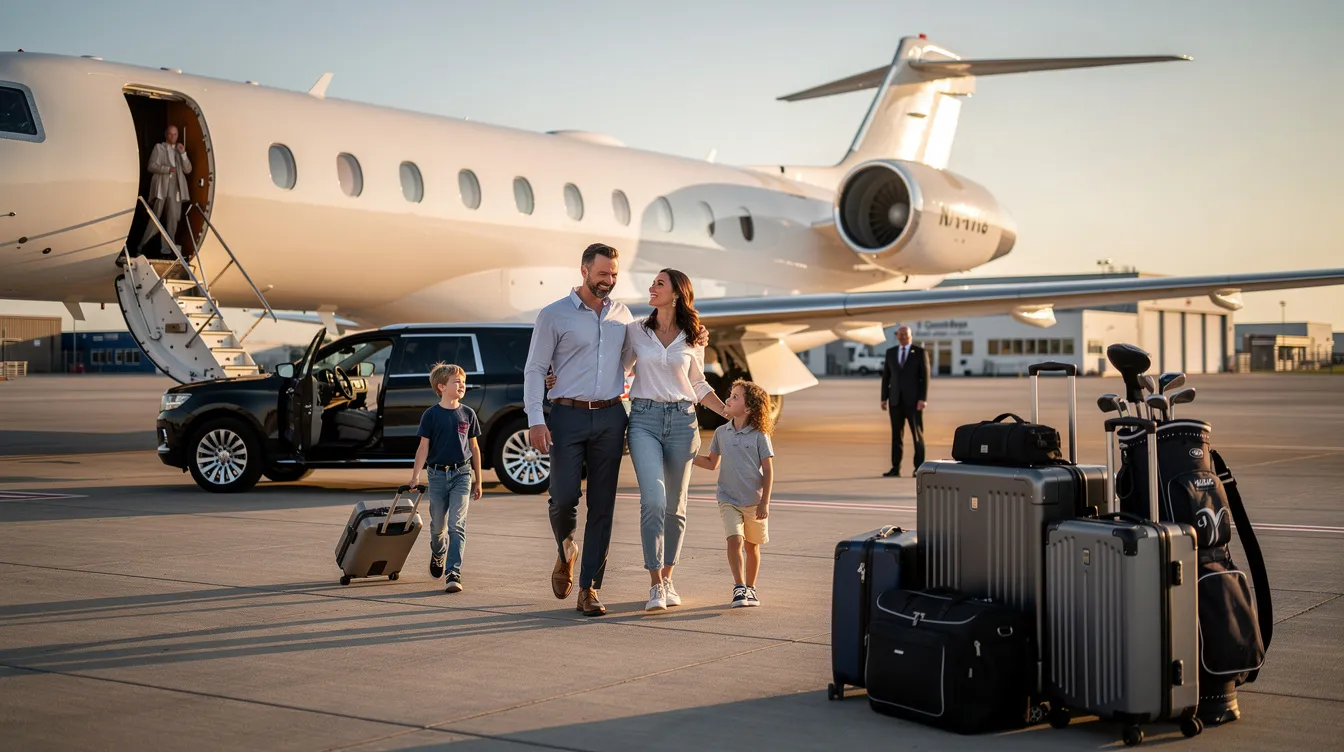
Private jet access is more than luxury; for executives, families, and discerning travelers, it is a strategic advantage. The right private flight saves time, avoids crowded terminals, and lets the trip fit the traveler—not the other way around. This guide is for executives, families, and frequent travelers considering or planning private jet travel with BlackJet. Knowing the baggage process and limits ensures a smooth, stress-free private jet experience.
Unlike commercial flights, where commercial airlines often limit you to one 23 kg / 50 lb checked bag and one carry-on, flying private gives far more flexibility. Still, how much luggage you can bring is not unlimited. It depends on aircraft model, aircraft size, route, runway, passengers, and safety.
BlackJet Jet Card members receive exact private jet luggage capacity guidance before every flight through 24/7 Member Services, so baggage becomes part of the flight plan—not a last-minute problem.
Do You Have to Check Bags on a Private Jet?
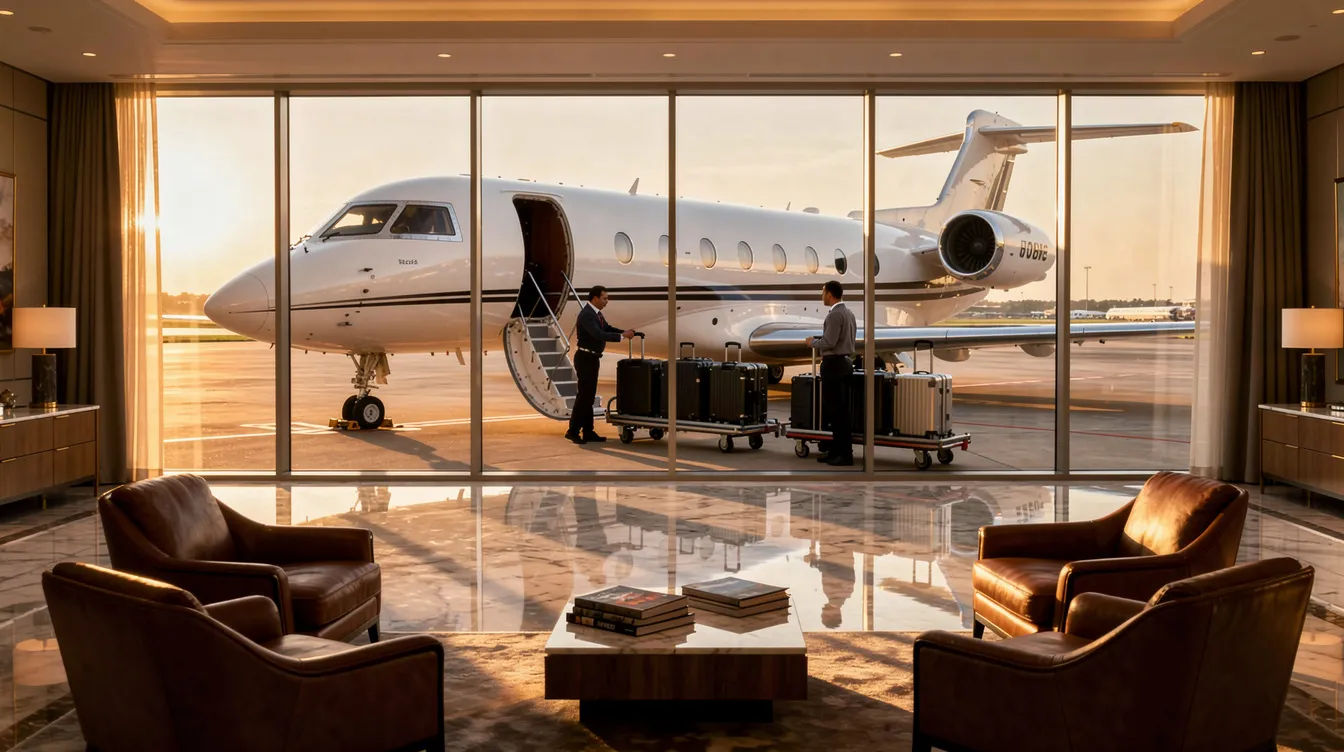
Yes, bags are “checked,” but a private jet baggage check is nothing like the commercial baggage process. At private jet terminals, known as Fixed-Base Operators, or fixed base operators, porters take luggage from your car trunk without the need for luggage tags or barcodes, and these facilities often serve smaller airports, which makes the curb-to-aircraft handoff even easier.
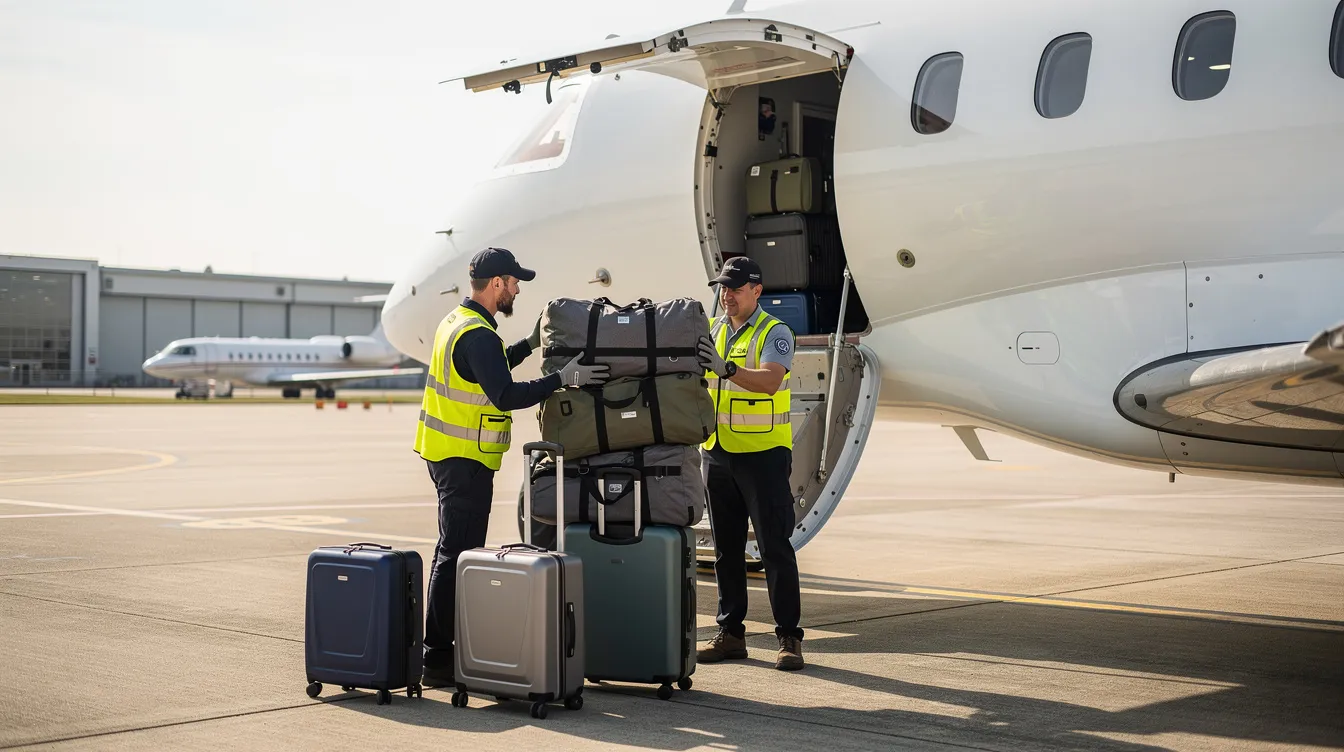
Private jet travel allows for the transfer of luggage directly to the flight crew or ground staff at the private terminal upon arrival. Ground crew carts bags to the aircraft and loads luggage directly into the hold, while you relax before boarding.
You typically arrive 15–30 minutes before departure. Staff visually verify your ID, match the manifest, and may do a quick bag check. No long security lines, no conveyor belts, no boarding groups, and no public terminal or main terminal stress. For BlackJet Jet Card flights, luggage details are pre-advised, making the curb-to-cabin baggage step often under five minutes.
Key Factors That Determine How Much Luggage You Can Bring
Private jet luggage requirements vary depending on the aircraft type and mission. The amount of luggage that can be brought on a private jet is determined by the aircraft’s physical storage capacity and weight limits, as well as the types of private jets available for each traveler and broader private jet size categories and capabilities.
Key factors include:
Aircraft size: a small jet or light jet has less baggage capacity than midsize jets, super-midsize jets, or large-cabin jets.
Weight: private jet operators focus on the aircraft’s Maximum Takeoff Weight (MTOW) and total payload rather than checking individual bag weights against an airline policy.
Payload: the total weight of luggage and passengers must stay within the aircraft’s specific maximum payload.
Performance: weight limits in private aviation are restricted by aircraft size, not airline rules.
Runway: Aspen, Telluride, heat, altitude, and shorter runways may require reducing much luggage to ensure safety.
Route: long flights such as Teterboro–London or Los Angeles–Hawaii may trade luggage capacity for extra fuel.
These limits exist for weight and balance purposes. Balance purposes are especially important because the flight crew must keep passengers, fuel, and baggage inside certified center-of-gravity limits.
Typical Luggage Capacity by Private Jet Category and Aircraft Model
Baggage capacity is measured in cubic feet, not by a strict number of pieces. Private jet luggage capacity varies significantly by aircraft model, with smaller jets like the Embraer Phenom 300 offering 76 cubic feet of luggage space, while larger jets like the Gulfstream G650 can accommodate up to 195 cubic feet. Travelers considering the most spacious options may look at the largest private jets for sale and charter.
Below is a table summarizing typical luggage capacities and passenger counts by private jet category and representative aircraft models:
Jet Category | Aircraft Model | Typical Passengers | Approximate Luggage Capacity (cubic feet) | Typical Luggage Examples |
|---|
Light Jets | Embraer Phenom 300 | 4–7 | 76 | 4–6 medium suitcases plus soft bags |
| Cessna Citation CJ3+ | 4–7 | 70–80 | Similar to Phenom 300 |
Midsize Jets | Citation XLS/XLS+ | 6–8 | 70–90 | Business trip luggage for 6 executives |
| Hawker 800XP | 6–8 | 70–90 | |
Super-Midsize Jets | Challenger 350 | 8–9 | 100+ | Larger luggage, some in-flight access |
| Citation Sovereign+ | 8–9 | 100+ | |
Large-Cabin Jets | Gulfstream G450 | 12–16 | 169 | Families, sports gear, oversized luggage |
| Gulfstream G550/G650 | 14–18 | 195 | Long flights, multiple large bags |
Ultra-Long Range | Bombardier Global 6000 | 13–17 | 170–190 | International travel, varied luggage |
The luggage capacity on a private jet is influenced by the number of passengers and the specific aircraft type, with larger jets generally allowing for more luggage per person compared to smaller jets.
Private Jet Baggage Restrictions vs Flying Commercial
Flying commercial means rigid fees, liquid rules, and overhead-bin competition. Flying privately is different: luggage restrictions are about physics, security, and local laws—not airline pricing, and understanding whether chartering a private jet is worth it financially helps put those differences in context.
Liquid size limits imposed by TSA do not apply to private jet travel, allowing passengers to bring full-sized liquids into the cabin. Private jet passengers enjoy far fewer limitations on what they can bring compared to commercial flights, allowing for items like skis, golf clubs, and full-size liquids, while also benefiting from the ability of many private jets to fly higher than commercial aircraft for smoother, faster routes.
When flying privately, passengers can carry on multiple personal items, such as purses and laptops, without the restrictions typically imposed by commercial airlines. That said, private aviation does not mean you can bring absolutely anything.
Federal regulations restrict dangerous goods, including explosives and flammables, from being brought on board private aircraft. Hazardous materials, prohibited items, certain batteries, firearms, and regulated substances must follow aviation rules, charter operator policies, and other countries’ requirements. Alcohol may be carried, but the flight crew generally controls service.
How Private Jet Security and Customs Work for Your Bags
Private jet security feels effortless, but it is not casual. There are no commercial TSA checkpoints for private jet travel, as luggage is screened discreetly by the flight crew or private security personnel, all within the broader framework that makes private jets a very safe mode of air travel.
Private jet passengers do not typically go through TSA security checks, as their security measures differ from those of commercial flights. Security measures for private jets include background checks, identity verification, and baggage screening, which are implemented by private jet operators rather than TSA.
Private jet terminals, known as Fixed-Base Operators (FBOs), have their own security protocols that include identity verification and baggage checks, providing a streamlined yet secure process for passengers. Bags rarely go through X-ray machines, and staff visually verify your ID. While private jets do not go through TSA, they are still subject to security measures that may include random checks and inspections of both passengers and luggage.
For international flights, a private plane does not skip customs. You still need passports, visas, declarations, and sometimes inspections. A BlackJet member flying from New York Teterboro to London Stansted in 2026 may clear customs in a private arrivals area, with selective bag review and quick access to the car. Agricultural rules in the U.S., Switzerland, Australia, and other international destinations with strict controls may affect food, plants, or valuables.
Packing Smart for a Private Flight: Practical Luggage Tips
Here are practical ways to make private jet travel smoother when you fly with a provider like BlackJet and its premium private jet card programs, especially if you are comparing the best jet cards for frequent flyers:
Use soft-sided bags. Soft-sided bags are recommended because they can be compressed and stacked to maximize space.
Keep essentials in the cabin: documents, devices, medication, and one change of clothes.
Share the exact passenger count and luggage before the trip so your aircraft category aligns with your needs and overall jet card cost structure.
Mention oversized luggage, car seats, strollers, skis, golf clubs, or instruments at booking.
For December holidays or summer Europe trips, add luggage notes early in BlackJet’s digital platform so the aircraft choice, routing, and jet card cost per hour all reflect your real baggage needs.
On certain aircraft models, passengers can access their luggage during the flight, providing added convenience compared to commercial travel. On others, bags stay in external holds until arrival.
Special Items: Pets, Sports Gear, Instruments, and Valuables
One reason private jet travelers fly private is the ability to carry what commercial airliners make difficult. On private jets, passengers can typically bring a greater variety of items compared to commercial flights, including oversized luggage, sports equipment, and even pets, with fewer restrictions on the quantity and type of luggage—especially on larger-cabin aircraft such as the best private jets for around 20 passengers and other private jet options ideal for 15 passengers.
Dogs and cats can often travel in the cabin with advance notice, though international health documents and import rules apply. Private jets allow for the transport of oversized luggage and specialized items, such as sports equipment and musical instruments, which are often restricted on commercial flights.
Surfboards, bicycles, skis, and golf clubs usually fit midsize and larger jets, but dimensions matter, and very large groups may look at private jets that accommodate around 30 passengers or even private jets suited for up to 50 passengers when baggage lists grow. Fragile art or instruments may need cabin straps. Firearms and hunting gear may be allowed with permits, prior notice, locked cases, and unloaded storage. Keep watches, jewelry, and documents with you for added peace.
How BlackJet Jet Cards Simplify Baggage Planning
With an ad-hoc charter, baggage questions can change from trip to trip. BlackJet’s 25+ Hour Jet Card and 50-hour Jet Card programs make private jet access more predictable by matching luggage requirements to aircraft category, while savvy travelers also consider jet card tax deduction strategies when planning overall usage.
Through BlackJet’s mobile booking platform, members can select aircraft, add passengers, note “8 large suitcases and 2 golf bags,” and receive suitability guidance. This helps confirm whether to choose a light jet, midsize option, or larger aircraft, and pairs naturally with evaluating 25-hour jet card features and costs versus a 50-hour jet card program.
BlackJet works with audited, certified operators and enforces manufacturer and regulatory limits. That is how a premier private flight remains safe, efficient, and refined, while transparent jet card pricing structures keep total trip costs predictable. BlackJet flights are carbon-neutral as of 2024, with offsets calculated from actual fuel burn, including the weight impact of luggage.
Compared with owning a plane, there is no plane owner responsibility, maintenance burden, or fixed fleet limitation, and travelers who might otherwise research the cheapest private jet options or broader budget-friendly private aircraft choices often find Jet Cards more practical. Compared with standard charter, Jet Cards provide unparalleled flexibility, real-time support, and unparalleled service—particularly in larger commitments like a 100-hour jet card program, which can be evaluated alongside a comprehensive private jet price list and cost overview.
Frequently Asked Questions About Private Jet Baggage Check
How much luggage can a light jet carry for 4 passengers?
For a two-hour regional flight, expect roughly 4–6 medium bags plus carry-ons, depending on fuel, aircraft, and weather.
Do TSA liquid rules apply in the United States?
No standard 100 ml / 3.4 oz airport security liquid rule applies in most private jet travel, though local laws and operator discretion still matter.
Can I access bags during the flight?
Some midsize and large aircraft have internal baggage access. Many light jets require baggage to remain in external holds.
What if luggage exceeds capacity on departure day?
BlackJet may recommend a larger aircraft, shipping overflow baggage, or adjusting the load to maintain weight restrictions, often by moving from small private aircraft options to a bigger jet category.
Do international flights skip immigration?
No. You still clear customs and immigration, but the screening process is usually handled privately and quickly at the FBO, even on large charter flights for around 100 passengers.
Can I fly with pets, firearms, or expensive equipment?
Yes, often, but documentation, permits, insurance, and advance notice are essential, especially when you charter a small private plane where cabin layout and baggage holds are more constrained.
How early should I arrive with 10–12 suitcases?
Arrive 20–30 minutes early so baggage can be loaded and verified without delaying the flight, particularly if you are flying on a 12-seater private jet where weight-and-balance planning is precise.
Conclusion: Make Every Private Flight Effortless-Bags Included
Private jet baggage check is more flexible than flying commercial, but it is still guided by aircraft performance, payload, safety, and security. The key is choosing the right aircraft model, understanding how much it costs to rent a private jet, and sharing accurate luggage details in advance.
With BlackJet, certified operators, carbon-neutral private jet travel, 24/7 support, and technology-enabled Jet Card planning turn baggage into a simple formality, and frequent flyers may even evaluate unlimited private jet flight memberships for maximum flexibility.
Explore BlackJet Jet Cards and speak with a flight specialist to design a private aviation strategy where every bag, passenger, and journey is handled with precision, whether you are comparing Flexjet jet card costs, learning how to buy a seat on a private jet, exploring small private jets and luxury travel options, or planning private jet charters in Karachi.


 Sign up with google
 Sign up with Apple