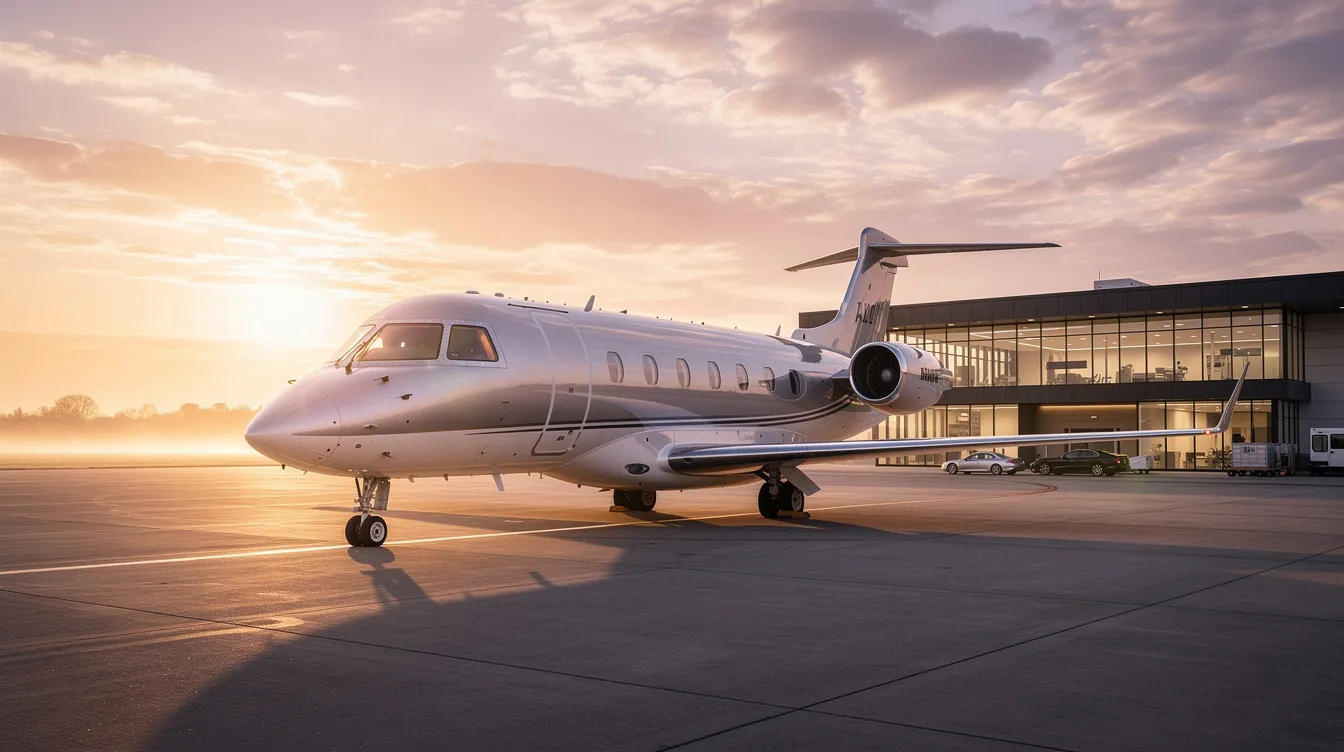
Private jet access is not only a luxury; for executives, family offices, sports groups, and high-performing teams, it is a strategic advantage. The Embraer 175 jet sits in a rare category: large enough to move a group in comfort, yet efficient enough for regional missions where schedule control matters most.
This guide explains how the Embraer 175 works, why it remains relevant in 2026, and how BlackJet’s Jet Card model can make E175-class aircraft access more seamless, safe, and carbon-neutral.
Why the Embraer 175 Matters for Discerning Private Travelers
Regional jets like the Embraer 175 are not just smaller airliners. They are practical tools for travelers who value time, privacy, and control. On a commercial San Francisco–San Jose–Los Angeles business loop, a traveler may lose hours to security, boarding, gate delays, and airport transfers. With a privately arranged aircraft, the trip can be built around the meeting calendar rather than airline schedules.
For example, a team could depart from San Jose in the morning, fly to Los Angeles, return through San Francisco, and avoid fragmented commercial bookings. Instead of sitting through standard terminal procedures, passengers board through private facilities, use tailored catering, and preserve confidentiality.
The Embraer 175 bridges traditional private jets and a commercial airliner. It offers regional-jet economics with a larger cabin, 2+2 seating, no middle seats, strong short to mid-range flights performance, and modern cockpit technology. BlackJet gives members premium Jet Card access to multiple private jet categories and to aircraft in the Embraer 175 class where available, supported by safety-certified operators, carbon-neutral flights, and digital booking tools.
Embraer 175 Overview and Core Specifications
The Embraer 175 is part of the first-generation Embraer E-Jet family, optimized for regional routes and typically operated by airlines with 70–88 seats. The first Embraer 175 was delivered to Air Canada in July 2005 and began commercial service with the airline that same month.
Key specifications include an overall length of 98 feet (31.68m), an overall height of 32 feet (9.73m), and a wingspan of about 85 feet. Its max take-off weight is around 89,000 lb, while maximum payload capacity can range from 22,112 lbs based on a specific variant. The airplane can fly at a maximum operating speed of 0.82 Mach, reach a maximum service ceiling of 41,000 feet, and cover a range of 1,700 to 2,000 nautical miles, depending on the variant.
The Embraer 175 features a low-wing monoplane design with a conventional-tailed body, designed for short to mid-range flights. It uses GE CF34-8E engines and is equipped with a fly-by-wire flight control system. The cockpit is designed for a common type rating across the E-Jet family, allowing greater flexibility in crew assignments.
The aircraft incorporates approximately 86 percent of common parts used by the entire E-Jet commercial family, facilitating easier maintenance. It was also designed to meet U.S. airline scope clause compliance, making it suitable for operation by regional carriers. As of 2024, the E175 continues in production, driven by strong demand from U.S. regional airlines that are restricted from ordering the newer E175-E2 model due to scope clause limits on maximum takeoff weight.
Specification | Details |
|---|
Length | 98 feet (31.68 m) |
Height | 32 feet (9.73 m) |
Wingspan | ~85 feet |
Maximum Takeoff Weight (MTOW) | ~89,000 lbs |
Maximum Payload | Up to 22,112 lbs |
Maximum Operating Speed | 0.82 Mach |
Service Ceiling | 41,000 feet |
Range | 1,700 - 2,000 nautical miles |
Engine Type | GE CF34-8E turbofan |
Seating Capacity | 76 - 88 passengers (airline config) |
In its operational niche, the E175 works well for stage lengths of roughly 1,800–2,000 nmi, including San Francisco–Seattle or San Jose–Denver. Most aircraft remain in commercial service, but select operator networks can configure E175-class options for high-end charter, Jet Card, and group travel for travelers comparing whether chartering a private jet is worth it versus commercial options.
Cabin Experience, Middle Seats, and Aircraft Features
The E175 features a double-bubble fuselage design, which maximizes personal space and provides more shoulder and headroom than competing aircraft. With a cabin height of 6.5 feet (2 m), most adults can stand completely upright. The main cabin uses four-abreast 2+2 seating as standard, giving every passenger either a window or aisle position.
The Embraer 175 typically accommodates approximately 78 passengers in a single-class setup, 76 in a two-class layout, and can seat up to 88 in a high-density arrangement. The aircraft typically seats between 76 and 88 passengers, depending on the configuration chosen by the airline, and U.S. regional carriers operate it under scope-clause limits that cap seating and weight thresholds. A typical layout includes a small First Class cabin, extra-legroom row options, and Economy, a format that helped drive early airline adoption.
Private or semi-private configurations are different. Fewer seats, often 30–40, allow enhanced pitch, recline, leather finishing, meeting zones, and fitted catering galleys, similar to other private jets that accommodate around 30 passengers. The Embraer 175 features a flexible seat configuration that allows airlines to adjust capacity based on market demand, enhancing operational efficiency; the same concept helps private planners match cabin layout to the mission.
Passenger-facing aircraft features can include Wi-Fi, in-flight media options, overhead bins, power outlets in premium areas, spacious lavatories, and a quieter, more modern interior. For executives, the point is workflow: passengers can spread out documents, hold a cabin-wide briefing, and turn the plane into a moving office.

Performance, Range, and Operating Profile
The Embraer 175 is built for frequency: quick turnarounds, efficient climb, and reliable regional operations. Its design choices and support maturity led to efficient regional performance, helping drive early airline adoption. It generally climbs to cruise in under 20 minutes, cruises around Mach 0.78–0.80, and can operate up to 41,000 feet.
Range depends on the variant, payload, reserves, and weather. The std model is commonly associated with shorter regional missions, while airline configurations that helped make the E175 an early service favorite still vary, anLRlr and advanced-range variants extend flexibility toward the upper end of the 1,700–2,000 nmi band. Lower-density private layouts can also improve practical mission planning because total passenger weight and cargo may be lower.
Runway performance depends on conditions, but the aircraft can use many secondary and regional airports with runways in the 4,000–4,500 ft range under standard assumptions. That capability is important when the best airport is not the largest airport.
Consider a BlackJet member planning a product roadshow: San Jose–San Diego–San Francisco in one day. The aircraft can take off on the member’s schedule, keep the same group together, and reduce the time spent waiting between flights. For teams that travel every week, those saved hours compound, especially when they understand how private jets maintain high safety standards through rigorous regulation and oversight.
Safety, Technology, and Environmental Performance
The E175 has a strong safety and reliability profile across the E-Jet family. By July 2020, approximately 25 million passengers had flown on Air Canada's E175 fleet, which had accumulated around 650,000 flight hours. That kind of utilization reflects mature engineering, maintenance support, and pilot familiarity.
The cockpit uses large displays, a modern flight management suite, redundant systems, and fly-by-wire controls. The common type rating approach across the E-Jet family helps operators manage crew planning and training requirements more efficiently. In the U.S., flights are governed by FAA standards, while international missions follow the applicable authority in each jurisdiction.
GE CF34-8E engines are valued for proven reliability, efficient fuel burn, and broad support infrastructure across North America and Europe, even if they do not match the ultra-long-range capabilities of the largest private jets for intercontinental missions. Embraer, as a manufacturer, also benefits from continuing global support and parts commonality, while the newest generation of private jets pushes boundaries on range, speed, and cabin technology at the top end of the market.
Environmental performance matters too. Wing design improvements and winglets help reduce fuel burn and emissions, while regional jet economics can be favorable per seat when the aircraft is well matched to demand. BlackJet connects this directly to service: every BlackJet flight, including aircraft in the Embraer 175 category when available, is offset to carbon neutral as part of the core experience, not an add-on.
How Embraer 175-Class Aircraft Fit into BlackJet’s Jet Card Model
BlackJet’s 25+ hour Jet Card programs, including 25-hour and 50-hour plans, give prepaid access across multiple aircraft categories, and travelers evaluating options can look at a dedicated, complete guide to the 25-hour Jet Card to understand how such structures work. For the smallest aircraft missions, a light jet may be best, and some travelers will instead focus on choosing among the best small private aircraft for specific mission needs. For around 20 travelers, large-cabin private jets designed for 20 passengers can be an option, while for 20–40 travelers, corporate shuttles, sports teams, or multi-city roadshows, an Embraer 175-class aircraft can be the better fit; understanding the broader types of private jets for different traveler profiles helps match each mission to the right category.
Booking is designed to be simple. A member opens the BlackJet app or portal, enters departure site details such as San Francisco or San Jose, group size, destinations, date, catering preferences, and itinerary needs. The system and advisor team then recommend the appropriate class.
Compared with owning a similar aircraft, understanding the full Jet Card cost and structure, and reviewing how Jet Card cost per hour works across aircraft types highlights that Jet Card access offers:
No capital expenditure or depreciation exposure, while Jet Card pricing structures and comparisons of the best jet cards for frequent flyers keep hourly costs predictable
No direct crew, maintenance, hangar, or insurance responsibility
Access to larger jets is only available when the mission requires them, including ultra-long-range private jets optimized for nonstop international travel, as well as other private jet sizes tailored to different journey lengths and group needs
24/7 support, manifests, itineraries, and catering details handled digitally
Curated operators that meet BlackJet’s safety certification standards, similar to the rigor seen at top private jet companies worldwide, and aligned with transparent benchmarks like those discussed in a comprehensive private jet price list and access model overview
For the best experience, members should share passenger count, baggage, cargo needs, timing flexibility, and privacy preferences at the start. If you scroll through a trip view in the platform, you should notice how each detail supports a smoother board, flight, and landing process.
Route Examples: Embraer 175 from San Francisco and San Jose
Bay Area travelers often need flexibility across multiple airports. From San Francisco, an E175-class aircraft may be well-suited for Seattle, Las Vegas, Aspen, Vancouver, or other destinations where a larger group needs direct routing and coordinated ground transfer.
A San Jose-based example is even clearer. A tech firm needs to move 30 team members from San Jose to Phoenix for a conference, continue to Los Angeles for a product launch, and return within 36 hours, using planning logic similar to organizing charter plane solutions for around 100 passengers but scaled to a smaller group. A single Embraer 175-class aircraft can keep the group together, support a catered working breakfast onboard, and deplane into private terminals for rapid city access.
The advantage is not only flight time. It is consolidated security, private terminal handling, tailored departure times around board meetings, and less exposure to airline disruption. Commercial airlines may offer seats, but they rarely offer control.

Comparing the Embraer 175 to Other Private Aircraft Options
The right aircraft depends on mission profile, passenger count, privacy requirements, and cost efficiency. A light or midsize jet is often ideal for four to six passengers on a short hop, while private jets sized for about 15 passengers work well for mid-size groups. But when a company needs to move several dozen people, multiple smaller aircraft can create complexity.
Compared with light and midsize jets, the Embraer 175 offers a larger and wider cabin, more seats, more baggage flexibility, and better space for movement, similar in spirit to top 16-seat private jet options for comfort and convenience. The tradeoff is a higher hourly cost and more planning requirements, much as buyers evaluating the cost of a 12-seater private jet must weigh ownership expenses against flexibility.
Compared with long-range large-cabin business jets, the E175 cannot match intercontinental range. A Gulfstream or Global-type aircraft is better for nonstop oceanic missions; even a Boeing business jet serves a different category, as illustrated by the top private jets in the world for luxury and performance. But for high-frequency regional routes, the E175 can deliver strong economics and comfort.
BlackJet advisory support helps members understand when the Embraer 175 is the right tool and when another airplane is more appropriate, including whether owning a pre-owned $5 million light or midsize jet makes sense versus using access models, or if it is more efficient simply to understand how much it costs to rent a private jet for specific trips. That prevents trial-and-error planning and keeps each trip aligned with budget, privacy, and timing needs.
Frequently Asked Questions About the Embraer 175 and Jet Card Access
How many passengers can an Embraer 175 accommodate in private configurations?
In airline layouts, the Embraer 175 usually carries 76–88 passengers. In private or semi-private configurations, the capacity is often reduced to around 30–40 passengers for better recline, spacing, privacy, and service.
Can an Embraer 175 fly nonstop from San Francisco to destinations like Chicago or Houston?
When nonstop range is critical, or you need the capabilities of the largest private jets on the market, or even private jets configured for 50 passengers, other aircraft classes may be preferable.
Often, yes, depending on variant, payload, reserves, weather, and routing. With a range of 1,700 to 2,000 nautical miles depending on the variant, missions such as San Francisco to Houston are well within typical planning, while Chicago may require closer operational review; ultra-long missions or ultra-luxury use cases are better suited to the most expensive private jet options, while frequent regional flyers may instead compare a 50-hour Jet Card cost guide against owning an aircraft outright.
How does BlackJet ensure safety on Embraer 175 flights?
Whether booking a full aircraft or buying a single seat on a private jet, safety due diligence around operators, maintenance, and crew standards remains essential, and it becomes even more critical as group size grows into 100-passenger charter arrangements.
BlackJet works with operators that meet stringent safety, certification, pilot experience, and maintenance standards. Each flight is operated by a qualified operator, with aircraft maintenance aligned to regulatory and manufacturer requirements, comparable to the rigor seen in major providers discussed in NetJets jet card cost and program overviews and analyses of Flexjet Jet Card pricing and options.
Are Embraer 175 flights with BlackJet carbon neutral?
For travelers comparing options, it’s worth noting that even cheaper private aircraft and budget-friendly access models can be paired with sustainability initiatives to manage environmental impact, whether pricing is being evaluated in dollars or via a dedicated guide to private jet prices expressed in rupees.
Yes. BlackJet offsets every flight to carbon neutrality, including Embraer 175, while also guiding clients who explore the most affordable private jet options on how to balance cost with sustainability and, for very frequent users, whether a 100-hour Jet Card cost structure offers better value than ad hoc flying.
Conclusion: Elevate Your Regional Travel with the Embraer 175 and BlackJet
For discerning travelers who demand efficiency, comfort, and control, the Embraer 175 jet represents an ideal balance between regional performance and private aviation convenience, while some clients will also explore premium private jets for sale in the UK market when long-term ownership better fits their strategy. Its spacious cabin, flexible configurations, and proven reliability make it a standout choice for groups needing seamless, productive journeys within a 2,000-nautical-mile range.
BlackJet’s Jet Card programs unlock access to this exceptional aircraft class without the burdens of ownership, delivering safety-certified operations, carbon-neutral flights, and personalized service. Whether coordinating a corporate roadshow, family trip, or sports team travel, the Embraer 175 combined with BlackJet’s expertise transforms regional flight into a strategic advantage.
Discover how effortless private jet access can reshape your travel experience. Explore BlackJet’s offerings and elevate your next journey with the Embraer 175—where performance meets prestige and every detail is tailored to your needs.


 Sign up with google
 Sign up with Apple