For people who measure productivity in hours reclaimed rather than miles flown, international flight planes are not a luxury—they are infrastructure. This guide covers the types of international flight planes available, how to plan global routes, safety and compliance considerations, the role of technology, sustainability efforts, and how BlackJet’s Jet Card programs simplify international travel for business executives and high-net-worth individuals. Whether you are a business traveler, executive, or high-net-worth individual, understanding the landscape of international private aviation is essential for saving time, maximizing productivity, and ensuring seamless travel across borders. In a world where every hour counts, the right aircraft and support systems can transform complex global journeys into efficient, comfortable, and secure experiences.
Strategic Advantage of International Private Flights vs. Commercial When Traveling to More Than One Country
International flights typically connect major cities or continents, and commercial airlines use wide-body aircraft with two aisles to carry large numbers of passengers in relative comfort. (Wide-body aircraft have two aisles, allowing for more passengers and better comfort.) Airlines offer four service classes—Economy, Premium Economy, Business, and First Class—yet cabin comfort varies depending on the airline's seating configuration, and even first class cannot eliminate the hours lost to airport logistics.
Consider a business executive flying from New York to London. Commercial first class means arriving at JFK two to three hours early, navigating security, enduring a seven-plus-hour flight, then customs, baggage claim, and ground transfer—easily twelve to fourteen hours door-to-door. A BlackJet Jet Card flight from Teterboro compresses that journey to roughly eight to nine hours: check-in takes twenty to thirty minutes, baggage is handled personally, the cabin is entirely private, and in-flight meetings happen without interruption from other passengers.
BlackJet's 25+ Hour Jet Card membership—available in 25-hour and 50-hour blocks—unlocks on-demand access to international-capable aircraft without the burden of ownership, offering a structured alternative to more experimental models like unlimited private jet flight memberships. Every ride is supported by four pillars that run through this article: safety certification, carbon-neutral flights, a digital booking platform, and real-time flight support on cross-border missions.
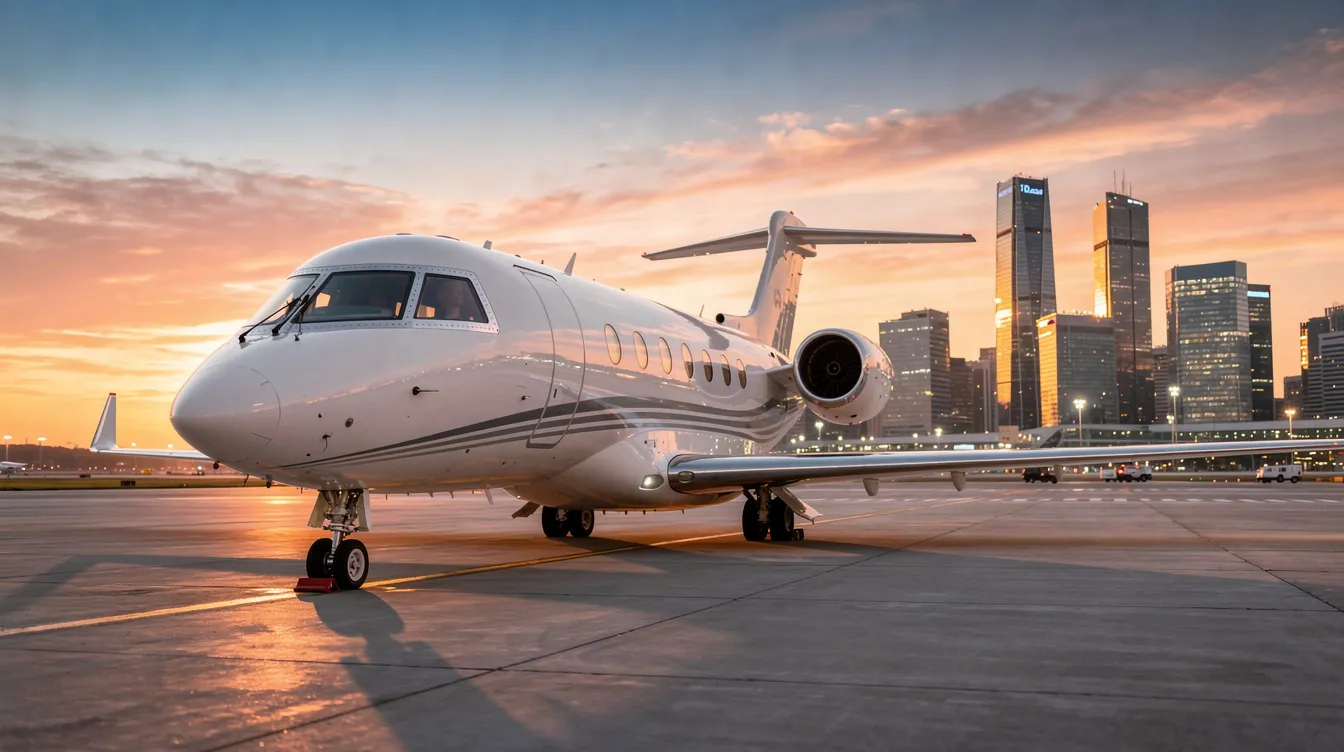
Types of International Flight Planes in Private Aviation
Not every private jet can efficiently cross oceans. Aircraft type significantly influences cabin layout and available amenities, so selecting the right category defines which routes are realistically non-stop. In the world of commercial aviation, large aircraft are essential for high-capacity transoceanic travel—the Airbus A380 and Boeing 747 are designed to transport large numbers of passengers, and long-haul aircraft usually carry between 200 and 450 passengers, even as savvy travelers look for ways to fly private at a lower cost when they need more control over time and routing. Airlines use wide-body jets for long-haul flights due to their larger space and comfort. But passenger demand influences the choice of aircraft for specific routes, and in private aviation the calculus shifts from volume to precision.
Midsize jets such as the Citation Latitude and Learjet 60XR handle shorter international hops—Miami to Cancún, Geneva to Marrakesh—with four-to-five-hour range and fit well for intra-Europe missions.
Super-midsize jets like the Challenger 350 and Gulfstream G280 serve as workhorses for transcontinental routes—Chicago to Reykjavík, Toronto (Ontario, Canada) to Lisbon—balancing fuel economy with cabin comfort and reaching up to 3,600 nautical miles; the same class is often used for regional missions such as private jet charters in Karachi or other key business hubs.
Heavy and ultra-long-range jets such as the Gulfstream G650ER, Bombardier Global 7500, and Dassault Falcon 8X are the primary international flight planes for non-stop sectors. The G650ER offers roughly 7,500 nautical miles of ferry range, enabling non-stop flights from New York to London, London to Dubai, or Los Angeles via Honolulu to Tokyo. Cabins feature lie-flat seating, dedicated work zones, conference tables, and in some configurations private bedroom suites—so executives arrive boardroom-ready. Long-haul flights last over six hours and prioritize passenger comfort, and these vehicles deliver exactly that.
Aircraft Category | Typical Models | Range (Nautical Miles) | Typical Routes | Passenger Capacity | Cabin Features |
|---|
Midsize Jets | Citation Latitude, Learjet 60XR | ~2,500 - 3,000 | Miami to Cancún, Geneva to Marrakesh | 7-9 | Comfortable seating, suitable for short international hops |
Super-Midsize Jets | Challenger 350, Gulfstream G280 | Up to 3,600 | Chicago to Reykjavík, Toronto to Lisbon | 8-10 | Enhanced cabin comfort, good fuel economy |
Heavy & Ultra-Long-Range Jets | Gulfstream G650ER, Bombardier Global 7500, Dassault Falcon 8X | Up to 7,500 | New York to London, London to Dubai | 12-18 | Lie-flat seats, work zones, conference tables, private suites |
While industry leaders in ground transportation—like IC Bus, headquartered in Illinois, and the Traton Group—focus on sustainable mobility and fuel economy in trucks and commercial buses, their mission is different from ours, with real-world fleet experience often measured through feedback from drivers. For context, those fleets build international trucks with engines like the S13 Integrated Powertrain, which is 2027 EPA ready, uses 90% of unchanged powertrain components from previous models, and is at least 5% more fuel efficient. The T14 Transmission enhances performance and efficiency in trucks, and the International LT truck is 5% more fuel efficient than competitors, a gain operators see in daily routes, while using up to 3.5% more DEF per gallon of fuel to meet emissions standards. BlackJet's focus, by contrast, is exclusively on airframes optimized for long-range, high-speed, premium travel, including large-cabin aircraft that are often considered the best private jets for 15 passengers on complex international itineraries. Wide-body aircraft are used in commercial aviation for their large fuel capacity and passenger comfort; private jets trade capacity for exclusivity and time savings.
BlackJet's premium Jet Card programs give members access across multiple cabin classes, allowing them to right-size the aircraft to each itinerary rather than being locked into a single jet—a smart approach that protects both budget and productivity, whether you are weighing the economics of a 12-seater private jet for a core executive team or a smaller cabin for leaner trips.

Planning International Routes: Range, Fuel Economy, and Performance
International routes require careful planning regarding routes and crew management, and BlackJet's operations team manages this complexity so members never have to, whether the mission originates in New York, Dubai, or emerging private aviation centers served by private jet charters in Lahore. Every detail—range, payload, weather, fuel economy—is calculated behind the scenes, just as a clear grasp of private jet charter pricing fundamentals helps travelers understand how those variables translate into total trip cost.
Take a closer look at range: the G650ER's book range is approximately 7,700 nautical miles, but with reserves for alternate airports, headwinds, and a full passenger load, real-world range drops closer to 6,500 nautical miles. For shorter sectors, especially point-to-point hops that do not require long-range aircraft, understanding the cost to charter a small plane helps determine when right-sizing the jet unlocks the best value. Winter westbound crossings of the North Atlantic can cut range further. Sometimes a short tech stop—say, Los Angeles to Fiji via Honolulu—actually improves fuel economy and operational safety by reducing takeoff weight.
Modern avionics and optimized flight-planning software form part of a connected digital ecosystem that links weather data, NOTAMs, and aircraft systems to minimize fuel burn and delays, while altitude optimization—understanding how high a private jet flies compared to commercial aircraft—further refines route efficiency and comfort. In commercial aviation, the Boeing 787 Dreamliner is known for fuel efficiency and passenger-friendly features, while the Airbus A350 is recognized for its long-range capabilities and modern cabin design. Private aviation mirrors this drive toward efficiency: optimal cruise altitudes, step-climb profiles, and route selection reduce total CO₂ per sector—accelerating sustainability goals.
Jet Card members see this as simple options—non-stop versus one-stop, ETD and ETA—while BlackJet's team handles every performance calculation and global handling requirement, reaching solutions before problems reach you, even as new long-range private jets push range, speed, and cabin innovation further each year and expand the field of the largest private jets available for sale and charter for ultra-high-capacity missions.
Safety, Certification, and Cross-Border Compliance
Safety is non-negotiable on international flights. Oceanic crossings, remote alternates, and varying national regulatory regimes create layers of complexity that demand rigorous collaboration between operators, crew, and support teams.
BlackJet partners exclusively with operators holding top-tier ratings—ARGUS Platinum, Wyvern Wingman, and IS-BAO Stage 2 or 3—certifications that matter even more on long-haul and night-ocean flights, positioning it alongside leading private jet companies in safety and global reach while still competing with the most expensive private jet experiences on comfort, privacy, and service. International flights involve additional regulations compared to domestic flights, and international aviation authorities define and oversee flight operations for security across nations.
Crew requirements for international missions include thousands of minimum flight hours, specific type ratings, recurrent training in oceanic procedures involving HF radio protocols, and scenario-based simulator checks, all of which factor into the broader economics of how much a private jet pilot costs when comparing ownership to access models like Jet Cards. Cross-border compliance—overflight permits, landing permits, APIS submissions, customs and immigration procedures for the Schengen Area, the UK, UAE, and Caribbean—is managed entirely by BlackJet's service team across more than one country, contributing to a safer world for every traveler.
A 24/7 operations desk monitors each international sector within a connected digital ecosystem of flight tracking, weather alerts, and security intelligence. For the traveler, this manifests as seamless arrivals through private terminals, expedited immigration, and pre-arranged ground transport—the impact felt only as effortless simplicity.
Technology and the Connected Digital Ecosystem of International Travel
Managing global travel from a phone should feel as intuitive as managing investments, and innovations like private jet rideshare platforms and modern options to buy a seat on a private jet are expanding what flexible access to the sky can look like. BlackJet's digital booking platform is designed with that vision: search for available aircraft by entering origin and destination—say, New York to Zurich—select a departure window and cabin class, and see options displayed on the page with estimated flight times and pricing against your Jet Card balance.
Behind the interface, aircraft availability, crew scheduling, maintenance status, and ground handling connect through a unified system that minimizes delays and last-minute changes—bringing greater uptime to every mission. Real-time support means members can talk to a flight specialist via in-app messaging or a direct line, adjusting departure times, adding passengers, or coordinating catering even within twenty-four hours of an international departure.
Pre- and post-flight digital touchpoints include secure document handling for passports, visas, and special permits; detailed Jet Card cost-per-hour transparency; insights that complement broader guides on how much it costs to rent a private jet; carbon-offset reporting per leg; and post-trip summaries for corporate travel managers to learn from and manage expenses. Compare this to the fragmented commercial experience—multiple airline apps, limited personalization, restricted schedule control—and the meaning of a member-centric interface becomes clear. Your browser becomes a cockpit for your entire journey.
Sustainability and Carbon-Neutral International Flights
Long-range international flight planes can be carbon-intensive, and high-net-worth travelers are increasingly accountable to boards, family offices, or personal values on climate impact, especially when weighing private travel for large corporate or group charters of around 100 passengers. BlackJet makes every international sector carbon neutral by default, at no additional cost to Jet Card customers.
Offsets are calculated per route: fuel burn per block hour, route length (for example, 3,450 nautical miles for New York to London), aircraft efficiency for even the world’s top-performing private jets, and resulting CO₂ tonnes matched 1:1 with certified credits. Projects span reforestation, clean energy, and advanced carbon removal—verified under Gold Standard and Verified Carbon Standard registries to avoid greenwashing. This story of accountability is central to our drive toward responsible aviation, and it extends to markets worldwide, including cost-sensitive regions where understanding private jet prices in rupees shapes how clients integrate sustainability into their travel strategy.
Aircraft and route choice amplify the effort: newer long-range jets and even more affordable private jet options can reduce fuel burn by double-digit percentages compared to older airframes while delivering the same luxury experience, much like the most budget-friendly private aircraft choices that balance efficiency with access in shorter-range markets. Disciplined scheduling, route optimization, and carbon accounting create a modern travel strategy—not unchecked flying, but aviation with purpose, whether you access aircraft via Jet Cards, on-demand charter, or long-term structures like private jet leasing programs. Understanding this detail helps every member see private travel as part of a broader commitment.
How BlackJet Jet Cards Simplify International Trips (Examples & FAQs)
Jet Cards convert complex international aviation logistics into predictable, prepaid flight hours—words that the majority of frequent travelers deserve to hear, and the best Jet Card programs for frequent flyers emphasize exactly this blend of guaranteed access and pricing clarity.
Use case one: A CEO based in york uses a 50-hour Jet Card over a year—roughly 12.5 hours per quarter for New York to London on an ultra-long-range jet, five hours for a São Paulo return, and remaining hours for a family trip to Rome. Hours are drawn down per block hour; employees handling corporate travel see transparent pricing with no hidden fees. The community of members benefits from priority access.
Use case two: A European family office in Geneva uses a 25-hour Jet Card for Geneva to Dubai, Geneva to Riyadh, and summer Mediterranean hops—selecting super-midsize or heavy category depending on each leg's life and distance requirements. Even tough routing decisions become simple. Dealers in ad-hoc charter cannot match this continuity.
Key guidance: For many travelers, understanding overall Jet Card pricing structures is the first step toward using these international examples effectively.
Book international sectors at least one to two weeks ahead for best aircraft selection; 24-48 hours minimum for permits, and use a 100-hour Jet Card cost framework to decide how many hours you should reserve upfront.
Peak days (holidays, major events) raise handling fees and tighten availability.
Ultra-long-range flights exceeding eight to ten hours may require augmented crew for rest compliance, particularly on missions using large-cabin jets for around 20 passengers.
Weather or ATC re-routing is managed in real time by BlackJet's support team, keeping disruption minimal, even on complex itineraries using private jets configured for up to 50 passengers.
How BlackJet compares: versus ownership, there is no capital lock-up, depreciation, or crew payroll to manage, and versus one-off charter, comparing whether chartering a private jet is worth it highlights the predictability advantages of a Jet Card. Even against other leading membership programs—where understanding NetJets Jet Card costs or alternative charter models is essential—BlackJet’s structure keeps international flying straightforward and transparent. Versus ad-hoc charter, members enjoy priority access, fixed hourly rates, and stronger service continuity, benefits that become clearer once you understand the broader private jet price landscape across ownership, charter, and membership models. Versus commercial first class, the sales pitch is straightforward—privacy, flexibility, and hours saved on every international leg, backed by transparent Jet Card pricing that converts those hours into predictable line items. Refer to our transatlantic private jet guide for route-specific detail. This is not merely a job of logistics—it is a way to connect your global life and business with precision.
Conclusion: Elevate Your Global Travel with BlackJet
International flight planes are more than just aircraft; they are strategic assets that redefine how high-net-worth travelers and executives connect across continents. BlackJet’s Jet Card programs offer unparalleled access to a carefully curated fleet of private jets optimized for range, comfort, and efficiency—transforming complex international itineraries into seamless, productive journeys. With a steadfast commitment to safety, sustainability, and cutting-edge technology, BlackJet ensures every flight is secure, carbon neutral, and supported by real-time global operations.
Choosing BlackJet means choosing flexibility without compromise: the ability to select the ideal aircraft for each mission, backed by transparent pricing and expert support. Whether crossing the Atlantic for business or exploring remote destinations, BlackJet’s international flight planes deliver not just convenience, but a premier travel experience that respects your time, values, and ambitions.
Explore BlackJet Jet Card membership for your next international mission—and discover how premium jet access can reshape the way you move through the world.


 Sign up with google
 Sign up with Apple


