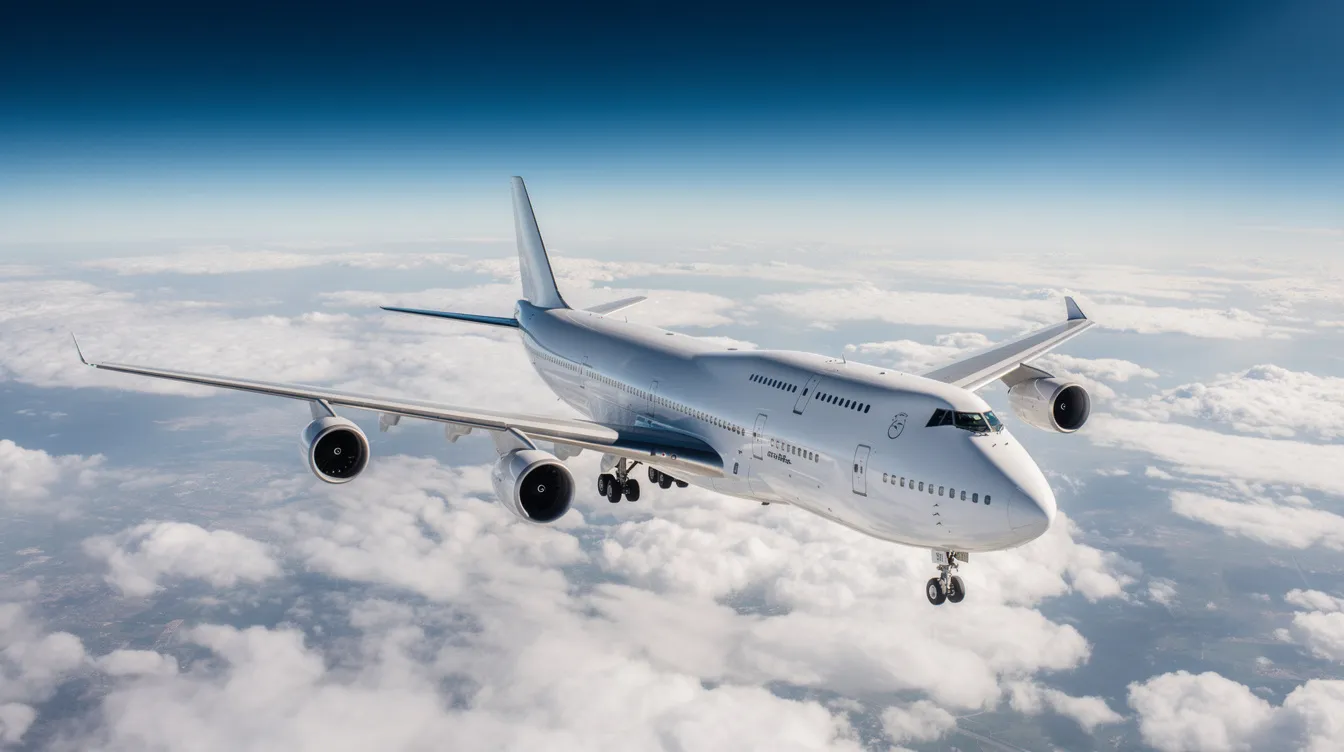
Quick Answer: 747-8 Wingspan in Feet and Meters
The Boeing 747-8 has a wingspan of 224 feet 7 inches (68.4 meters), making it about 13 feet wider than the 747-400 and the final evolution of the world’s most recognizable airplane. That added span reflects engineering ambition, aerodynamic refinement, and measurable gains in fuel efficiency, airport performance, and long-haul capability, including range of up to 8,000 nautical miles.
Both the 747-8 Intercontinental and 747-8 Freighter use the same 68.4-meter wingspan through a common wing design. For frequent business travelers and high-net-worth leisure flyers comparing commercial aircraft scale with private aviation options, that dimension gives useful context for how jumbo-jet design affects payload, cabin layouts, airport compatibility, safety, sustainability, and overall operating efficiency. It also helps clarify where an airliner like the 747-8 sits relative to the flexibility, privacy, and tailored experience offered by services such as BlackJet.
For context, here is how the 747-8 wingspan compares to other widebody aircraft:
Aircraft | Wingspan |
|---|
Boeing 747-8 | 68.4 m (224 ft 7 in) |
Boeing 777X | 71.80 m (in flight) |
Boeing 747-400 | 64.40 m (211 ft 5 in) |
Boeing 777-300ER | ~64.8 m (212 ft 7 in) |
Airbus A350-1000 | 64.75 m (212 ft 5 in) |
Boeing 787-10 | 60.10 m (197 ft 2 in) |
Airbus A380-800 | 79.75 m (261 ft 8 in) |
To frame the scale for private aviation travelers: a large-cabin business jet like a Gulfstream G650 has a wingspan of roughly 30 meters. The 747-8's wingspan is more than double that, reflecting the infrastructure and engineering demands of carrying hundreds of passengers across oceans.
Overview: The Boeing 747-8 and Its Place in Aviation
The 747 Legacy and Production
The Boeing 747 has been called the queen of the skies since it first entered service in 1970, ushering in a new era of mass long-haul air travel. Over five decades, Boeing produced 1,574 total 747 aircraft by 2023, making it one of the most consequential models in aviation history.
The Boeing 747-8 represents the final and most advanced chapter of that legacy. Boeing designed the 747-8 to incorporate innovative new technologies drawn from the 787 Dreamliner program. This created a technology connection between the two platforms.
First Flights and Deliveries
The airplane's first flight took place in 2010 from Paine Field in Everett, Washington, following an extensive flight test program. The freighter entered service first, while the 747-8 Intercontinental and other passenger variants followed soon after.
The first delivery of a 747-8F freighter went to Cargolux, the launch customer and cargo carrier, on October 12, 2011.
The first 747-8 Intercontinental passenger variant was delivered to Lufthansa on May 5, 2012, making it the first airline to operate the 747-8I in scheduled service.
Fuselage and Production End
The development of the 747-8 program produced two variants: the freighter and the Intercontinental passenger model. The fuselage was extended by 18.3 feet over the 747-400, resulting in a total length of 250.2 feet (76.3 m)—making it the world's longest passenger airliner.
Boeing ultimately kept both versions the same length to increase passenger capacity, though that reduced the passenger model’s range somewhat. Boeing announced plans to end 747 production in July 2020, and the last 747-8F, the final aircraft in the line, was delivered to Atlas Air on January 31, 2023.
Why the 747-8 Matters for Private Jet Travelers
For BlackJet's audience, understanding this plane is more than trivia. It sets a benchmark: the 747-8's cabin space, range, and features help illustrate exactly what commercial aircraft models offer versus the privacy, flexibility, and control that BlackJet's premium private jet services provide.
Detailed Wingspan and Dimensions of the 747-8
747-8 Key Dimensions
The precise dimensions tell the story of a massive airframe:
Wingspan: 68.4 m (224 ft 7 in)
Wing area: approximately 5,960 sq ft (554 m²)
Overall length: 250.2 ft (76.3 m)
Height: 63 ft 6 in (19.4 m)
747-8 vs Previous 747 Models
The 747-8's wingspan is larger than all earlier 747 models because Boeing gave the plane an entirely new wing. The wing's design optimizes lift and reduces drag using advanced airfoils, supercritical sections, and raked wingtips instead of the vertical winglets found on the 747-400.
Model | Wingspan | Length |
|---|
747-100/200/300 | ~195 ft 8 in (59.64 m) | ~231 ft 10 in (70.6 m) |
747-400 | ~211 ft 5 in (64.40 m) | 231 ft 10 in (70.6 m) |
747-8 | ~224 ft 7 in (68.40 m) | 250 ft 2 in (76.3 m) |
747-8 vs Other Widebody Aircraft
The 747-8's wingspan is shorter than the Airbus A380-800's wingspan of 79.75 meters, but it was optimized to fit more existing airport infrastructure while still gaining meaningful aerodynamic improvements. A variant of the 747-8 airframe even serves as the basis for the next U.S. Air Force One (VC-25B), reflecting confidence in the platform's capabilities.
Aircraft | Wingspan | Length | Max Passengers |
|---|
Boeing 747-8 | 68.4 m (224 ft 7 in) | 76.3 m (250 ft 2 in) | 467 |
Boeing 747-400 | 64.4 m (211 ft 5 in) | 70.6 m (231 ft 10 in) | 416 |
Airbus A380-800 | 79.75 m (261 ft 8 in) | 72.7 m (238 ft 7 in) | 853 (max) |
Visually, the wings sweep gracefully from a deep root, extending outward into slender raked tips that taper smoothly rather than turning upward. Compared to the 747-400's distinctive upright winglets, the 747-8's wing profile looks cleaner and more refined—a reflection of the engineering Boeing Field teams invested in aerodynamic testing.
747-8 Wingspan vs 747-400: What Changed and Why
The jump from 64.40 meters to 68.4 meters—roughly 4 meters or 13 feet—represents more than added material at the wingtips. Boeing replaced the 747-400's traditional winglets with raked wingtips, which extend outward and sweep back to reduce induced drag. The 747-8's redesigned wing improves lift-to-drag ratio and fuel efficiency across the entire flight envelope.
The larger wingspan supports a maximum takeoff weight of 975,000 pounds, compared to roughly 875,000 pounds for the 747-400. That additional structural capacity means more fuel, more cargo, or more passengers. The 747-8 can carry 51 more passengers than the 747-400 in comparable configurations, accommodating up to 467 passengers in a three-class layout.
Combined with four General Electric GEnx-2B67 engines, the new wing delivers roughly 16% less fuel burn per seat and a 30% smaller noise footprint than the 747-400. These improvements help airlines operate long-haul routes like Frankfurt to Los Angeles or Seoul to New York more efficiently, lowering seat-mile costs by approximately 13%.
The 747-8 is also 18.3 feet longer than the 747-400 in fuselage length, providing space for extra seating or cargo volume depending on the variant.
Aerodynamics: How a Longer Wingspan Improves Performance
A larger wingspan with a higher aspect ratio reduces induced drag—the aerodynamic penalty created by wingtip vortices during flight. For the 747-8, this translates directly into better climb performance, more efficient cruise, and lower fuel consumption on every sector.
The Boeing 747-8 features raked wingtips that taper smoothly outward, reducing vortex formation more effectively than the older winglet approach. Boeing's load alleviation system, inspired by the 787 program, reduces structural loads on the outboard wings during gusts and maneuvers. This saves approximately 1,400 pounds of structural weight while maintaining safety margins.
The plane typically operates at a cruising altitude between 35,000 and 43,000 feet at a speed of about Mach 0.855. The wing is optimized for this envelope, balancing high-speed cruise drag against low-speed landing and takeoff performance.
For passenger comfort, efficient wings contribute to a smoother ride. Cabins forward of the wing root—where first and business class are typically located—experience less engine noise and vibration. The upper deck, with its enclosed cabin, benefits from reduced turbulence effects during flight.
These same aerodynamic principles—high aspect ratio wings, advanced airfoils, slender profiles—appear in the long-range private jets that BlackJet members use for intercontinental travel, including some of the largest private jets for sale configured for VIP use. The physics scale down, but the engineering philosophy remains identical.
Airport Compatibility and 747-8 Wingspan Limits
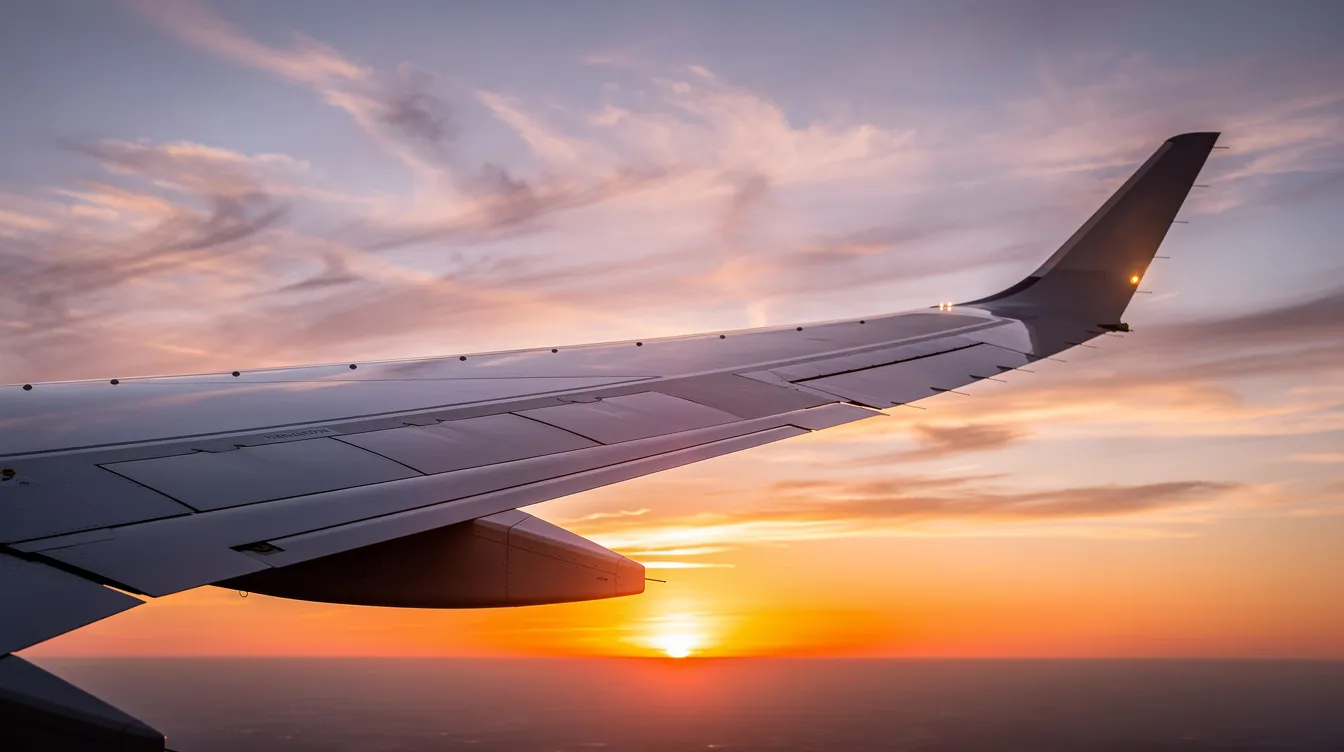
The 747-8's wingspan fits into ICAO Aerodrome Reference Code F, which covers aircraft with wingspans between 65 and 80 meters. The 747-400, with its 64.40-meter span, sits in Code E (up to 65 m). That single category jump has real operational consequences.
Wingspan impacts airport compatibility regarding taxiway clearance and gate positioning. Code F requires wider taxiways, greater wingtip clearance between parked aircraft, and reinforced pavement at gates. Major hubs like Frankfurt, Seoul Incheon, Hong Kong, and Dubai already support Code F operations for both the 747-8 and the A380. Other airports have had to upgrade stands or impose gate restrictions.
Boeing worked extensively with airports around the world through its "747-8 Airport Compatibility" program to ensure the airplane could operate from as many existing facilities as expected without prohibitive modifications.
For private aviation travelers, these constraints are largely irrelevant. Private jets typically have wingspans of 20 to 35 meters, allowing access to secondary airports closer to city centers—often with shorter runways, narrower taxiways, and far less congestion. This is especially true when you focus on the best small private aircraft that excel at operating from shorter fields.
This airport flexibility is one of the strategic advantages that make private jet access more than a luxury, especially when you understand the many ways to buy a seat on a private jet or explore affordable private plane options beyond chartering an entire aircraft.
Range, Payload, and How the Wing Enables Long-Haul Flights
747-8 Range and Payload
The 747-8 Intercontinental has a maximum range of 8,000 nautical miles (approximately 14,800 km). That capability rests on the wing: its fuel capacity of roughly 64,225 US gallons, combined with aerodynamic efficiency from the 68.4-meter wingspan, lets the aircraft cover intercontinental distances without refueling.
The 747-8 can carry up to 467 passengers in a three-class layout, or massive cargo loads in the freighter version. Korean Air, one of the remaining operators, uses the 747-8I on transpacific trunk routes. Lufthansa deploys its fleet on demanding sectors like Frankfurt to Singapore (~5,620 nmi) and Frankfurt to Los Angeles (~5,300 nmi), routes where the airplane's wing and engine combination prove their worth.
747-8 in Cargo Operations
Among cargo aircraft operators, Atlas Air has been the largest operator of the 747-8F. The freighter variant's combination of main deck cargo space and range serves global logistics demand. This illustrates how chartering aircraft for groups of around 100 passengers or equivalent payloads can unlock similar point-to-point efficiency at a different scale.
Dedicated guides to the best private jet for 20 passengers show how large-cabin options support smaller but still substantial groups.
Private Jet Range Comparison
How does this compare to private jet range? Large-cabin aircraft like the Bombardier Global 7500 (~7,700 nmi) or Gulfstream G650ER (~7,500 nmi) can fly similar stage lengths—but with 8 to 18 passengers instead of 467, or up to 16 passengers on select large-cabin private jets.
This illustrates how different private jet sizes deliver long-range capability for much smaller groups. Purpose-built aircraft such as the best private jet for 50 passengers can bridge the gap between typical business jets and jumbo airliners.
Inside the 747-8: Cabin Layout from First to Economy Class
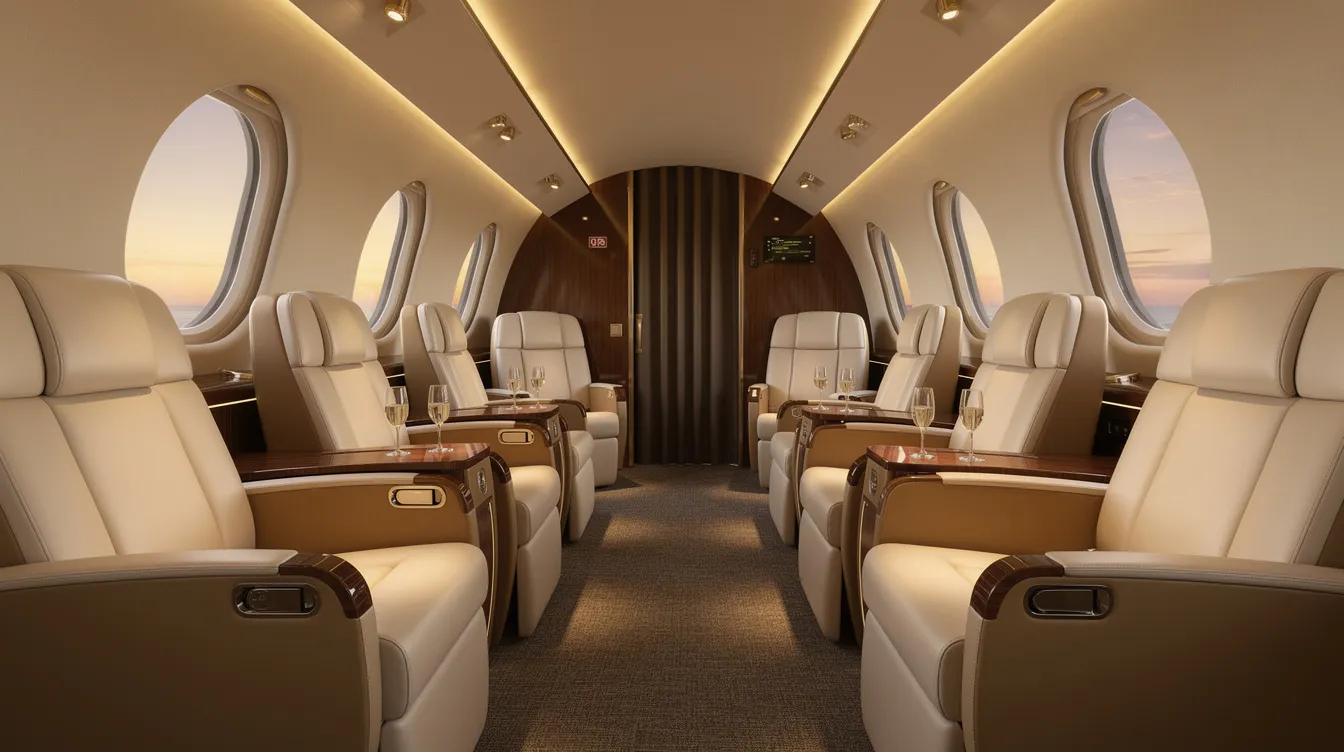
The 747-8's double deck configuration and distinctive hump give it a unique interior. The shorter upper deck on the 747-8 (relative to the A380's full-length second level) houses a dedicated cabin, while the main deck stretches the full 250.2-foot length of the fuselage.
Lufthansa's current layout seats approximately 364 passengers across three classes (sometimes four):
8 in first class
80 in business
32 in premium economy
244 in economy class
The curved stairway connecting the main deck to the upper deck remains one of the 747's most iconic features.
Cabin Location Relative to the Wings
Cabin location relative to the wings matters:
First class occupies the forward main deck (rows 1–3), ahead of the wing—quieter, smoother, less vibration
Business class spans the upper deck and forward main deck—the upper deck sections offer exceptional privacy and reduced foot traffic
Economy class fills the mid and aft main deck, over and behind the wing
Now consider the comparison. A Lufthansa first class suite on a Frankfurt–Los Angeles sector offers lie-flat beds, fine dining, and prestige. But schedule is fixed, the terminal experience involves security lines and other passengers, and privacy is limited to a curtained space—factors that often lead travelers to evaluate whether chartering a private jet is worth it for their specific routes and schedules.
A BlackJet member holding a 25-hour Jet Card or the flexible BlackJet 25+ Hour Jet Card could fly that same route on a large-cabin private jet or a 12-seater private jet, departing from a private terminal at a time of their choosing, with the entire cabin to themselves. This access model sits alongside options like leasing a private jet for clients with sustained, predictable flying needs.
Technical Data: 747-8 Wing Structure and Materials
The 747-8's wing is not a modification of the 747-400's wing—it is an entirely new wing, powered by computational fluid dynamics and wind-tunnel validation from the 787 development program.
Key technical details:
Wing twist, sweep, and thickness-to-chord ratio were re-optimized for the 747-8's higher maximum takeoff weight of 975,000 pounds
Advanced aluminum alloys form the primary structure, with carbon fiber composite components in secondary structures (fairings, leading/trailing edges, raked tips)
Four General Electric GEnx-2B67 engines mount on redesigned pylons with chevron nacelle trailing edges for noise reduction
Flap system: double-slotted inboard, single-slotted outboard, with fly-by-wire spoilers and outboard ailerons
The Boeing 787-10 Dreamliner's wingspan of 60.10 meters uses similar aerodynamic principles but in a smaller, twin-engine airframe
The wing includes features for fatigue reduction—load alleviation systems, optimized flap track fairings, and fewer flap segments—that extend structural life and reduce maintenance costs per flight hour compared to earlier 747 models. These innovations reflect how Boeing designed the aircraft to remain competitive even as twin-engine widebodies reshaped the market. Today’s VIP widebody conversions—from BBJs to concepts like a private jet Airbus A380—reimagine large airframes for ultra-luxury missions.
From Jumbo Jets to Private Jets: What the 747-8 Teaches Private Travelers
The engineering that makes the 747-8's wingspan so effective—high aspect ratio, raked tips, advanced aerodynamics—appears in scaled-down form across the types of private jets that serve intercontinental missions. The same physics apply whether the aircraft seats 467 or 14.
BlackJet curates access across multiple aircraft categories—light, midsize, super-midsize, and large cabin—to match each mission profile. This draws from a full spectrum of private jet types optimized for range, capacity, and comfort, including private jets ideal for 15 passengers and many of the top private jets in the world.
Airlines choose the 747-8 for dense, high-demand trunk routes. Private travelers choose aircraft based on range, cabin size, and flexibility.
Consider a concrete example: a BlackJet member flying New York to London on a super-midsize jet departs from a private terminal, avoids commercial airport congestion, and arrives at a secondary London airport closer to the city center. Similarly, a traveler booking private jet charters in Karachi or private jet charters in Lahore can choose airports that minimize ground transfer time.
The total door-to-door time often rivals or beats a commercial business class booking on a Boeing 747-8—despite the commercial airplane's faster block speed.
Unlike fixed airline schedules and economy class cabins, Jet Card members control departure times, routing, and onboard environment, regardless of wingspan. They gain the benefits outlined in the best jet cards for frequent flyers, the predictability of unlimited private jet flight memberships, and many of the same efficiencies described in guides on how to fly private cheap.
Safety, Certification, and Sustainability Around the 747-8
The 747-8F freighter received FAA and EASA type certificates on August 19, 2011, followed by the 747-8 Intercontinental certification later that year. Both test flight campaigns and the broader flight test program were conducted from Paine Field and Boeing Field, with rigorous validation across all flight regimes.
Early operational issues—structural and engine-related concerns typical of new high-weight aircraft—were resolved through inspection regimes, software updates, and engineering corrections within regulatory frameworks. The 747-8 even earned an ETOPS-330 rating in 2015, a rare distinction for a four-engine aircraft.
Modern widebodies like the Boeing 747-8 must meet strict safety and performance standards, similar in principle to the audits BlackJet applies to its private jet partners and the broader realities outlined when asking whether private jets are safe. Certification is not a one-time event; it requires continuous airworthiness management throughout an aircraft's service life.
On sustainability, the 747-8's wing and engine combination delivers roughly 16% better fuel efficiency per seat than the 747-400, with that 30% smaller noise footprint. While four-engine jets face increasing scrutiny as twin-engine models dominate new orders, the 747-8 represented meaningful progress during its era.
BlackJet takes sustainability further: all flights are carbon-neutral, ensuring that private travelers offset their environmental footprint without compromising the strategic advantages of flying privately—even when they opt for some of the most expensive private jet options available in the market. Emerging models like private plane rideshare options add even more flexibility for efficiency-minded travelers who are also comparing options across a comprehensive private jet price list or evaluating exactly how much it costs to rent a private jet.
747-8 Wingspan FAQs
What is the exact wingspan of the Boeing 747-8?
Is the 747-8 bigger than the 747-400?
Yes. The 747-8 has a wingspan roughly 4 meters wider, a fuselage 18.3 feet longer, a higher maximum takeoff weight of 975,000 pounds, and capacity for 51 more passengers.
How does the 747-8 wingspan compare to the Airbus A380?
Does wingspan affect turbulence and comfort?
Do private jets have similar wingspan-to-range efficiency?
Can I still fly on a 747-8 Intercontinental in scheduled service?
As of 2026, Lufthansa, Korean Air, and Air China continue to operate the 747-8I on intercontinental routes. However, the fleet is expected to gradually shrink as airlines transition to newer twin-engine models.
Is wingspan the only factor in range?
No. Range depends on fuel capacity, engine efficiency, aerodynamic drag, aircraft weight, cruising altitude, and speed. Wingspan improves the drag equation, but without efficient engines and adequate fuel, range cannot be maximized.
If I value comfort more than seat count, is a private jet a better option than a Boeing 747-8?
How BlackJet Elevates Long-Haul Travel Beyond the Jumbo Jet
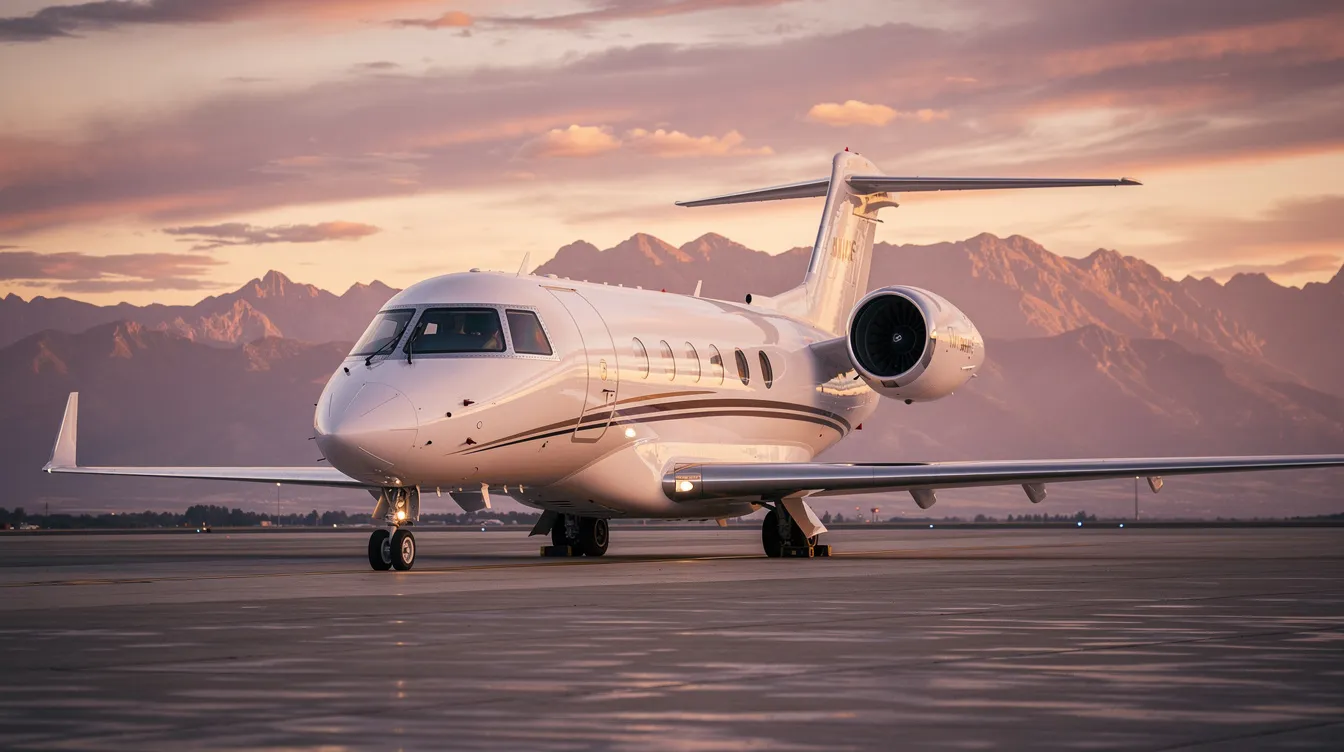
The Boeing 747-8 represents the pinnacle of jumbo jet engineering—a plane that pushed wingspan, range, and passenger capacity to their limits. But for discerning travelers, the question is not how big the aircraft is. It is how well the journey serves you.
BlackJet's Jet Card programs provide pre-purchased flight hours with guaranteed access across multiple aircraft categories, 24/7 digital booking, and real-time support. All of this is underpinned by a clear understanding of jet card cost per hour, how competitors such as Flexjet jet card pricing and other top private jet companies structure their offerings.
No security lines. No fixed schedules. No sharing the cabin with hundreds of strangers. Every flight is operated by rigorously vetted, safety-certified partners, and every flight is carbon-neutral—at no extra cost.
The 747-8 proved that wingspan, aerodynamics, and engineering precision can transform what an aircraft achieves. BlackJet applies the same principle to private travel: precision in aircraft selection, safety certification, and service delivery that transforms how you experience every journey, whether you favor ultra-long-range flagships or the cheapest private aircraft for point-to-point efficiency.
Elevate your travel—effortlessly. Explore BlackJet's Jet Card programs, compare structures such as NetJets jet card cost, and consider how a 100-hour jet card cost guide can help you plan sustained long-haul travel, and discover how refined, meaningful travel becomes your new standard.


 Sign up with google
 Sign up with Apple