Private jet access is already a strategic advantage: no security queues, fewer hub delays, private terminals, flexible departure times, and a cabin built around your priorities. The next tier is emerging below the jet: the VTOL personal aircraft, a compact aircraft that can land vertically and connect homes, estates, resorts, offices, and airports without a runway. These aircraft have the ability to hover, ascend, and descend vertically, and some models can even perform water landings, greatly expanding operational flexibility and urban mobility options.
VTOL means vertical takeoff and landing; eVTOL adds electric propulsion. These personal air vehicles are not replacing BlackJet’s long-range private jet access. They are shaping the short-range, first/last-mile layer of advanced air mobility. As a carbon-neutral Jet Card provider with a dedicated BlackJet 25+ Hour Jet Card program and other jet card options for frequent flyers, BlackJet is tracking Air One, Jetson One, Pivotal Helix, and other EVTOL aircraft because future premium trips may combine a BlackJet flight with a quiet electric vertical takeoff hop.
What Is a VTOL Personal Aircraft?
A VTOL personal aircraft is a compact personal aircraft whose design includes vertical lift for takeoff and landing, then, in many models, wings or tilting rotors for efficient forward flight. VTOLs use dedicated vertical lift rotors or tilting engines to ascend and descend, transitioning to wings for efficient cruising.
Most personal VTOLs rely on electric motors and battery packs, simplifying maintenance and eliminating direct emissions. Compared with helicopters, they use distributed motors, software stabilization, and fewer complex mechanical systems, which can reduce operating costs in much the same way that entry-level and more affordable private jets are reshaping expectations in traditional business aviation.
In plain terms:
Jetson One looks like a single-passenger open-frame electric aircraft for recreational flying.
AIR ONE adds a cabin, wings, and two seats for longer-range private use.
Certified air taxi models carry passengers through controlled urban routes.
VTOL personal aircraft eliminate the need for runways and combine vertical lift with the efficiency of fixed-wing airplanes for urban and rural travel.

Design and Technology: Inside Modern VTOL Personal Aircraft
The personal Electric Vertical Takeoff and Landing (eVTOL) and flying car market is transitioning from experimental prototypes to real-world deployment. Modern personal aircraft are designed with advanced materials and technology, focusing on efficiency, safety, and versatility for urban commuting or recreational flying.
Many companies are moving from prototypes toward low-volume production between 2024 and 2028. The construction of personal aircraft has evolved with technologies like 3D printing and computer-aided design (CAD), allowing for rapid prototyping and high precision in production. Personal aircraft are increasingly utilizing modular construction techniques, which facilitate easier maintenance and faster assembly, improving overall production efficiency, paralleling broader advances captured in recent guides to the best aircraft of 2026.
Lightweight Construction and Electric Propulsion
Many personal aircraft utilize carbon fiber, a material that is both lightweight and exceptionally strong, enhancing aerodynamic efficiency and energy conservation, which in turn supports extended flight durations and increased durability. Advancements in materials such as carbon composites and lightweight alloys are enhancing the strength and reducing the weight of personal aircraft, leading to improved performance and fuel efficiency.
Electric aircraft designs often incorporate advanced aerodynamic elements that minimize drag and boost efficiency, thereby improving both performance and sustainability. Jetson One’s aluminium and carbon fiber structure, at roughly 86 kg all-up aircraft weight without pilot, depending on configuration, shows how aggressively designers manage weight.
Electric propulsion replaces one large engine with multiple motors. New specialized soft magnetic components are increasing the power density of electric aircraft motors by up to 30%, helping aircraft generate more lift from less mass. Battery technology remains the constraint: more battery means more range, but also more weight.
Safety Systems and Redundancy by Design
Current eVTOL models often feature redundancy in electric propulsion to ensure safe landings in the event of motor failure. The important role of redundancy, emergency backup systems, and dynamic algorithms in these aircraft is to ensure stability, safety, and operational reliability. Redundant flight control systems are commonly integrated into personal VTOL aircraft, providing backup controls in case of failure to enhance safety during operation.
Key safety systems include:
redundant safety systems across motors, controllers, and batteries. Stability assistance systems that help prevent loss of control are particularly beneficial for novice pilots
auto-landing on low battery
geo-fencing around restricted airspace
crash-tolerant landing gear
ballistic parachute systems on many modern personal aircraft
Jetson One and LIFT Hexa have publicized parachute-based emergency concepts; Pivotal Helix benefits from the broader BlackFly test program, with more than 7,000 reported flights contributing to maturity; RYSE Recon limits operations around 400 ft for controlled use. This mirrors BlackJet’s safety mindset: operator vetting, independent audits, maintenance discipline, and clear operational limits, the same standards increasingly reflected in the newest generation of private jets.
Leading VTOL Personal Aircraft on the Market
Multiple manufacturers are now delivering or preparing to deliver personal VTOL aircraft. BlackJet does not sell aircraft, but these models show where personal aviation is moving and how they sit alongside small private aircraft for personal and business travel and other affordable private plane options.
Aircraft Model | Passenger Capacity | Max Speed (mph) | Flight Time (minutes) | Price Range | Key Features | Typical Use Cases |
|---|
Jetson One | 1 | 63 | 20 | ~$128,000 | Ballistic parachute, auto-landing, ultralight FAA | Recreational, estate inspection |
AIR ONE | 2 | 100-120 | ~60 (110+ miles range) | TBD | Enclosed cabin, folding wings, ballistic parachute | Everyday air mobility, regional hops |
Pivotal Helix | 1 | ~63 | 20 | ~$190,000 | Panoramic canopy, fault-tolerant propulsion | Personal freedom, utility flights |
RYSE Recon | 1 | 63 | 20 | ~$150,000 | Amphibious landing pads, multiple electric motors | Outdoor enthusiasts, remote access |
Zapata AirScooter | 1 | 62 | Up to 120 (hybrid) | TBD | Hybrid combustion-electric propulsion | Extended range, hybrid reliability |
LIFT Hexa | 1 | N/A | Rental-based | $249 per 15 mins | VR training, amphibious floats, 18 electric motors | Rental experience, pilot training |
Jetson One: Iconic Single-Person Electric Aircraft
Jetson One is a single-person EVTOL aircraft with eight electric motors and a tubular aluminium/carbon fiber frame.
The Jetson One, a personal eVTOL aircraft, has a top speed of 63 mph (102 km/h) and a flight time of approximately 20 minutes per charge.
Pricing has started near $128,000, with waitlists extending for years.
Safety systems include a ballistic parachute, auto-landing routines, and computer-assisted stabilization.
Typical use: estate inspection, private land hops, and recreational personal flight.
Many personal eVTOL aircraft, including the Jetson One, are specifically designed to comply with the FAA's ultralight category. This regulatory framework makes personal aviation more accessible by not requiring a pilot's license for operation. Under the FAA's ultralight category, these aircraft must adhere to strict constraints such as a maximum empty weight of 254 pounds, a top speed of 63.3 mph, and single-occupant operation. Safety features like ballistic parachutes and computer-assisted stabilization are often integrated to meet regulatory and operational requirements, while operational limitations restrict flights to daylight hours and uncongested areas.
AIR ONE: Two-Seat Electric Aircraft for Everyday Air Mobility
AIR ONE, or air one, is a two-seat electric aircraft for everyday personal flight rather than brief novelty hops, illustrating many of the same factors you’d weigh when choosing the best personal plane. It targets about 110+ miles of range, a cruise of near 100–120 mph, and a more enclosed cabin experience.
The design includes a conventional wing for efficient forward flight, multiple rotors, folding elements for storage, redundant batteries, and a ballistic parachute. AIR ONE is compelling because it looks like a future feeder: home to a regional airport, then BlackJet’s premium private jet card access sector.
Pivotal Helix and Other Advanced Single-Seat EVTOL Aircraft
Pivotal Helix, or Pivotal Helix, evolved from Pivotal’s BlackFly program. It uses an approximately 8 kWh battery, Level 2 charging from 20% to 100% in roughly 75 minutes, and initial pricing around $190,000, placing it in the same conversation as budget-friendly private aircraft options for early adopters with the right mission profile.
Its panoramic canopy, fault-tolerant propulsion, and simplified controls make it useful for both freedom and utility. The RYSE Recon personal eVTOL aircraft is designed to have a maximum speed of 63 mph and a flight time of 20 minutes, with a payload capacity of 255 pounds, including the pilot. It also uses amphibious pads, which appeal to outdoor enthusiasts near water, ranches, and remote properties.
New Hybrids and Rental Models (Zapata AirScooter, LIFT Hexa, etc.)
Hybrid designs are also emerging. Zapata AirScooter has announced hybrid propulsion, combining combustion and electric power to target about two hours of flight time and speeds near 62 mph. Innovators have integrated hybrid architectures into eVTOLs to extend range and accelerate adoption in defense markets.
LIFT Hexa previews access without ownership: about $249 per 15-minute session, VR-based pilot training, 18 electric motors with redundancy, and amphibious float landing capability. The idea is simple: book a short electric VTOL experience as easily as reserving premium transport.
Regulation, Pilot’s License Rules, and Where These Aircraft Can Fly
The FAA regulates personal aircraft in the U.S., requiring compliance with standards for airworthiness, maintenance, and operational rules, particularly for VTOL and low-altitude flights. Notably, some personal VTOL aircraft—especially those classified as ultralight vehicles under FAA Part 103—do not require a pilot's license. This regulatory approach is designed to make personal aviation more accessible to amateurs and enthusiasts by allowing operation under specific safety and weight restrictions. Regulatory changes by the FAA are establishing frameworks for personal eVTOL testing and certification.
The FAA finalized SFAR No. 120, establishing rules for powered-lift vehicle operations, airman certification standards, and pilot training parameters. The FAA also launched the Advanced Air Mobility and eVTOL Integration Pilot Program (eIPP), approving pilot proposals to fast-track urban flight testing, cargo routing, and air-taxi safety.
FAA Part 103 and License-Free Personal Flight
Under FAA Part 103, certain ultralight vehicles, including some personal VTOL aircraft, can be flown without airworthiness certification or a pilot’s license, provided they meet specific criteria such as weight and speed limits.
Common limits include:
single occupancy
powered empty weight generally under 254 lb
top speed around 55 knots, or about 63 mph
daylight, uncongested operations
no commercial use
no passengers
Even when no pilot’s license is required, manufacturer training and insurance standards remain essential. Rules change; owners should verify current FAA or EASA guidance before flying.
Certified eVTOL Aircraft, Air Taxis, and Urban Air Mobility
Many eVTOL concept models are designed for air taxi applications, providing on-demand passenger services in urban areas. The new air taxi market includes Joby, Archer, Volocopter, Pipistrel 801 concepts, VoloCity, Beta Technologies, and other companies seeking certification.
The European Union Aviation Safety Agency (EASA) has been working on the certification of eVTOL aircraft since 2018, publishing guidelines to establish safety and design objectives for these vehicles. China’s aviation sector has led the commercialization of eVTOLs, with the EHang EH216-S securing regulatory approval for autonomous flights.
Certified services will use vertiports, approved corridors, professional pilots at first, and integrated scheduling. That is where BlackJet customers may benefit: city center to airport by air taxi, then long-range flight by private jet aboard the latest generation of advanced aircraft.
Performance: Speed, Range, and Flight Time in VTOL Personal Aircraft
Modern lithium-ion batteries restrict eVTOL flights to 15- to 30-minute durations, limiting use to short hops rather than extended travel. A primary limitation of early eVTOL designs was restricted range due to battery weight.
Flight Time and Range Today
Representative numbers are practical, not futuristic:
Jetson One: about 20 minutes
MC ONE: about 12–15 minutes
RYSE Recon: about 20 minutes
FlyNow passenger version: targeting about 30 minutes
Zapata AirScooter: up to about two hours using a hybrid system
Some advanced concepts, such as AltoVolo Sigma, explore speeds above 200 mph and ranges approaching 500 miles, but those are not near-term ultralight machines. Battery improvements will matter, but current aircraft remain best for short-range hops.
Speed, Altitude, and Operating Envelope
Many single-seat models sit around 50–80 mph; AIR ONE aims higher. Software-defined envelopes limit speed, pitch, and angle to protect less experienced pilots.
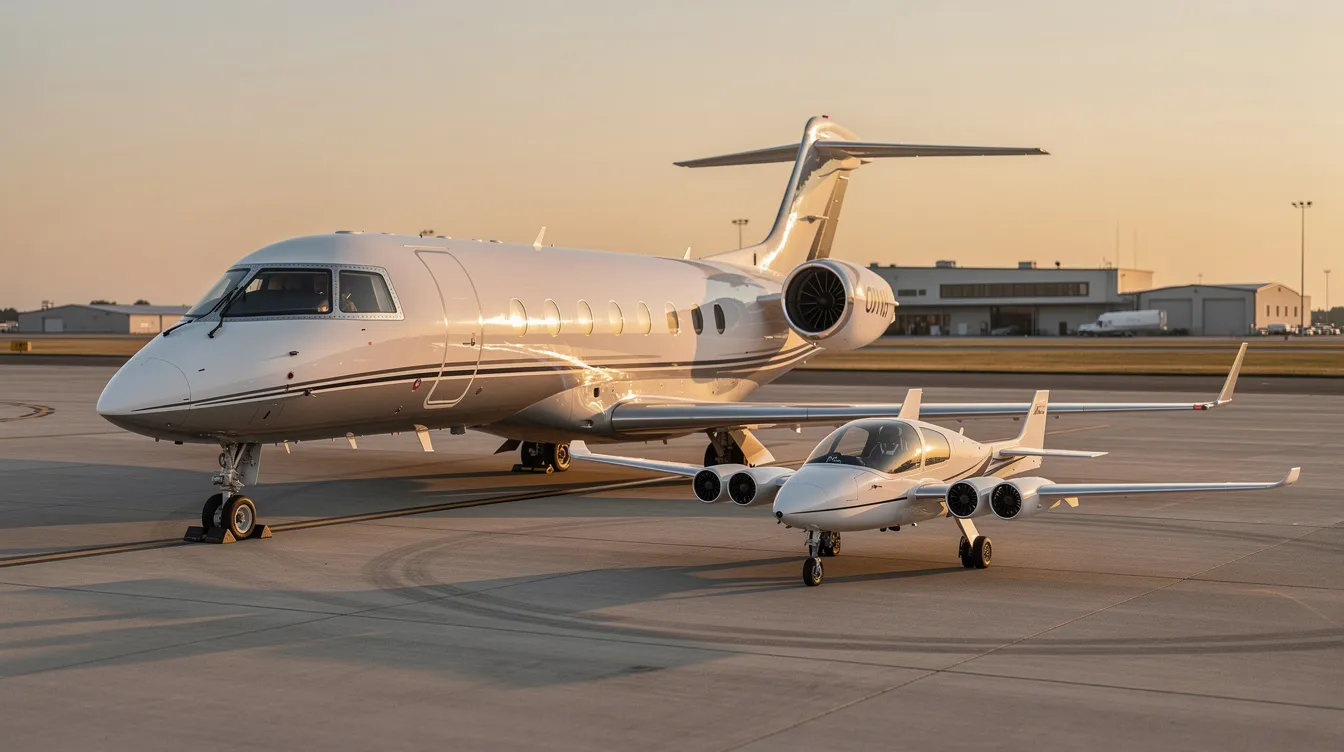
Private jets operate in another world: 450–500 knots and high-altitude cruise, across a wide spectrum of private jet types for different missions and long-range private jet options. That contrast explains the role of VTOL: ground-to-airport, campus-to-campus, estate-to-island. Weather sensitivity is higher for light aircraft, so responsible route planning is critical.
Use Cases: How VTOL Personal Aircraft Fit into Luxury and Business Travel
Imagine a BlackJet member leaving a downtown vertiport, reaching a satellite airport in 10 minutes, then boarding a midsize jet already positioned for Dallas. The strategic advantage is time saved without sacrificing privacy.
Recreational Flight, Estates, and Remote Properties
Personal eVTOLs are increasingly being used for recreational flying, appealing to outdoor enthusiasts and individuals seeking unique flying experiences. On ranches, islands, and large estates, owners can inspect fencing, reach remote cabins, or enjoy calm-weather flying from private ground.
Some aircraft may charge from on-site solar or grid power. This is lifestyle enhancement, not all-weather airline replacement.
Business, Executive Mobility, and Jet Integration
A CEO can use a BlackJet Jet Card for New York to Dallas, then connect by air taxi to a suburban campus, locking in predictable costs similar to the structures outlined in jet card pricing guides and other jet card pricing structures. Emerging fleets will likely integrate into mobile platforms, similar to BlackJet’s digital booking and real-time support.
Corporate sustainability teams will prefer electric and hybrid-electric options. Future personal aircraft are expected to feature electric and hybrid-electric propulsion systems, which will reduce emissions, noise, and operating costs, making them more environmentally friendly.
Medical, Emergency, and Special-Mission Uses
eVTOL aircraft are being developed for various applications, including emergency medical services, allowing rapid deployment of medical personnel and supplies. The use of eVTOL aircraft for parcel and delivery services is growing, with companies like Wing offering drone delivery services that utilize eVTOL technology.
These missions require certification, trained crews, and integration with emergency protocols.
Safety, Training, and Operational Support
Personal flight demands the same professionalism BlackJet applies to its private jet card and charter programs and to every way travelers buy a seat on a private jet.
Pilot Training and Simulation
Training usually includes ground school, simulator sessions, supervised first flight work, and emergency drills. LIFT Hexa uses classroom and VR preparation; Pivotal has structured pilot support. The same disciplined approach that underpins private jet safety and risk management will shape how automation and AI are integrated into personal aircraft, potentially enabling semi-autonomous or fully autonomous flight capabilities, which could make flying accessible to non-pilots.
Maintenance, Inspections, and Fleet Management
Electric aircraft still require disciplined care: battery diagnostics, motors, inverters, software updates, thermal checks, pre-flight inspections, and post-flight reviews. Modular batteries and plug-and-play components can reduce downtime. Serious owners may use management providers, much like jet owners do.
Sustainability: Electric Aircraft, Hybrid Systems, and Carbon-Neutral Travel
Electric propulsion in VTOLs reduces greenhouse gas emissions and the need for hazardous fuel management. This aligns with BlackJet’s carbon-neutral flights and carbon offset programs, and increasingly factors into how clients interpret any private jet price list and cost comparison.
Electric and Hybrid-Electric Propulsion Advantages
Fully electric vertical systems produce no direct exhaust and less noise than turbine helicopters. Hybrid propulsion can enable a longer range while reducing fuel burn. Future integration could track the entire itinerary, electric vertical take-off feeder, private jet sector, and arrival transfer as one carbon-neutral journey.
Materials, Noise, and Lifecycle Impact
Carbon fiber and composites improve energy efficiency, but lifecycle recycling matters. Distributed rotors can reduce perceived noise, helping cities, resorts, and campuses accept air mobility. As urban air mobility (UAM) becomes more practical, cities are preparing for infrastructure such as vertiports and dedicated air lanes to accommodate the growing presence of personal aircraft in urban environments.

The Future of VTOL Personal Aircraft and Premium Private Travel
The personal VTOL aircraft market is accelerating, driven by advancements in battery density and autonomous flight software. The market for personal eVTOLs has experienced a consolidation period, reducing the number of highly speculative firms. High-profile startups have ceased operations or been acquired by larger aerospace firms, shifting market dynamics in ways that echo consolidation among top private jet companies in luxury travel.
The future of personal aircraft is poised for rapid transformation as advancements in aerospace technology, sustainable design, and urban air mobility accelerate, driving innovation that continually expands the possibilities of personal air travel.
From Ownership to Access: EVTOL Memberships and Jet Cards
As fleets mature, many customers will prefer access over ownership. That mirrors BlackJet’s 25-hour and 50-hour Jet Cards: flexible private jet access without managing an aircraft, much like programs built around the cheapest practical private aircraft or other 2-million-dollar private jet options make ownership more approachable for some flyers.
A future itinerary could combine:
personal aircraft pickup
BlackJet private jet departure and
arrival-side eVTOL transfer
unified safety, maintenance, and carbon accounting
That is frictionless sky-to-sky travel, anchored by trust.
Frequently Asked Questions About VTOL Personal Aircraft
What is a VTOL personal aircraft?
A VTOL (Vertical Takeoff and Landing) personal aircraft is a compact vehicle capable of taking off and landing vertically without the need for runways. Many models use electric propulsion (eVTOL) and combine vertical lift rotors with wings or tilting engines for efficient forward flight, making them ideal for urban and short-range travel.
Do I need a pilot’s license to fly a VTOL personal aircraft?
Many single-seat eVTOL personal aircraft fall under the FAA’s ultralight category (Part 103), which allows operation without a traditional pilot’s license, provided the aircraft meets strict weight, speed, and operational limits. However, manufacturer training and insurance requirements often apply.
How long can VTOL personal aircraft fly on a single charge?
Current battery technology limits most personal eVTOLs to flight times between 15 and 30 minutes per charge, suitable for short-range hops. Hybrid models, like the Zapata AirScooter, can extend flight durations up to two hours.
Are VTOL personal aircraft safe?
Modern personal VTOLs incorporate multiple safety features such as redundant motors and flight controls, ballistic parachute systems, stability assistance, and auto-landing capabilities. These systems are designed to enhance safety, especially for novice pilots.
How do VTOL personal aircraft contribute to sustainability?
Most personal VTOLs use electric or hybrid-electric propulsion, producing zero or significantly reduced direct emissions compared to traditional aircraft. Lightweight materials and aerodynamic designs reduce drag and increase efficiency, supporting carbon-neutral travel when combined with offset programs.
What are typical use cases for VTOL personal aircraft?
They are used for recreational flying, estate and ranch inspections, urban and executive mobility, emergency medical services, and parcel delivery. Their vertical takeoff and landing capability allows access to remote or congested areas without runways.
How do VTOL personal aircraft fit into luxury travel?
VTOL aircraft serve as a first/last-mile solution connecting homes, offices, and airports. When combined with private jet services like BlackJet’s Jet Card programs, they offer seamless, time-saving, and exclusive travel experiences with integrated safety and sustainability.
What is the future outlook for personal VTOL aircraft?
Advancements in battery technology, autonomous flight software, and regulatory frameworks are accelerating market growth. Future models will feature longer ranges, improved safety, hybrid propulsion, and expanded urban air mobility infrastructure, making personal flight more accessible and practical.
Conclusion and Call to Action: Preparing for the Next Era of Personal Flight
VTOL personal aircraft are real enough to matter, but limited enough to require discipline. Today’s single-seat models are mainly recreational; tomorrow’s certified networks may reshape executive transport.
BlackJet is built for the part of private aviation that already delivers: seamless jet access, rigorous safety, flexible Jet Card programs, and carbon-neutral flights—qualities mirrored in the cabins and capabilities of 20 million dollar private jets, 10 million dollar private jet options, 15 million dollar private jet features, 5 million dollar private jets, 2 million dollar jet options, private jets under 10 million, the largest private jets for sale, the most expensive private jets, top 10 private jets worldwide, 16-seat private jet options, private jets for 15 passengers, private jets for 20 passengers, private jets for 50 passengers, and detailed NetJets jet card cost comparisons, including premium UK private jets for sale. Explore how BlackJet can anchor your long-range travel today while helping you navigate the coming world of personal VTOL aircraft tomorrow.


 Sign up with google
 Sign up with Apple


