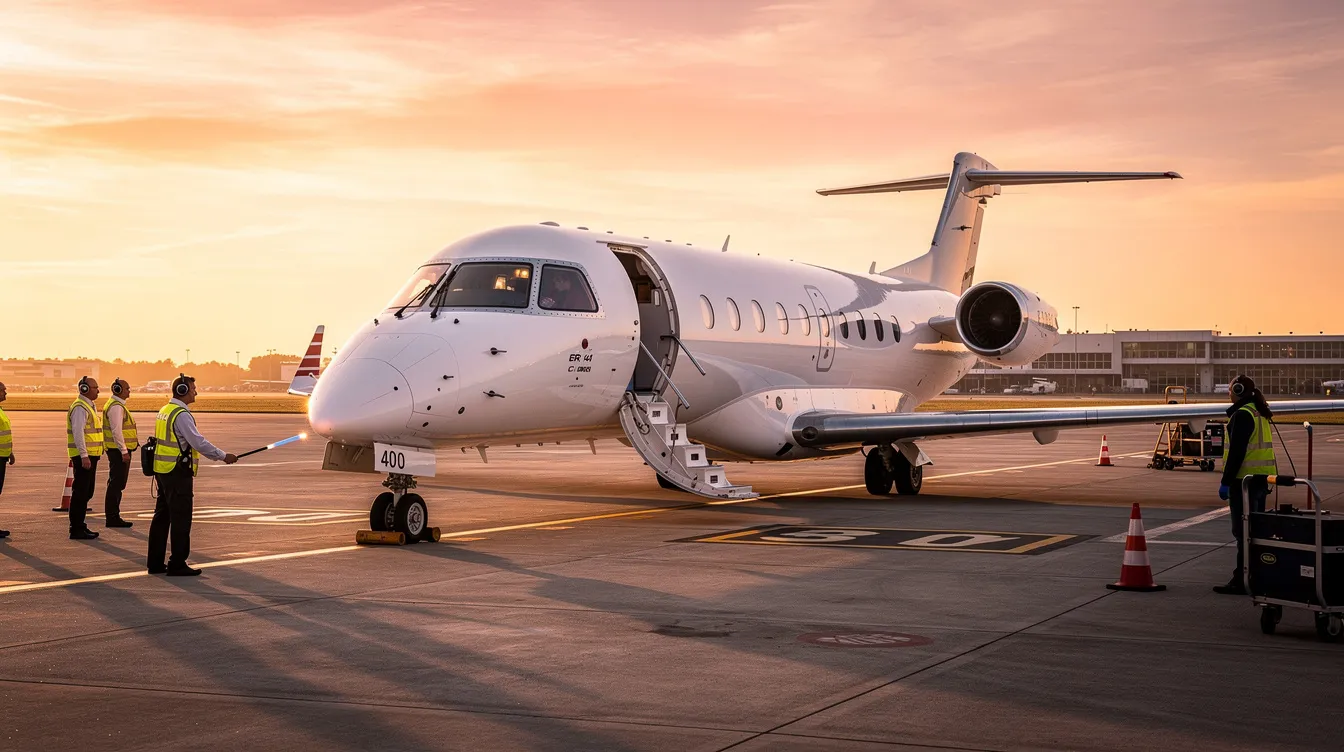
Private jet access has long represented a strategic advantage for executives shuttling between regional hubs, sports teams moving city-to-city, or project crews visiting multiple sites in one day. The introduction of the Embraer Regional Jet 145 in the late 1990s marked a significant debut that transformed regional air travel, setting new industry standards for efficiency and flexibility. When groups exceed 15-20 passengers, the calculus shifts dramatically, and some organizations begin comparing private jet options suitable for around 20 passengers and broader 12-seater private jet cost considerations against regional jet shuttle solutions. Originally built for airlines like American Eagle, the ERJ 145 now underpins many private shuttle and ad-hoc charter solutions thanks to its range, speed, and remarkably low per-seat cost.
This guide is intended for private aviation clients, corporate travel planners, and anyone interested in the ERJ 145's role in both commercial and private jet markets, and how it compares with broader types of private jets for every traveler.
The contrast with commercial aviation is stark: direct access to secondary airports, no security queues, tailored schedules, and the ability to reconfigure cabin layouts for corporate or VIP use. For BlackJet Jet Card members, the ERJ 145 presents a compelling option when traveling as a larger group—delivering the flexibility of private aviation at a fraction of what multiple midsize jets would cost, especially compared with other private jet options for 30 passengers.
This post explores the aircraft’s history and design, operational performance, family variants (ERJ 135/140/145 and the extended range ERJ-145XR), safety record, and how BlackJet optimizes this platform for discerning private aviation clients, while also fitting into the broader landscape of different private jet sizes and categories.
Key Takeaways
The Embraer ERJ 145, launched at the Paris Air Show in 1989 as a stretch of the EMB 120 Brasilia with a development cost of approximately $150 million, transformed regional air travel in the 1990s and now serves as a cost-effective private jet and corporate shuttle platform for groups of 20-50 passengers.
With a range of approximately 1,550 nautical miles (extending to 2,000 nm for the ERJ-145XR variant) and a maximum cruise speed of Mach 0.78, the aircraft delivers efficient regional performance powered by Rolls-Royce AE 3007 turbofan engines.
BlackJet does not sell aircraft but curates ERJ 145 access through vetted charter operators and Jet Card solutions, ensuring stringent safety standards, carbon-neutral flights, and seamless digital booking, all within a transparent private jet price list and access model frameworks.
The ERJ 145’s 2-1 seating configuration offers more personal space compared to competing regional jets like the Bombardier CRJ-200, which features a 2-2 layout for the same 50-passenger capacity.
Passengers often report that the ERJ 145 cabin is small and cramped, with limited overhead bin space, making it less comfortable for longer flights. However, refurbished cabins add leather seating, wi fi, and upgraded lighting for a private jet experience comparable in comfort to many top 16-seat private jet options.
For larger groups, a single ERJ 145 charter often proves more economical and efficient than booking multiple smaller private jets or dozens of individual business class tickets, especially when compared with private jet solutions tailored for 15 passengers or widebody charter scenarios explored in our guide to charter plane 100 passengers cost.
Background and Development of the Embraer Regional Jet 145
Embraer’s decision in the late 1980s to transition from turboprops like the EMB 120 Brasilia into regional jets marked a pivotal shift in aviation. Airlines demanded faster, more comfortable 45-50-seat aircraft for routes between 500 and 1,500 nautical miles. The ERJ 145 was launched at the Paris Air Show in 1989 as a stretch of the EMB 120 Brasilia, with a development cost of approximately $150 million initially.
The original design featured overwing podded engines and supercritical wings engineered to reduce drag and improve fuel burn. Key redesign milestones followed: engineers moved engines under the wing, stretched the fuselage, and refined aerodynamics for optimal performance. The definitive ERJ 145 first flew in the month of August, specifically on August 11, 1995, developed with risk-sharing partners from Spain, Chile, and the USA. The estimated total development cost reached around $300 million, with Embraer covering 34% and partners absorbing the remainder through shared investment and loans.
FAA certification arrived in the month of December 1996, and by the mid-2000s, more than 890 ERJ 145 family aircraft had been delivered. This large installed base today makes the plane an accessible, proven platform for conversion to corporate shuttle and private jet configurations, complementing smaller entry-level ownership paths explored in our guide to the best options for the cheapest plane.
Design, Cabin Experience, and Technical Specifications
The ERJ 145 typically accommodates up to 60 seats, although many operators configure it with fewer seats for added comfort. In standard airline service, the aircraft features a 2-1 seating configuration, which offers more personal space compared to the 2-2 configuration found in competing regional jets like the Bombardier CRJ-200, which also seats 50 passengers.
Specification | ERJ 145 (Standard) | ERJ-145XR |
|---|
Seats | 50 (2-1 layout) | 50 |
Range | ~1,550 nm | ~2,000 nm |
Max Cruise Speed | Mach 0.78 | Mach 0.78 |
Fuel Capacity | 5,973 kg (13,168 lb) | Increased |
Service Ceiling | 37,000 feet | 37,000 feet |
Engines | Rolls-Royce AE 3007 | AE 3007A1P |
The ERJ 145 family is powered by Rolls-Royce AE 3007 series turbofan engines, which have a bypass ratio of 5:1 and can generate up to 8,917 lbf of thrust. The engine’s fan section plays a key role in both performance and noise levels, contributing to the aircraft’s overall efficiency and passenger experience. For comparison, the Bombardier CRJ-200 has a maximum fuel capacity of 6,489 kg (14,305 lb), while the Embraer ERJ-145 has a maximum fuel capacity of 5,973 kg (13,168 lb), making the Embraer ERJ-145 more fuel-efficient for its range
It is important to note that during the summer months, high temperatures can impose operational limitations on the ERJ 145, restricting the aircraft’s weight and performance due to reduced air density.
The cabin height of the ERJ 145 is approximately 6 feet, which can feel restrictive for taller passengers. Passengers often report that the ERJ 145 cabin is small and cramped, with limited overhead bin space. The small overhead bins often cannot accommodate larger carry-on bags, requiring most passengers to gate-check their bags. The rear-mounted engines may contribute to higher cabin noise levels, particularly towards the back of the aircraft.
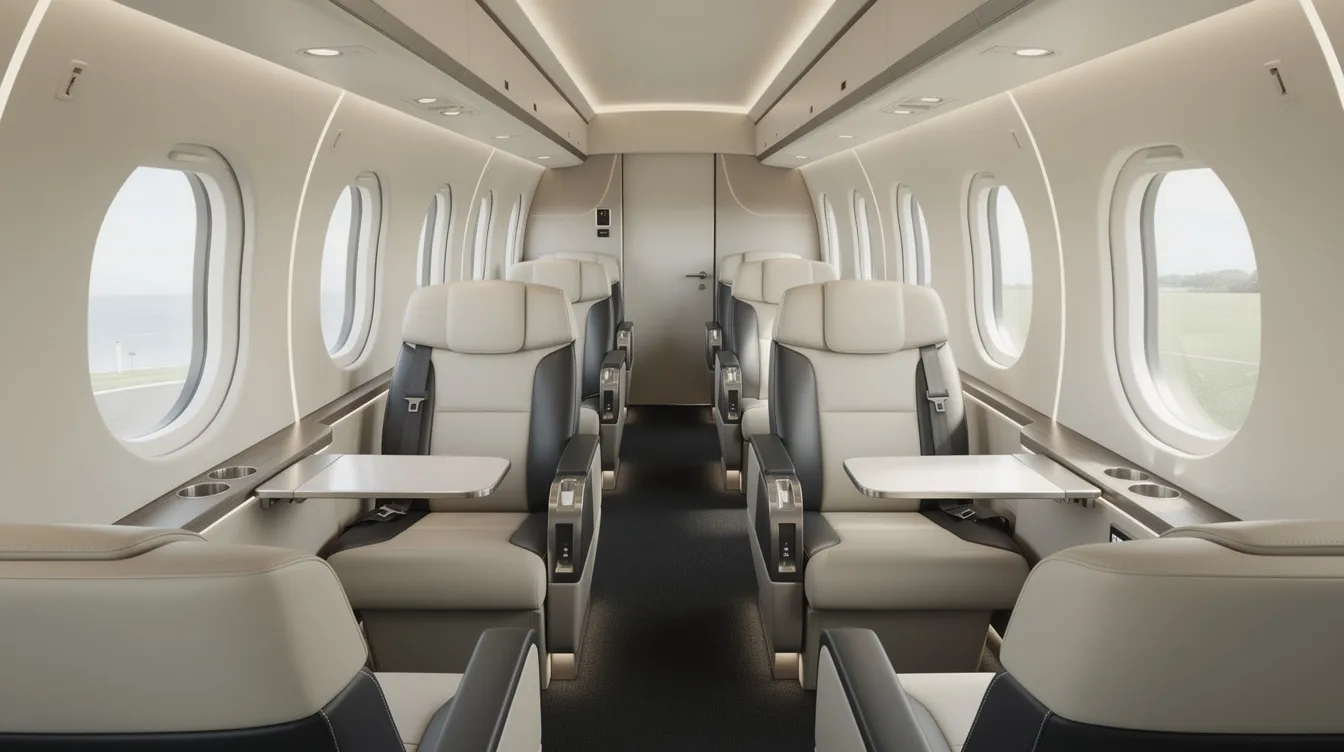
However, in private configurations, operators have transformed these cabins. Modern refurbishments add leather seating with enhanced seat pitch (36-40 inches versus the standard 31-inch), wi fi connectivity, power outlets, upgraded LED lighting, and noise insulation that reduces interior sound levels significantly.
The flight deck features an all-digital cockpit equipped with the Honeywell Primus 1000 avionics suite, which includes multiple electronic flight displays. This advanced avionics package enhances pilot situational awareness and operational safety, supporting BlackJet’s commitment to rigorous safety standards.
The ERJ-145XR (extended range) variant delivers enhanced capability: additional fuel capacity, aerodynamic winglets, and higher thrust ratings push range close to 2,000 nautical miles. For comparison, the range of the Bombardier CRJ-200 is approximately 1,700 nautical miles (3,148 km), compared to the Embraer ERJ-145’s range of about 1,550 nautical miles (2,873 km), although the ERJ-145XR variant can fly up to 2,000 nautical miles (3,700 km). The operational altitude for the Bombardier CRJ-200 can reach up to 41,000 feet, whereas the Embraer ERJ-145 is limited to a maximum altitude of 37,000 feet.
Operational History: From American Eagle Workhorse to Private Charter Favorite
The first delivery of the ERJ 145 was made to ExpressJet Airlines in December 1996, marking the beginning of its operational history in the regional airline market. Companies such as American Eagle, ExpressJet, and CommuteAir incorporated the ERJ 145 into their fleets, making it a staple of regional operations and a backbone of US regional networks through the 2000s.
The ERJ 145 is known for its effective operation on thin routes, making it suitable for low-demand flights that would be unprofitable for larger aircraft. (Thin routes refer to airline routes with lower passenger demand, where operating larger aircraft would not be economically viable.)
It enabled hub-and-spoke growth with frequent frequencies from smaller communities into major hubs—faster and more comfortable than turboprops on shorter routes.
The ERJ 145 quickly gained popularity in the Americas for high-demand regional routes, although it faced challenges in the European market due to logistical difficulties. Government and special-mission use expanded the platform’s utility to VIP transport, medical evacuation aircraft, and surveillance variants for military applications in Brazil and beyond. The ERJ 145 is recognized and valued across the world, serving diverse markets and clients internationally, which reinforces its global reputation in regional aviation.
By the 2020s, many operators began retiring their ERJ 145 fleets in favor of newer regional airliners, often replacing them with members of Embraer’s E-Jet family. As of August 2021, CommuteAir was the largest operator of the ERJ 145, operating a fleet of 165 aircraft under the United Express brand. During its peak airline service years, the ERJ 145 sat at the center of regional connectivity, playing a crucial role in linking smaller communities to major hubs. This transition has created opportunity: retired airline frames now serve private charter, ACMI lease, corporate shuttle, and sports team transport roles worldwide. Pilots appreciate the ERJ 145's handling characteristics, especially the importance of proper technique when they land the aircraft, as smooth touchdowns and correct nose wheel contact are essential for safe and efficient operations.
Variants Within the Embraer ERJ Family
The ERJ family shares approximately 70% commonality across models, allowing pilots to maintain a common type rating. This significantly reduces crew complexity for operators—a benefit that translates directly to better aircraft availability for private jet charter clients.
ERJ 135: Approximately 37 seats, shorter fuselage (26.37m length), suited for thinner routes and smaller groups.
ERJ 140: Roughly 44 seats, mid-length fuselage, balancing capacity and range for moderate passenger loads.
ERJ 145: Up to 50 seats, the largest variant with 29.87m fuselage length, designed for maximum regional utility.
ERJ 145 Sub-variants:
ERJ 145ER: Standard range with baseline specifications
ERJ 145LR: Longer range with increased MTOW and additional fuel
ERJ-145XR: Extended range performance with aerodynamic winglets and upgraded AE 3007A1P engines
Specialized configurations include quick-change freighter options, medevac layouts, and VIP/business shuttle designs that strip airline galleys in favor of meeting-style seating. BlackJet typically leverages ERJ 135/140/145 aircraft in corporate shuttle or large-group charter roles, advising clients on the right variant for distance, runway requirements, and passenger count.
Production in China and Global Footprint
Embraer introduced localized ERJ 145 production in China through a joint venture with Harbin Aircraft Industry Group, established around 2002. This partnership targeted the fast-growing domestic regional market, with assembly capacity of roughly two dozen aircraft per year at peak.
First Chinese-assembled ERJ 145 deliveries occurred in 2004, with more than 40 ERJ 145 aircraft produced under this program before final delivery around 2016, complementing Embraer’s broader presence alongside premium private jets for sale in key markets like the UK. Production stretched across the Americas, Europe, Africa, and Asia, creating a broad maintenance and parts ecosystem that supports reliability for private operations.
This global footprint ensures robust MRO (maintenance, repair, overhaul) support—an important factor for BlackJet when vetting aircraft for Jet Card and on-demand missions. Parts availability and experienced technicians across multiple continents mean high dispatch reliability for charter clients.
Safety Record, Reliability, and Incidents
The ERJ 145 is regarded as a safe and reliable platform with a proven track record of millions of flight hours, a reputation that places it among the reliable fleet types evaluated by leading private jet companies worldwide. The ERJ 135/140/145 family has accumulated extensive operational experience across hundreds of aircraft since the mid-1990s.
The aircraft’s safety credentials stem from thoughtful systems design: redundant hydraulics, modern avionics for its generation, and stable flight characteristics that pilots frequently describe as “forgiving” and “predictable.” However, some pilots have noted that flying older systems can sometimes feel like relying on hope that everything will function as expected, especially as the aircraft ages. Still, the ERJ 145 is often described as a reliable, high-performance regional workhorse, especially effective for short- to medium-haul routes.
In private service, aircraft are typically maintained to even higher standards than legacy regional airline operations. BlackJet only sources ERJ 145 operators who meet or exceed top third-party audit standards (ARGUS Platinum, Wyvern Wingman, or equivalent) and maintain rigorous pilot training and currency requirements, the same safety-first approach we apply when evaluating affordable private plane rideshare options.
For Jet Card members, this translates to peace of mind: pre-flight checks, continuous monitoring, and real-time support from BlackJet’s operations team accompany every ERJ 145 mission we manage.
The ERJ 145 as a Private Jet and Corporate Shuttle Platform
Why does a “regional jet” matter in private aviation? The answer lies in group economics. The operational costs of the ERJ 145 are estimated to range between $757 and $1,338 per block hour, depending on the operator—a figure that becomes remarkably competitive when spread across 30-40 passengers, when compared with large private jets accommodating up to 50 passengers. When you take into account leasing costs and other financial metrics, the ERJ 145 often proves more cost-effective for frequent shuttle operations compared to other options.
Typical private configurations feature 30-40 seat corporate shuttle layouts with enhanced pitch, VIP sections at the front of the cabin, and upgraded soft furnishings, connectivity, and catering options. Consider these use cases:
A US tech company running weekly shuttles between Austin and San Jose, saving 4+ hours per trip versus commercial connections
A European football club traveling for away matches with equipment and staff
A private university chartering flights for alumni events across multiple cities in a single day
Many passengers have thought the ERJ 145 offers a surprisingly comfortable ride for a regional jet, especially appreciating the spacious aisle and quiet cabin, while pilots have often thought highly of its reliability and straightforward handling in various operational scenarios.
BlackJet helps clients search for the best aircraft options to fit their specific travel needs, ensuring a tailored solution for every group or mission, including advising when chartering a private jet is worth it.
Compared to owning a dedicated corporate shuttle, access via BlackJet avoids capital expenditure, crew employment, and maintenance liabilities while still ensuring schedule control, and can be benchmarked against typical costs to rent a private jet. Versus commercial business class, an ERJ 145 charter delivers complete schedule flexibility, privacy for onboard briefings, and direct point-to-point routing to smaller airports, while still allowing travelers to apply strategies to fly private cheap with affordable luxury options. The ERJ 145’s quick turn capability also allows for short ground times between flights, maximizing operational efficiency.
The ERJ 145 is not a classic small private jet for 6-10 people—it’s a strategic asset for 20-50 travelers who value time, privacy, and predictability over individual lie-flat luxury, while smaller groups might instead look to the best, cheapest planes for personal flying. And as any guy who’s piloted one will tell you, there’s a real sense of camaraderie among the crew when operating such a versatile aircraft.

BlackJet Jet Card Access: When to Choose an ERJ 145 Over Smaller Private Jets
The BlackJet Jet Card model provides prepaid blocks of flight time (25-hour and 50-hour options) that guarantee access to vetted aircraft across multiple cabin classes—including regional and shuttle configurations like the ERJ 145 when appropriate—mirroring the structure of the dedicated BlackJet 25+ Hour Jet Card program and even enabling comparisons with unlimited private jet flight memberships.
Decision criteria for choosing an ERJ 145:
Group size above 15-20 passengers
Multi-city itineraries in a single day
Recurrent point-to-point shuttles where per-seat economics matter
Consider the value comparison: one ERJ 145 can be more cost-effective and operationally efficient than booking three or four separate midsize private jets for a large team, especially when evaluated alongside broader jet card cost and membership pricing. BlackJet’s digital platform simplifies booking—members can request ERJ 145 capacity, view real-time options, confirm aircraft and configuration, and receive consolidated itineraries.
Jet Card members benefit from flexibility: combine smaller private jets for executive travel with occasional ERJ 145 uplift for company-wide meetings, roadshows, or event charters under the same membership framework, taking advantage of transparent jet card pricing structures and benefits, and insights into private jets for sale under 10 million.
Ready to explore ERJ 145 solutions for your organization? Connect with a BlackJet advisor to tailor Jet Card usage to your specific network of offices or events, and review how a 50-hour Jet Card cost framework can align with your flight profile.
Sustainability, Technology, and the Future of the ERJ 145 in Private Aviation
While the ERJ 145 was designed in the 1990s, it remains competitive on short-haul efficiency, especially measured on a per-seat basis for 40-50 passengers. The aircraft continues to benefit from technological upgrades: retrofitted avionics, satellite-based navigation, and modern flight-planning tools minimize fuel burn and optimize routing.
BlackJet’s carbon-neutral commitment means every ERJ 145 flight scheduled through our programs is automatically offset through verified carbon projects—at no added complexity for clients, a philosophy that also underpins our guidance on the cheapest private aircraft and budget-friendly options, and a broader look at top affordable private planes and entry-level private aviation options. Some operators are beginning to blend sustainable aviation fuel (SAF) for ERJ 145 operations where available, and BlackJet prioritizes such options when clients request them, similar to how we approach affordable private jet options for cost-conscious travelers and our broader analysis of the best small private aircraft for different missions.
The aircraft’s future likely includes continued use as a niche regional and charter workhorse through the 2030s, with further cabin refurbishments extending its relevance. For BlackJet, the ERJ 145 represents a bridge: combining legacy airframe dependability with modern safety, sustainability, and digital booking tools to deliver a forward-looking yet practical private travel solution.
How to Book an Embraer ERJ 145 With BlackJet
Booking an ERJ 145 through BlackJet follows a straightforward process:
Initial consultation: Discuss passenger counts, routing, and scheduling requirements
Aircraft recommendation: BlackJet advisors compare ERJ 145 options against smaller jets based on your mission profile
Proposal presentation: Receive transparent pricing, tail numbers, safety credentials, and carbon-offset details
Confirmation: BlackJet’s 24/7 operations team handles all logistics—passenger manifests, ground transportation, and catering
New clients can charter an ERJ 145 on a one-off basis or integrate it into a broader Jet Card strategy for recurring shuttles and group movements, leveraging insights similar to those in our guide to the best jet cards for frequent flyers and evaluations of 10-million-dollar private jet options for luxury travelers.
Explore how BlackJet can deploy the ERJ 145 platform to streamline your regional travel—from quarterly all-hands meetings to weekly executive shuttles, informed by market benchmarks like Flexjet jet card cost and options.
What range can I realistically expect from an ERJ 145 on a private charter?
Typical planning range runs around 1,200-1,550 nautical miles for the standard ERJ 145, suitable for most regional routes within the US, Europe, and parts of South America. The extended range ERJ-145XR variant can stretch up to approximately 2,000 nautical miles, enabling longer point-to-point flights without refueling. Range may vary slightly depending on passenger load, weather conditions, and operational requirements.
Are there any comfort considerations passengers should be aware of when flying on an ERJ 145?
Passengers should note that the ERJ 145 cabin is relatively compact, with a cabin height of about 6 feet and a narrow fuselage, which can feel tight for taller travelers. Overhead bin space is limited, often necessitating gate-checking larger carry-on bags. Rear-mounted engines may contribute to increased cabin noise, especially towards the back. However, many private charters refurbish interiors with upgraded seating, enhanced soundproofing, and modern amenities to provide a more comfortable experience than typical regional airline configurations.
How does the ERJ 145's safety record compare to other regional jets?
The ERJ 145 boasts a strong safety record, with millions of flight hours logged and a relatively low incident rate. Its design incorporates redundant systems and an advanced Honeywell Primus 1000 avionics suite that enhances situational awareness. BlackJet exclusively partners with operators who meet or exceed stringent safety certifications such as ARGUS Platinum and Wyvern Wingman, ensuring the highest levels of operational safety and maintenance standards.
What is the significance of the ERJ 145's 2-1 seating configuration?
The unique 2-1 seating layout of the ERJ 145 offers passengers more personal space and easier aisle access compared to the 2-2 layout common in competing regional jets like the Bombardier CRJ-200. This configuration reduces crowding and enhances comfort, particularly on longer regional flights or private charters. It also facilitates customized cabin arrangements for VIP or corporate shuttle use.
Can I book an ERJ 145 for a multi-city itinerary or same-day return trips?
Yes, the ERJ 145 is well-suited for multi-city itineraries and short-turnaround shuttle flights, and it can complement other access models such as buying a seat on a private jet. Its efficient cruise speed (Mach 0.78) and quick ground turnaround capabilities make it ideal for business travelers or groups needing to visit several locations in a single day. BlackJet’s Jet Card program provides flexible access to ERJ 145 charters tailored to complex scheduling needs.
How does BlackJet ensure sustainability for flights on the ERJ 145?
BlackJet is committed to carbon-neutral private aviation, a stance that differentiates our services when compared with competitors profiled in analyses of NetJets jet card cost and programs. Every ERJ 145 flight booked through BlackJet includes verified carbon offsets at no additional cost to the client. Additionally, BlackJet prioritizes operators utilizing sustainable aviation fuels (SAF) when available, reducing the environmental impact of private jet travel and aligning with regional market considerations such as private jet prices in rupees for Indian travelers. This approach combines the efficiency of the ERJ 145 with responsible environmental stewardship.
What are the advantages of using a Jet Card program to access the ERJ 145?
Jet Card membership offers prepaid access to a fleet of vetted ERJ 145 aircraft without the capital and operational commitments of ownership, and can be paired with on-demand solutions such as private jet charters in Karachi or private jet charters in Lahore for truly global coverage. Members benefit from guaranteed availability, fixed hourly rates, and 24/7 concierge booking support. The program includes rigorous safety vetting, carbon-neutral flights, and flexible scheduling, making it an ideal solution for organizations or individuals requiring reliable, large-group private jet travel.
Conclusion: The Embraer ERJ 145—A Strategic Asset for Modern Private Aviation
The Embraer Regional Jet 145 stands as a testament to innovation in regional aviation, evolving from a commercial workhorse into a versatile private jet platform that meets the demands of today’s discerning travelers, even when compared with the largest private jets for sale designed for maximum luxury and range. Its combination of efficient range, unique 2-1 seating configuration, and proven reliability makes it an exceptional choice for groups seeking the convenience and privacy of private aviation without the complexity and cost of multiple smaller jets.
At BlackJet, we recognize that private jet access is more than a luxury—it is a strategic advantage that saves time, enhances flexibility, and elevates the travel experience, whether clients are considering efficient regional shuttles or the best long-range private jets for nonstop global travel. Through our Jet Card programs, members gain seamless access to vetted ERJ 145 charters that uphold the highest standards of safety, sustainability, and service. Every flight is carbon neutral, reflecting our commitment to responsible travel without compromise.
Explore how BlackJet can redefine your regional travel with effortless booking, real-time support, and exclusive access to the Embraer ERJ 145. Elevate your journey—discover the possibilities at blackjet.com, where premier private aviation meets purposeful innovation.


 Sign up with google
 Sign up with Apple